The digital landscape has shifted beneath our feet. If you are still treating your website like a static digital brochure, you are essentially invisible to the modern search ecosystem. By mid-2026, the way customers find and interact with local businesses has moved beyond the simple “search and click” model. We have entered the era of Agentic UX.
For a local business, this means your website can no longer just sit there looking pretty. It has to act. It has to be an “agent” that works on behalf of your customer to solve their problems in real-time. Whether you provide plumbing services or legal counsel, your site’s ability to interface with AI agents and provide an autonomous user experience is now a primary ranking factor.
The Death of the Digital Brochure
In the early 2020s, a “good” website was fast, mobile-friendly, and had clear contact info. While those basics still matter, they are no longer the ceiling, they are the floor. Today, search engines like Google and specialized AI assistants don’t just look for keywords; they look for utility.
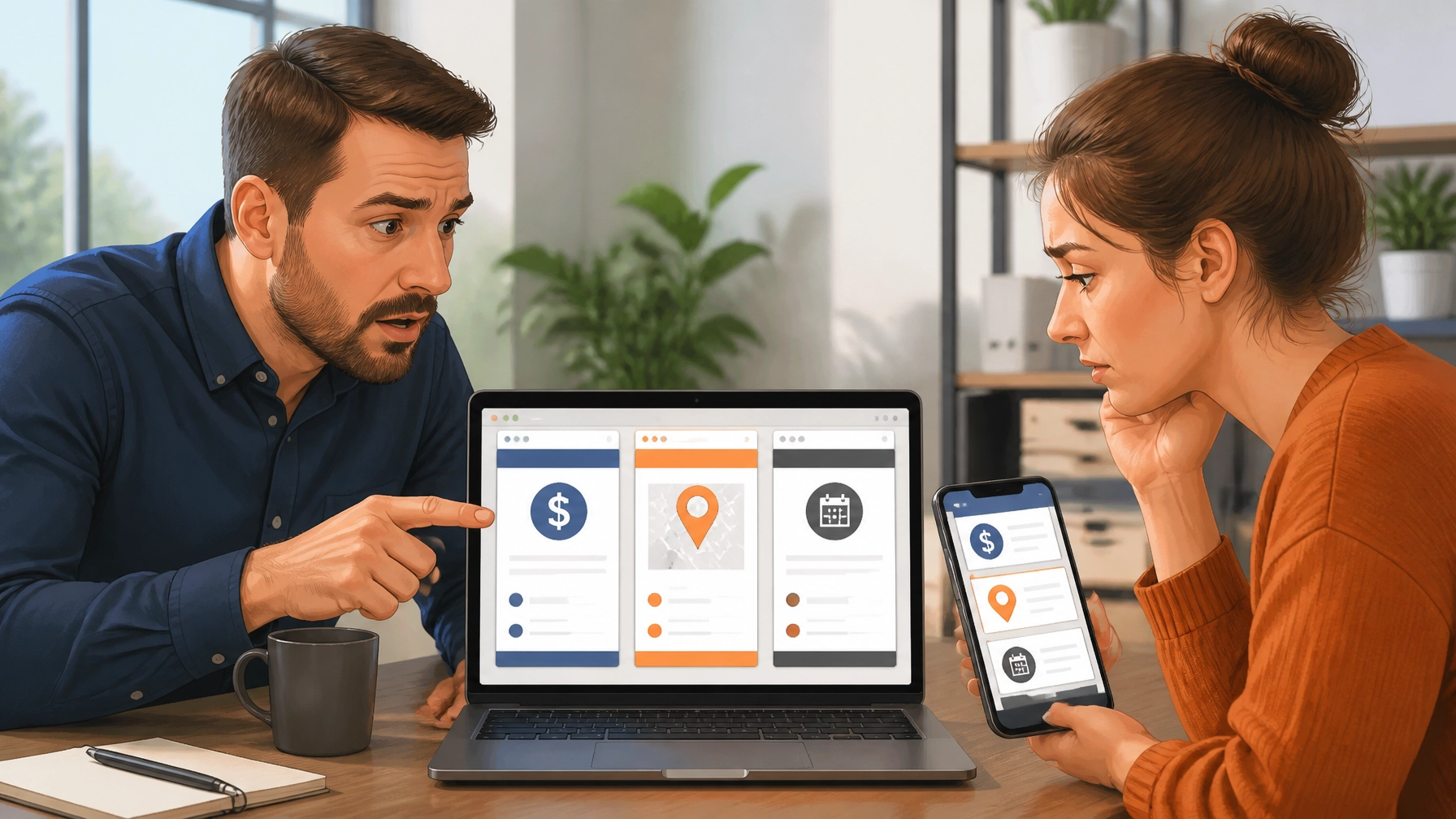
When a user asks their device to “find a reliable roofer who can come out this Tuesday,” an agentic website doesn’t just show a list of services. It interacts with the user’s request, checks live availability, and prepares the path for a seamless booking. If your site lacks these capabilities, search algorithms will deprioritize you in favor of competitors who offer a more functional, “agentic” experience. This is why modern local seo services now focus as much on interface functionality as they do on content.

What Exactly is Agentic UX?
Agentic UX refers to a user interface designed to support autonomous or semi-autonomous tasks. Instead of a visitor digging through your navigation menu to find a specific service page, an agentic site anticipates the user’s intent. It uses real-time data to present exactly what the user needs to complete their goal.
For local businesses, this means moving away from passive layouts and toward active problem-solving environments. Your website should act as your best salesperson, working 24/7 to guide a lead from “just curious” to “booked appointment” without them ever having to hunt for a “Contact Us” page.
Understanding how these interactions translate into business growth is a major part of the shift we’ve seen recently. As we explored in our guide, Beyond the Dashboard: Why 2026 is the Year of Actionable Analytics, tracking simple clicks is dead. You need to measure how effectively your site “acts” for the user.
Comparing Traditional vs. Agentic UX
| Feature | Traditional UX (The Old Way) | Agentic UX (The 2026 Standard) |
|---|---|---|
| User Interaction | Clicking through menus and links | Goal-oriented conversational flow |
| Content Delivery | Static pages and blog posts | Dynamic, intent-based components |
| Forms | Manual input fields | Pre-filled, voice-enabled, or API-triggered |
| Search Presence | Blue links in a search result | Direct answers and action triggers in AI Overviews |
| Goal Completion | User finds a phone number to call | Site autonomously schedules or confirms a task |
How Agentic UX Powers Modern Local SEO Services
Search engines have evolved into “Answer Engines.” To rank in 2026, your site needs to be structured so that AI agents can easily extract data and perform actions. This is a core component of web design that works in the current market.
When you invest in local seo services, the focus has shifted toward “Actionable Schema.” This isn’t just about telling Google your address; it’s about providing the underlying code that allows an AI to know your pricing, your real-time availability, and your specific service areas. If an AI agent can’t “understand” how to book a service on your site, it won’t recommend you to the user.
“By 2026, AI-driven personalization has moved from a ‘nice-to-have’ feature to a core operating model for competitive businesses, dictating how brands interact with consumers at every digital touchpoint.” , Gartner Research, Strategic Technology Trends

Why a Local SEO Audit Now Must Include AI Discoverability
If you haven’t looked at your backend lately, you are likely overdue for a local seo audit. A traditional audit might look at your title tags and site speed, but a 2026 audit looks at “Agent Readability.”
- LLM Optimization: Is your content written in a way that Large Language Models can summarize accurately?
- API Connectivity: Can your site talk to third-party AI assistants?
- Zero-Click Strategy: Are you providing enough information for Google to answer a user’s question directly on the search results page while still driving them to your “agentic” booking tool?
This shift is closely tied to how users find information on other platforms as well. We are seeing a massive crossover where Social Search is the New SEO, and the same rules apply: provide immediate, actionable value or lose the lead.
Agentic UX for High-Stakes Industries: Local SEO for Contractors
For those in the home services sector, the stakes are even higher. Local seo for contractors has become a race for the fastest response time. If a homeowner has a burst pipe, they aren’t going to read your “About Us” page. They are going to tell their phone to “Get a plumber here now.”
An agentic website for a contractor will:
- Instantly detect the user’s location.
- Show an immediate “Emergency Dispatch” button that provides a real-time ETA.
- Allow the user to upload a photo of the problem for an instant AI-generated rough estimate.
This level of utility is what keeps your business at the top of the search results. Google recognizes when users successfully complete a task on your site and rewards that “success signal” with higher rankings.

Partnering with a Digital Marketing Agency for Small Business Growth
Navigating this technical shift isn’t something most business owners can do between jobs. Finding a digital marketing agency for small business that understands the nuances of 2026 technology is critical. It’s no longer just about buying ads; it’s about building a digital infrastructure that functions as an autonomous extension of your team.
A modern agency won’t just give you a pretty design. They will implement the agentic triggers, conversational interfaces, and schema frameworks that make your business “search-active.” This ensures that whether a customer finds you via a voice command, a social media search, or a traditional Google query, your website is ready to close the deal.

Final Thoughts: The Future is Proactive
The days of waiting for a customer to find you, click your link, and then navigate your site are over. In 2026, your website must meet the customer halfway. By implementing an Agentic UX, you aren’t just improving your design; you are future-proofing your search rankings and ensuring your local business remains the go-to choice in an AI-driven world.
How does Agentic UX differ from a regular chatbot?
A regular chatbot is often a passive tool that answers basic questions. Agentic UX is a holistic design philosophy where the entire website is built to perform actions, integrate with AI search agents, and proactively solve user goals through deep data integration.
Will my old website still rank in 2026?
It might rank for very specific branded searches (like your business name), but for high-value “near me” or service-based keywords, static sites are being outperformed by sites that provide direct, actionable answers and AI-friendly structures.
Is Agentic UX expensive for a small business?
While it requires a more strategic initial setup than a basic template site, it often results in a much higher ROI because it automates the lead qualification and booking process, reducing the manual labor required by your staff.
Do I still need traditional SEO if I have an agentic site?
Yes. Traditional SEO (like quality content and backlink building) provides the authority and “trust” signals that AI agents use to decide which businesses are worth recommending in the first place. Agentic UX simply ensures that once you are recommended, the user can actually get things done.
How can I tell if my site is “agent-friendly”?
A thorough local seo audit using 2026 standards is the best way. This looks at your site’s structured data, API accessibility, and how well an LLM can parse and “understand” your service offerings without human intervention.