
An AI can write your next three hundred blog posts. It can script a video, generate a photorealistic spokesperson, and automate a twelve-month email sequence before you finish your morning coffee. But an AI cannot sit in your waiting room. it cannot walk through a customer’s front door to repair a furnace, and it cannot stand behind the counter of a local boutique.
As generative technology makes it trivial to produce convincing content at scale, the fundamental currency of the internet is shifting. We are moving away from the “Content Economy”: where the person with the most information won: and into the “Verification Economy,” where the person who can prove they are real holds the ultimate competitive advantage.
For business owners and marketers, this isn’t just a technological shift; it’s a strategic pivot. When everyone can sound like an expert, expertise itself becomes a commodity. The new “moat” around your business is no longer what you say, but the verifiable proof that a human being is responsible for saying it.
The Democratization of Deception
The same tools that democratize creativity also democratize deception. In the coming years, your customers will be flooded with synthetic reviews, AI-generated service pages, and automated social profiles that look and sound human. This creates a paradox: as content becomes more abundant, its individual value plummets.
Research suggests that consumers are already reacting to this flood of synthetic information. According to a 2024-2025 study by Baringa, nearly 77% of consumers want to know if the content they are consuming was created by AI. However, there’s a catch. When people see an “AI-generated” label without any human context, trust and engagement often drop by as much as 50%.
This is where the Verification Economy begins. Customers aren’t necessarily anti-AI; they are pro-certainty. They want to know that if something goes wrong, there is a person accountable for the outcome. If your website feels like a generic template populated by robotic copy, you’re asking your visitors to take a leap of faith that they are increasingly unwilling to make.
Content Economy vs. The Verification Economy
To understand how to position your business, it’s helpful to look at how the rules of engagement are changing.
| Feature | The Content Economy (2010–2023) | The Verification Economy (2024–Future) |
|---|---|---|
| Primary Asset | Information and Volume | Authenticity and Proof |
| Customer Question | “Who has the best information?” | “Is this business real?” |
| Primary Risk | Invisibility (not being found) | Anonymity (not being trusted) |
| Competitive Moat | High-quality content production | Verifiable human presence |
| Marketing Strategy | SEO and Content Inbound | Trust Infrastructure and Identity |
By shifting your focus from volume to verification, you stop competing on a level playing field with algorithms. You start competing on the one thing a machine can’t replicate: your physical and professional reality.
Building Your Trust Infrastructure
In the Verification Economy, your marketing needs to do more than inform; it needs to certify. This requires building a “trust infrastructure”: a series of signals that prove your business exists in the real world and is operated by real people.
One of the most effective ways to do this is through “Proven Human” positioning. This means moving away from stock photography and generic service descriptions. Instead, you should lean into the “messy” reality of your business.
For example, a home services contractor who shows real job site photos, unpolished video walkthroughs of recent projects, and a team page with actual employees will consistently out-convert a competitor using high-end stock images of a smiling family in a house they didn’t work on. The latter looks “better,” but the former feels “realer.” In a world of deepfakes, “realer” wins every time.

The Signal of Accountability
Trust isn’t just about showing your face; it’s about showing your work. This is why we’ve seen a massive shift in how businesses handle reviews and testimonials. In the past, a simple text quote on a website was enough. Today, that text is easily faked.
Strategic businesses are now moving toward authenticated proof points. This includes:
- Verified Video Reviews: A real customer speaking on camera about their experience is much harder to replicate than a text blurb.
- Real-World Check-ins: Using heatmaps or job-site check-ins (common in local SEO) to show exactly where your team has been working.
- Transparent Processes: Showing the “behind the scenes” of how you deliver your service or manufacture your products.
This level of transparency reduces the “cognitive load” on the visitor: a concept we explore in The Cognitive Load Trap. When a user doesn’t have to wonder if you’re a real business, they can focus on whether you’re the right business for them.
“As AI-generated content scales, the ‘human premium’ becomes the primary driver of digital value. Consumers are 52% less likely to engage with content they believe is purely algorithmic, highlighting a growing demand for verified human oversight.”
Strategic Observations: The Future of Positioning
As we move deeper into this new era, “proven human” will become a premium positioning. We already see this in other industries: “organic,” “hand-crafted,” and “locally sourced” are all verification signals. In the digital space, the equivalent will be “human-verified.”
This also changes how you handle your online presence. Your website shouldn’t just be a brochure; it should be a window. This ties back to the idea that you’re not fighting the algorithm; you’re fighting the user’s guard. If your website feels like it was built by a machine for a machine, the user’s natural defenses will go up.
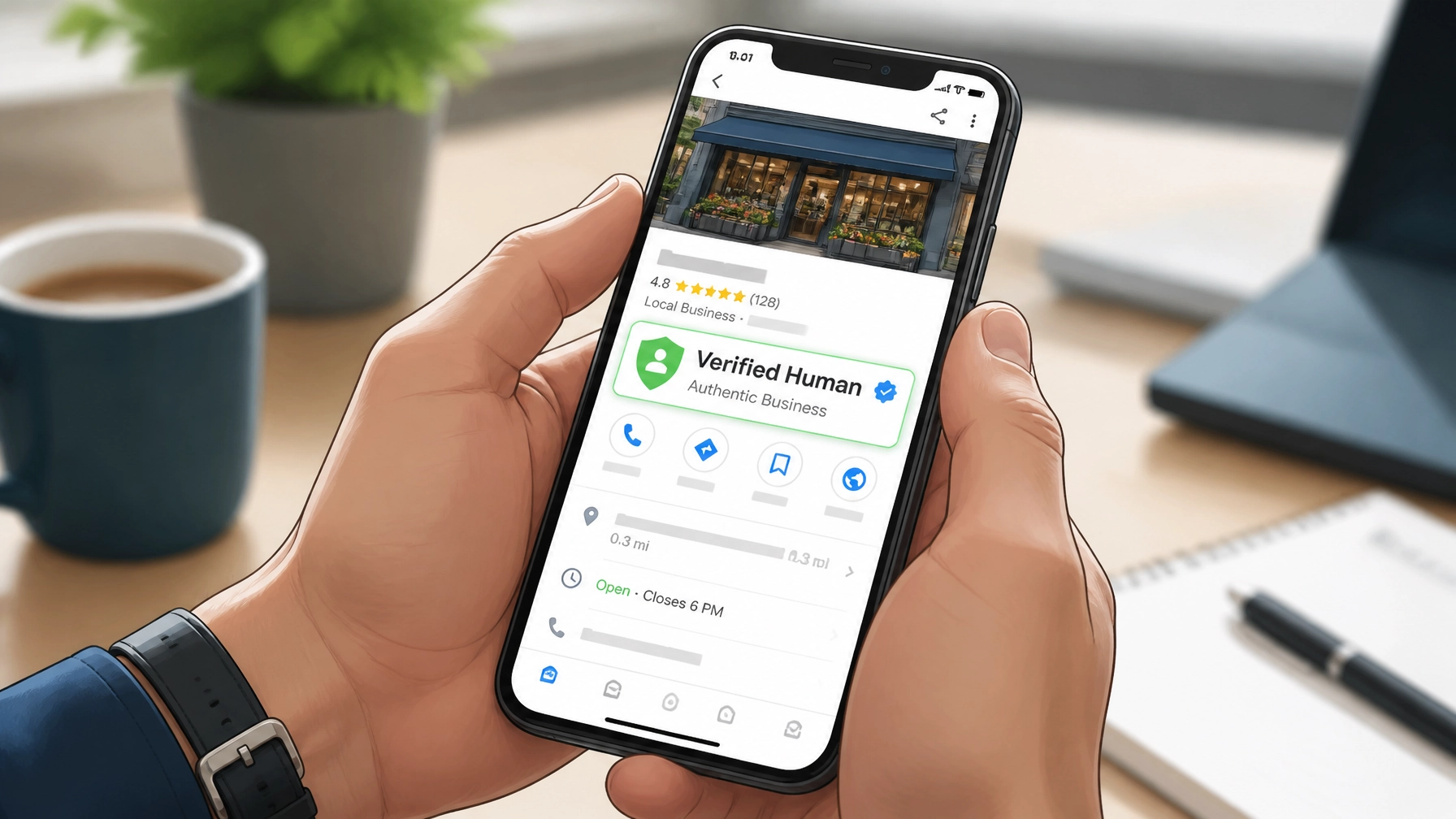
Practical examples of this shift are already emerging. We’ve seen local medical practices double their lead volume simply by replacing their professional headshots with candid photos of their staff interacting with patients. We’ve seen e-commerce brands see a 30% lift in checkout completion by adding a “human-verified” badge next to their customer support chat, letting users know they are talking to a real person in a real office.
The Roadmap to Authenticity
The transition to a Verification Economy doesn’t happen overnight, but the businesses that start building their trust moat now will be the ones left standing when the AI-content flood peaks.
Here is how you can begin:
- Audit Your Visuals: Remove every piece of stock photography that doesn’t represent your actual team or work. Even a lower-quality photo of your real office is better than a 4K image of a generic one.
- Humanize Your Messaging: Write like you speak. Avoid the corporate “we strive to provide” language that AI mimics so well. Use specific details about your local community or your unique professional history.
- Verification as a Feature: If you use AI to assist with your content (as many do), be transparent about it, but highlight the human review process. Labels like “AI-Assisted, Human-Verified” are becoming the new standard for quality.
In the end, technology always moves toward efficiency, but humans always move toward connection. AI can handle the efficiency. Your job is to handle the connection. By proving your reality, you’re not just surviving the digital transformation: you’re leading it.

Is AI going to make it impossible to rank on Google without human content?
Google’s primary goal is to provide helpful, reliable, and people-first content. While their algorithms can detect AI-generated text, they prioritize the “Experience” and “Expertise” (part of E-E-A-T) that only a human can verify. If your content lacks real-world insight or proof, it will likely struggle to maintain rankings as search engines prioritize verified authority.
How do I prove my business is “real” to a customer who has never met me?
The most effective way is through a combination of third-party verification (like a Google Business Profile with real reviews), authentic visual evidence (photos and videos of your actual work), and a clear “About” section that highlights your specific professional journey and local ties.
Does this mean I shouldn’t use AI in my marketing at all?
Not at all. AI is a powerful tool for research, formatting, and speeding up administrative tasks. The key is to use AI to support your human expertise, not to replace it. Use it to draft the structure of an article, but ensure the final product contains your unique voice, real-world examples, and verifiable data.
Will “Verified Human” badges become a real thing?
We are already seeing the early stages of this through platforms like LinkedIn (verified identities) and various third-party trust seals. As deepfakes become more common, it is highly likely that digital “provenance” protocols will become a standard part of website design and social media profiles.