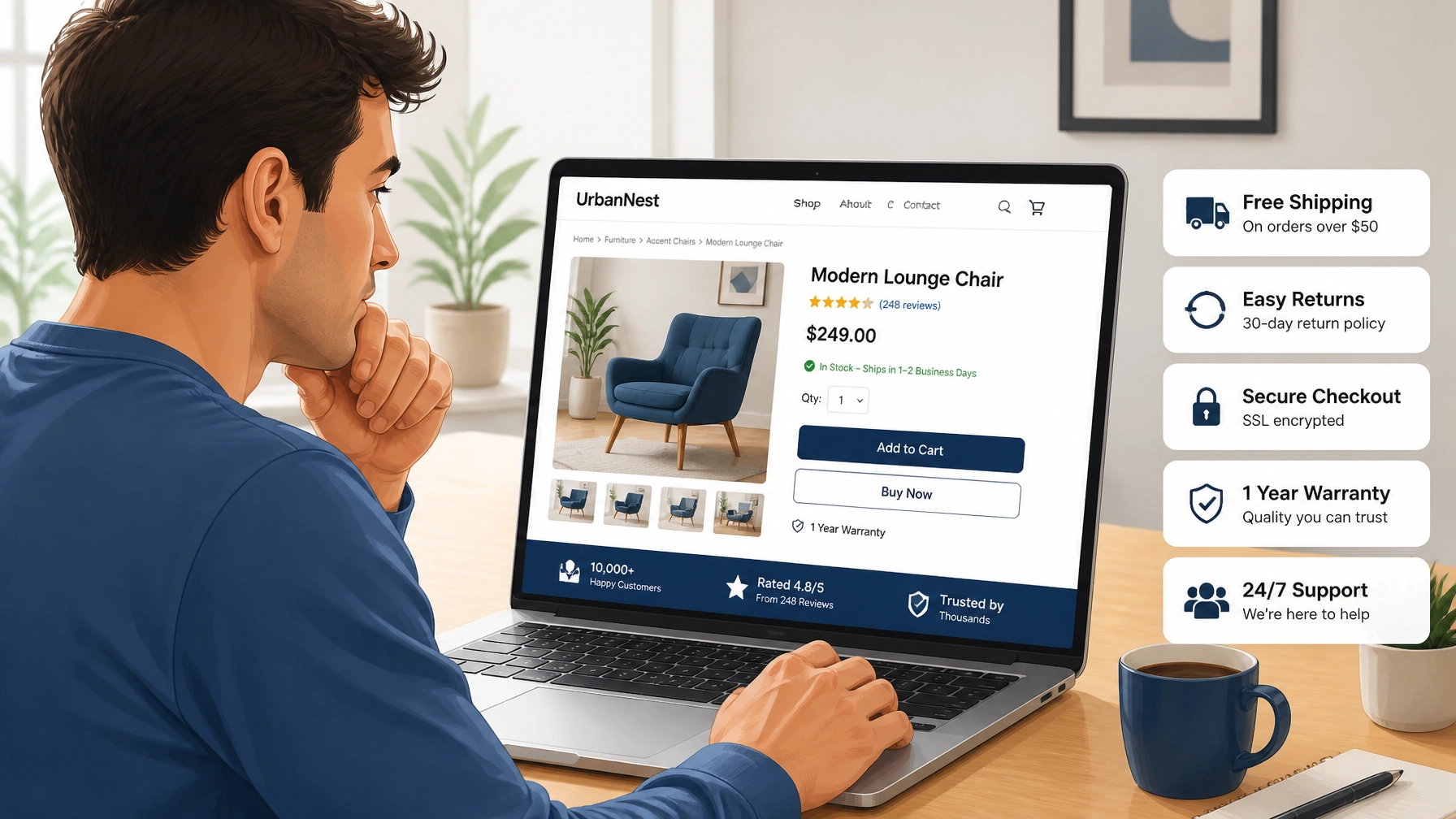
For years, e-commerce growth was fueled by a simple obsession: reducing clicks. The industry believed that if you made the “Buy” button big enough and the process fast enough, conversions would follow. But in 2026, speed is no longer the primary barrier. The modern consumer, bombarded by AI-generated content, sophisticated phishing, and a sea of “too-good-to-be-true” social ads, is operating from a position of profound skepticism.
We are living in a trust deficit. For your brand to win, you must stop engineering for speed and start engineering for certainty.
When a user reaches your checkout, they aren’t just asking “Do I want this?” They are silently auditing your credibility. They are looking for proof that their data is safe, that the product will actually look like the photo, and that your brand exists beyond a temporary landing page. If your checkout strategy doesn’t address these psychological hurdles, you’ll find yourself stuck in the efficiency illusion, where high traffic never quite translates into a healthy bottom line.
The Psychology of the “Micro-Journey”
The linear path from discovery to purchase is dead. Today’s shopper, particularly Gen Z, engages in what we call “micro-journeys.” They might discover your product on a creator’s video, compare prices via an AI shopping agent, read reviews on a third-party marketplace, and then, finally, visit your site to buy.

This cross-platform behavior means that by the time they reach your checkout, they have already encountered multiple “trust touchpoints.” Your job is to ensure your owned experience reinforces, rather than contradicts, that external trust. If your mobile site feels clunky or your payment options feel outdated, you break the chain of certainty they’ve built up across other platforms.
Reducing friction isn’t just about removing form fields; it’s about adding the right anchors at the moments of highest anxiety.
| Checkout Stage | Common Friction Point | Strategic Trust Anchor |
|---|---|---|
| Cart Review | Hidden shipping costs or late delivery dates. | Real-time “Arrival Certainty” calculator. |
| Account Creation | Forced registration that feels like data harvesting. | Single-click “Trust Identity” (ShopPay, Apple Pay). |
| Payment Info | Lack of familiar or secure-feeling methods. | Dynamic payment badges based on user region. |
| Post-Purchase | Vague “Order Received” page with no next steps. | Integrated live-tracking and fit-guarantee prompts. |
The Personalization Paradox
There is a fine line between helpfulness and intrusion. Modern brands are currently caught in the “personalization paradox”: consumers demand tailored experiences, yet they are increasingly wary of the data collection required to provide them.
Research from 2026 indicates that while 71% of shoppers expect personalization, nearly 70% have unsubscribed from brands because the messaging felt irrelevant or “creepy.” True personalization in the checkout phase shouldn’t be about showing them their name in a banner. It should be about surfacing the specific information they need to feel certain.
For example, if a user has visited your sizing guide three times, your checkout should proactively highlight your “Easy Exchange” policy or a “Verified Fit” badge from other customers with similar dimensions. This is strategic website optimization that solves a psychological problem, rather than just chasing a technical metric.
Scaling Trust Through Institutional Signals
Individual reviews are no longer enough. Sophisticated shoppers know that star ratings can be manipulated. They are now looking for “institutional trust signals”, endorsements that come from platforms or systems they already trust implicitly.
“Trust is no longer a static binary; it is a multi-faceted production of technological, relational, and institutional mechanisms. As cross-platform shopping becomes the default, consumers look past simple star ratings toward structural assurances, third-party payment intermediaries and platform-level dispute resolution, to mitigate perceived risk.” , Adapted from 2026 Systematic Review on E-commerce Trust Mechanisms.
This means that your choice of payment processor (like PayPal or Stripe) and your presence on trusted marketplaces act as a “security blanket.” When you use these institutional signals, you aren’t just processing a transaction; you are borrowing the credibility of a billion-dollar entity to protect your own brand reputation.

Engineering Certainty: A Practical Framework
To move beyond the trust deficit, you need to audit your checkout experience through three lenses:
- Relational Trust: Are you showing that real people use and love this product? This is where “hybrid reviews”, which combine user text, verified purchase badges, and AI-summarized sentiment, come into play.
- Technological Trust: Does your site load instantly? Does it look modern? A site that feels “2018” creates an immediate, often subconscious, fear that the business might not be around to handle a return in “2026.”
- Institutional Trust: Are you leveraging the giants? Offering “Buy Now, Pay Later” via a known provider doesn’t just help with cash flow; it signals that a major financial institution has vetted your business.
That said, the most effective way to build trust is to be radically transparent about the “after-purchase” experience. The moment of highest friction isn’t entering the credit card number; it’s the second after clicking “Pay,” when the user wonders if they’ve made a mistake.

At Trust Media, we focus on bridging this gap. We help brands move from generic “growth hacks” to a strategically intelligent architecture that respects how modern humans actually make decisions. By aligning your email marketing, your ad messaging, and your checkout experience around the core principle of certainty, you don’t just increase your conversion rate, you increase your customer lifetime value.
How do I know which trust signals my customers actually care about?
The best way is to analyze your “cart abandonment” reasons through post-abandonment surveys or heatmaps. However, generally, Gen Z prioritizes social proof and flexible payment options, while older demographics prioritize clear contact information and explicit security badges.
Does adding too many trust badges slow down my site or look cluttered?
Yes, this is a common mistake. Instead of a “wall of icons,” integrate them into the UI. For example, place the payment icons directly under the “Complete Purchase” button and the security certification near the credit card fields. Use high-quality, minimalist versions of the logos.
Is guest checkout still better than forced account creation?
Almost always. Forced registration is one of the top reasons for cart abandonment. If you need their data for retention, offer the option to “Save my details for next time” after the purchase is complete. At that point, you’ve already earned their trust.
What is the “Personalization Paradox” in simple terms?
It’s the conflict between a consumer’s desire for a customized shopping experience and their fear of how their personal data is being tracked and used. Resolving it requires being transparent and providing immediate value in exchange for that data.