For years, search engine optimization felt like a game of cat and mouse. You’d find a “hack,” Google would patch it, and you’d move on to the next tactic. It was an era of keyword density, backlink quantities, and technical gymnastics. But as we move further into 2026, that era hasn’t just faded; it has completely dissolved.
Today, the digital landscape is saturated. Between the explosion of AI-generated content and the shift toward AI-powered search overviews, the internet has become incredibly loud. In this environment, the “noise” is the generic, over-optimized content that says everything and means nothing. The “signal” is clarity.
Modern SEO is no longer about convincing an algorithm that you are relevant. It is about proving to both a machine and a human that you are the most clear, trustworthy, and authoritative answer to a specific problem. It’s a shift from technical manipulation to strategic business discoverability.
The Evolution: From Keywords to Concepts
In the early days of search, a business could rank by simply repeating a phrase enough times. If you were a plumber in Chicago, you wrote “plumber in Chicago” on every page until the search engine noticed. As search evolved, keywords became “long-tail,” and then “latent semantic indexing” (LSI) keywords became the trend.
That said, we have now reached a point where keywords are merely the starting point. Search engines, and the AI systems that power them, now operate on a level of conceptual understanding. They aren’t looking for the word; they are looking for the entity. They want to know what your business actually does, who you serve, and if you have the firsthand experience to back up your claims.
This is where many businesses get stuck. They focus so much on the technical “SEO checklist” that they lose the clarity of their message. If a human can’t understand your value proposition in five seconds, an AI summary certainly won’t extract it as a top-tier recommendation.
| Feature | Old SEO (Tactical) | Modern SEO (Strategic) |
|---|---|---|
| Primary Goal | High rankings for specific keywords | Direct intent matching and discoverability |
| Content Style | Quantity over quality; keyword-heavy | Clarity, depth, and “helpful” structure |
| Search Result | 10 Blue Links | AI Overviews, Zero-Click, Multi-channel |
| Metric for Success | Organic Traffic Volume | Qualified Leads and Conversional Intent |
| Authority Signal | Total Backlink Count | E-E-A-T (Experience and Trustworthiness) |

The Clarity Mandate: Why Simple Beats Complex
In practice, the modern searcher is impatient. Whether they are using a traditional search bar or a conversational AI assistant, they want the answer to their question immediately. When your website is buried in industry jargon or “SEO filler” text designed to hit a word count, you are creating friction.
Google’s own systems are now specifically tuned to reward “helpful, people-first content.” This isn’t just a marketing slogan; it’s a technical reality. AI models extract and recombine information from websites that provide clear, unambiguous statements. If your content is well-structured, using clear headings, concise paragraphs, and bulleted lists, it becomes a high-quality “input” for these AI summaries.
“Clarity will outperform complexity. Pages that present direct, scannable answers tied to recognizable business entities are significantly more likely to be cited in AI Overviews than those that hide information behind walls of text.” , Search Strategy Benchmark 2026
By simplifying your message, you aren’t “dumbing it down.” You are increasing its discoverability. You are making it easier for the algorithm to categorize your business as a “signal” rather than just more noise. This is a core component of The Intent Mapping Blueprint, where we focus on matching the exact goal of the searcher with the clearest possible solution.
Mapping Intent: The DNA of Modern Search
One of the biggest mistakes a business can make is treating all traffic as equal. In 2026, search behavior has fragmented into several distinct “intents.” If you don’t align your content with these intents, you’ll find yourself ranking for terms that never lead to a phone call or a sale.

To win in the modern landscape, you must categorize your visibility strategy into four primary areas:
- Informational Intent: The user is researching. They have a question but aren’t ready to buy. Here, clarity establishes your authority.
- Navigational/Local Intent: The user is looking for a specific business or a “best near me” option. This requires perfect structure and trust signals.
- Comparative Intent: The user is weighing options. This is where you highlight your unique differentiators over the competition.
- Transactional Intent: The user is ready to pull the trigger. This is where you must bridge The Trust Deficit by providing a frictionless path to conversion.
For example, a medical practice shouldn’t just try to rank for “doctor near me.” They should aim to be the clear answer for “how long does recovery take for [specific procedure]?” and “patient reviews for [specific treatment] in [city].” By being the clearest answer to those specific, high-intent questions, you capture a lead that is far more likely to book an appointment.
The Zero-Click Reality and AI Overviews
We are now living in a world where more than half of searches result in “zero clicks.” This means the user gets the information they need directly on the search results page without ever visiting your website. While this might sound discouraging, it’s actually a massive opportunity for businesses that prioritize clarity.
When your business is cited in an AI Overview or a featured snippet, you are receiving the ultimate “trust signal.” You are being positioned as the definitive answer by the platform the user trusts. This builds brand recognition that pays off when the user is finally ready to make a purchase or a phone call.
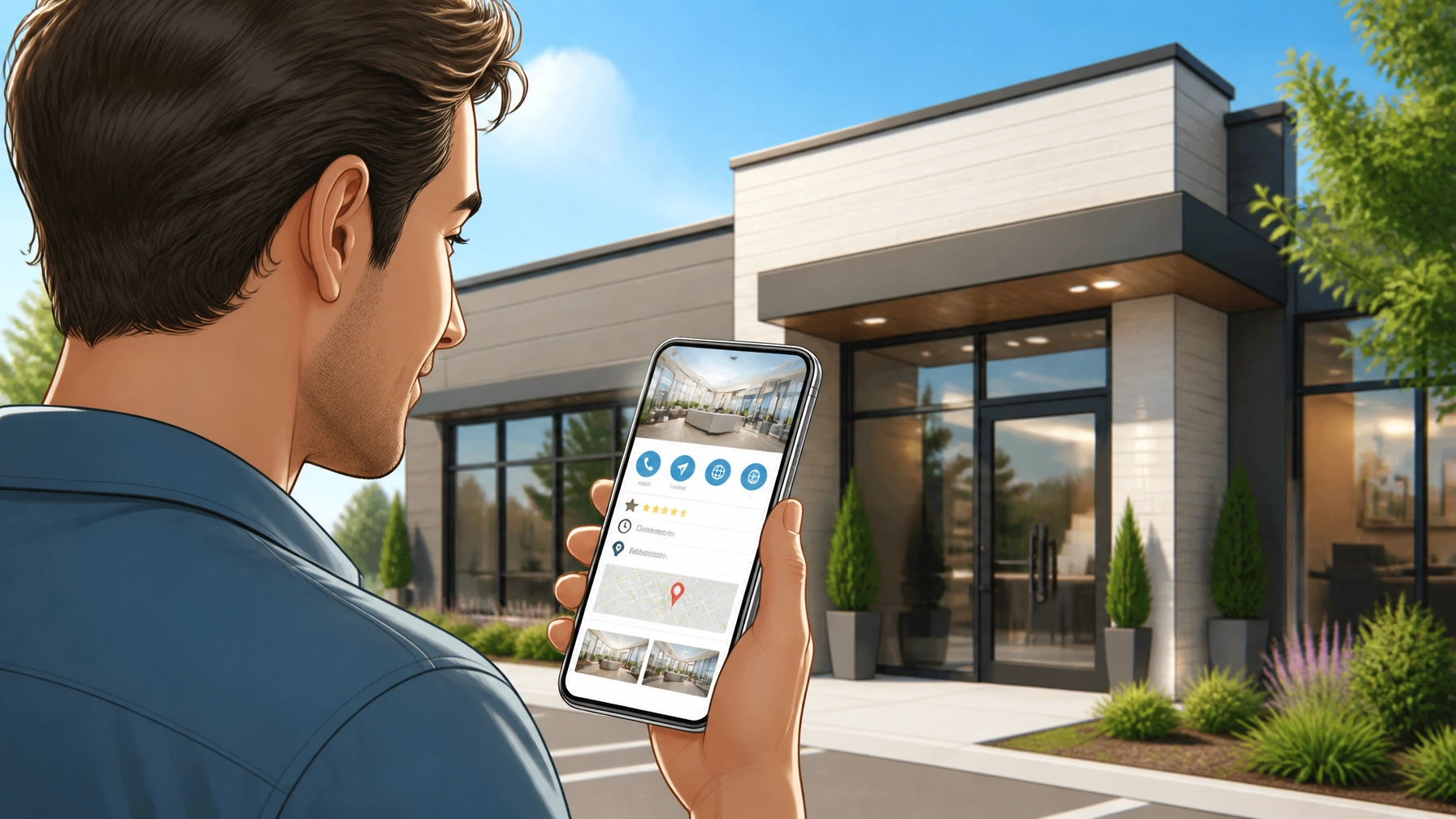
To thrive here, your digital footprint must extend Beyond the Pixel. Your Google Business Profile, your reviews, and your structured data all contribute to how search engines perceive your business “signal.”
E-E-A-T: The Filter for Generic Noise
As AI-generated content floods the internet, the value of human experience has skyrocketed. Google now explicitly looks for E-E-A-T: Experience, Expertise, Authoritativeness, and Trustworthiness.
How do you prove experience in a way that cuts through the noise?
- Case Studies: Show real-world examples of your work.
- Original Data: Share insights from your own business operations.
- Specific Examples: Avoid saying “we provide great service.” Say “we helped a local homeowner save 20% on their energy bills through specific HVAC upgrades.”
- Author Transparency: Show the real people behind the business.
This level of detail is something generic AI content cannot replicate. It creates a “trust loop” that satisfies both the algorithm and the customer. In an era of content fatigue, being the most authentic voice in the room is the fastest way to break The Attention Threshold.
Conclusion: Search as a Strategic Asset
Modern SEO is not a “set and forget” technical task. It is a fundamental part of your business strategy. It is about how you present your clarity and your value to a world that is increasingly overwhelmed by information.
When you move away from trying to “game” the system and start focusing on being the clearest, most trustworthy answer to your customers’ questions, your visibility will naturally follow. At Trust Media, we don’t just optimize websites; we engineer discoverability. We help you cut through the noise so that your best customers can finally find the signal they’ve been looking for.
What is the difference between keywords and entities in modern SEO?
Keywords are the specific words users type into a search bar. Entities are the actual things (businesses, people, places, concepts) those words refer to. Modern search engines try to understand the relationship between entities to provide more accurate results, regardless of the exact phrasing used.
Does ranking #1 still matter if AI provides the answer directly?
While the #1 spot is still valuable, it is no longer the only goal. Being cited as a source in an AI Overview or appearing in the Local Pack can often drive more high-intent leads than a traditional organic link, even if the user never “clicks” through to your site immediately.
How can I make my content more “clear” for AI search engines?
Use a logical structure with H2 and H3 tags. Start your sections with a direct answer to the likely question. Use bullet points for lists and ensure your “NAP” (Name, Address, Phone number) and business details are consistent across the entire web.
Is backlinking still important in 2026?
Yes, but the focus has shifted from quantity to quality and relevance. A single link from a high-authority, industry-specific publication is worth more than hundreds of low-quality links. Links act as “votes of trust” from other entities in your niche.
Why is “zero-click” search increasing?
Search engines are becoming better at answering simple questions (like “what are your hours?” or “is this doctor in-network?”) directly on the search page. This saves the user time. For businesses, this means your Google Business Profile and structured data are more important than ever.