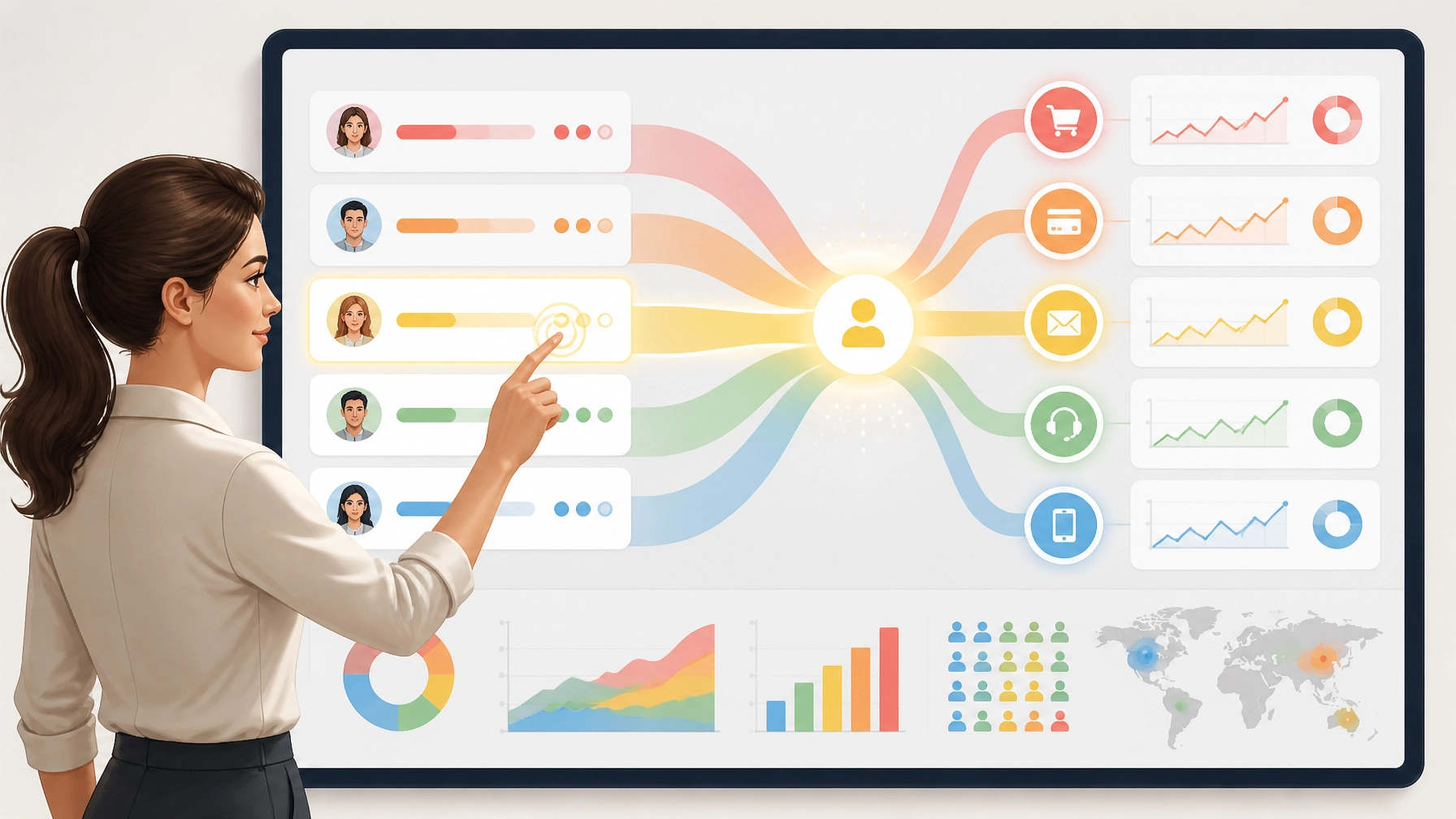
Your CRM knows what your customer bought last month. It doesn’t know what they really need to hear right now.
For the past decade, digital marketing has operated under a straightforward premise: gather more data, feed it into your customer relationship management platform, and trigger automated sequences that make every visitor feel individually recognized. We track clicks, tag behavioral events, and insert dynamic first names into email subject lines. We celebrate when our tech stack successfully detects that someone lingered on a pricing page for four minutes before bouncing.
Yet, something curious has happened as our automation tools have grown more sophisticated. While brands have been busy polishing their surface-level personalization, your customers have quietly evolved past it.
Today’s buyers do not just passively absorb marketing messages; they probe, compare, and interrogate brands with an unprecedented level of sophistication. They arrive at your digital doorstep armed with research, skepticism, and highly specific inquiries shaped by AI-assisted exploration and peer reviews. When your CRM responds with rigid, tag-based segmentation: recommending products based solely on past purchase history or serving generic retargeting ads based on a single page view: the disconnect is jarring.
This mismatch is what we call the Reverse Personalization Gap: the growing chasm between what automated marketing systems assume your customers care about and the complex, context-driven questions your customers are actually asking.
The Three Layers of Modern Customer Questioning
To understand why traditional personalization fails, you have to examine how modern buyers evaluate solutions. Customer inquiry has evolved beyond simple transactional parameters into three distinct psychological tiers:
[ Trust Layer:    What if it goes wrong? Who's accountable? Does this fit my values? ]
[ Context Layer:  Why this solution? Why now? How does this fit my unique situation?  ]
[ Surface Layer:  What is it? Where do I get it? How much does it cost?             ]
Most legacy CRMs and marketing automation platforms operate exclusively at the Surface Layer. They capture what someone bought, how long they hovered over a button, or which geographic region they pinged from. They treat the customer as a static profile rather than a dynamic decision-maker navigating real operational or personal complexity.
When a potential buyer moves into the Context Layer: evaluating how your solution integrates with their existing workflows, previous failed attempts, or specific constraints: surface-level personalization breaks down entirely. Dynamic name insertion cannot answer why your service works for a business with three legacy software integrations when their last vendor failed.
At the apex sits the Trust Layer, where customers ask probing questions about risk mitigation, accountability, and alignment. As explored in our analysis of the verification economy, buyers no longer accept polished brand promises at face value. They demand proof, transparency, and deep contextual alignment. When your digital channels fail to address these deeper tiers of inquiry, users experience friction, hesitation, and rapid abandonment: mirroring the usability breakdowns we examine in the cognitive load trap.
Surface-Level vs. Context-Driven Personalization
Bridging the Reverse Personalization Gap requires a fundamental shift in how organizations design customer data architecture and messaging workflows. The table below outlines how traditional automation contrasts with modern context-driven strategy:
| Dimension | Surface-Level Personalization (Traditional CRM) | Context-Driven Personalization (Modern Growth) |
|---|---|---|
| Primary Data Source | Past purchase history, page views, explicit click triggers | Problem context, historical friction points, situational constraints |
| Customer Trigger | “User clicked product category X” | “User is evaluating integration risk or implementation timeline” |
| Automated Response | Generic retargeting ad or automated email with discount code | Tailored advisory content addressing specific operational roadblocks |
| Conversion Outcome | Low-intent transactional impulse; high unsubscribe rates | High-trust consultation booking; long-term customer LTV |
As business strategist and technology analyst Geoffrey Moore notes regarding consumer evolution:
“Markets are conversations where customers are constantly raising the bar on what constitutes relevant value. When the tools businesses use to listen become automated echoes rather than intelligent instruments, trust dissolves into noise.”
Real-World Adaptation: Closing the Gap in Practice

To see how this plays out in real business environments, consider two distinct operational shifts across different sectors:
1. Home Services: Moving Beyond Retargeting Reminders
A regional home services and HVAC contractor was spending thousands monthly on automated retargeting ads. Whenever a visitor browsed emergency furnace repair pages, the CRM triggered banner ads displaying basic discount codes (“15% Off Your Next Repair!”). Conversion rates remained stagnant at under 0.8%.
The leadership team realized they were addressing surface-level urgency while ignoring context-driven anxiety. Customers weren’t just looking for a discount; they were worried about contractor reliability, hidden fees, and whether their specific 25-year-old heating system could even be salvaged.
They replaced the generic discount ads with a personalized video sequence featuring a master technician explaining common noises in older heating systems, complete with transparent diagnostic checklists for specific home ages. Instead of pushing an immediate sale, the messaging answered the customer’s unstated questions about competence and honesty. The result? Booking rates doubled within 60 days, and inbound phone leads demonstrated significantly higher initial trust.
2. Specialized Ecommerce: Replacing Recommendation Engines
An online specialty equipment retailer relied heavily on standard AI-driven recommendation widgets (“Customers who bought this also bought…”). While these algorithms generated moderate click-throughs, checkout abandonment hovered near 70% for high-consideration items.
Recognizing the Reverse Personalization Gap, the brand dismantled the generic product carousels and replaced them with scenario-based case studies. When visitors viewed professional-grade equipment, the site dynamically surfaced stories of how past buyers solved specific operational bottlenecks in similar industries. By answering how the product fit into real workflows rather than merely suggesting what else was popular, attachment-to-checkout jumped by 35%.
Designing for the Questions They Haven’t Typed Yet
Overcoming the Reverse Personalization Gap requires shifting your strategic posture from reactive data collection to proactive empathy. You cannot solve modern customer hesitation by simply buying a more expensive CRM or layering basic AI chatbots on top of legacy data silos.
Instead, growth-oriented businesses must ask three critical audit questions across every digital touchpoint:
- Does our messaging address the root constraint or just the surface action? If a user visits your pricing page three times, are you simply offering them a brochure, or are you addressing the underlying budget and ROI justification they need to present to their internal team?
- Are our automated sequences reducing friction or adding noise? If your CRM automation feels mechanical and predictable, it signals to sophisticated buyers that your organization is out of touch with their actual operational reality.
- Does our digital architecture encourage dialogue or demand submission? Modern web experiences must act as intelligent guides that help users navigate complex decisions rather than static funnels designed to extract contact information.
Personalization is no longer about knowing more data points about your customer. True modernization is about answering the nuanced, high-stakes questions your buyers are already asking: even the ones they haven’t typed into a search bar yet.

Frequently Addressed Questions
What is the Reverse Personalization Gap?
It is the growing mismatch between traditional CRM automation: which relies on basic surface-level data like past purchases and page views: and the sophisticated, context-rich questions modern customers are asking before making a purchasing decision.
Why do traditional CRM systems fall short of customer expectations?
Most legacy CRMs operate on batch processing, data silos, and rigid rule-based workflows. They capture transactional history rather than emotional nuance, situational constraints, or the deeper trust-building inquiries modern buyers bring to the table.
How can businesses move beyond surface-level personalization?
By shifting focus from static behavioral tagging to problem-centric content design. This means providing transparent case studies, operational guides, and expert answers that address the specific risks and constraints your customers face in their unique situations.
Does this mean AI and automation have no role in modern growth?
Not at all. AI and CRM tools remain powerful operational assets when used to scale efficiency, provided they are paired with strategic empathy and human-led insights that validate customer trust rather than replacing authentic engagement.