Trust is the most expensive currency in the home services industry. Whether you are an HVAC contractor, a residential roofer, or a dental practice owner, your prospective customers are inherently skeptical. They aren’t just looking for a service; they are looking for a recommendation they can bank on. In an era where traditional advertising often falls on deaf ears, the bridge between a “maybe” and a “booked appointment” is often a familiar face.
This is where the local micro-influencer comes in. These aren’t the celebrity mega-stars with millions of followers living in Los Angeles or New York. Instead, they are the local foodies, the “mommy bloggers” in your specific zip code, or the community advocates who have built a dedicated following of 5,000 to 20,000 neighbors. For a business that relies on a specific service area, these individuals offer something a national ad campaign never could: geographic relevance and high-intent engagement.
Why Micro Beats Mega for Local Services
If you’ve been focused on reach alone, you’ve likely been looking at the wrong metrics. In the world of social media, bigger isn’t always better, especially when your business doesn’t ship products nationwide. If you operate a local plumbing business, a shoutout from a national celebrity is useless if 99% of their followers live outside your service area.
The real magic happens in the engagement rates. Micro-influencers typically see engagement rates around 7%, whereas mega-influencers often hover around a mere 2%. This difference exists because micro-influencers maintain a personal connection with their audience. They reply to comments, they live in the same neighborhoods, and their followers view them as peers rather than distant icons.
“Research shows micro-influencers achieve engagement rates between 2% to 10%, significantly outperforming macro-influencers whose rates hover around 1% to 3%.” , Social Media Today
When a local influencer shows their followers a behind-the-scenes look at their new kitchen remodel or a routine HVAC check-up, it doesn’t feel like an ad. It feels like a neighborly tip. This shift in perception is vital because the trust deficit is the primary hurdle for professional services in 2026.
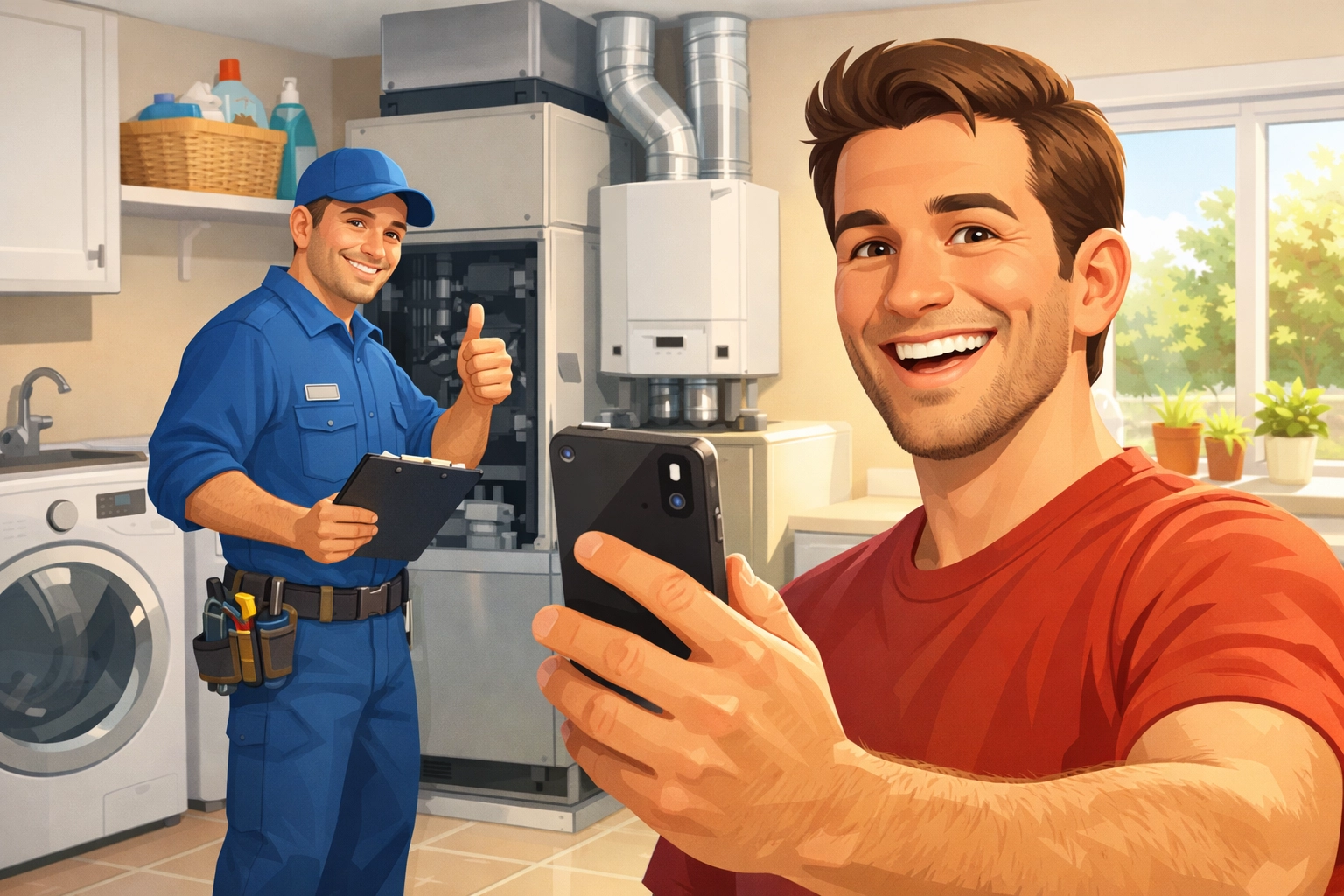
A colorful cartoon illustration of a local homeowner recording a video on their phone while a friendly HVAC technician works in the background, showing a “thumbs up” to the camera in a sunny suburban neighborhood.
The Proximity Advantage: Driving High-Intent Leads
High-intent leads are prospects who are ready to buy, not just browsing. When a local influencer shares their experience with your business, they are providing social proof that carries more weight than any Google review ever could. This is because the follower already has a parasocial relationship with the influencer.
For local service businesses, proximity is everything. A micro-influencer’s audience is geographically concentrated. This means when they talk about your service, they are talking to people who actually live within your reach. This geographic precision is a core part of the neighborhood hero strategy, where local HVAC and roofing companies use community voices to dominate their specific markets.
Comparative Value of Influencer Tiers
To help you understand where to put your marketing dollars, let’s look at how different influencer tiers stack up for a local service provider:
| Feature | Micro-Influencer (Local) | Macro-Influencer (National) |
|---|---|---|
| Follower Count | 5,000 – 50,000 | 500,000+ |
| Engagement Rate | ~7% | ~2% |
| Audience Location | Concentrated in your city/region | Distributed globally |
| Cost per Post | Low to Moderate | High to Extreme |
| Trust Factor | High (Peer-to-peer) | Moderate (Aspirational) |
| Primary Value | Conversions & Leads | Brand Awareness |
How to Identify and Vet the Right Local Partners
You don’t want to partner with just anyone who has a following. For home services and medical practices, your reputation is on the line. You need to ensure the influencer aligns with your brand values and actually reaches your target demographic.
- Check Local Geotags: Look at who is frequently tagging locations in your city. Are they visiting the local parks, hardware stores, or community events?
- Analyze the Comments: Are the people commenting actually local? Look for mentions of local landmarks or “neighbor talk.”
- Evaluate Content Quality: Does their content feel authentic? If every post is a sponsored ad, their audience has likely tuned out.
- Demand Data: Ask for a screenshot of their audience insights to confirm their followers are located in your service area.
By focusing on these details, you can ensure your partnership drives actual phone calls rather than just “vanity likes.” This tactical approach is similar to how we recommend optimizing your Google Business Profile for maximum local visibility.

A cartoon depiction of a local business owner and a micro-influencer shaking hands in front of a branded service van, with digital “heart” and “location pin” icons floating around them.
Integrating Influencer Marketing with Local SEO
Influencer marketing shouldn’t exist in a vacuum. When done correctly, it feeds into your overall digital ecosystem. When an influencer mentions your business, it generates social signals, likes, shares, and mentions, that search engines notice.
While social signals aren’t a direct ranking factor like backlinks, they drive traffic to your website and increase brand searches. When more people search for your business by name on Google, it signals to the algorithm that you are a prominent local authority. This synergy is a key component of mastering social signals for local contractors.
Furthermore, you can repurpose the content created by influencers on your own site. Using a testimonial video from a local influencer on your landing page can significantly improve your conversion rates. In fact, many businesses are seeing massive success by combining this social proof with high-speed communication tools, as seen in the 2026 SMS blueprint for local services.
Measuring the ROI of Local Proximity
One of the biggest myths in marketing is that influencer campaigns are hard to track. For home services, it’s actually quite straightforward if you set the right foundation. You can use unique promo codes, dedicated landing pages, or tracked phone numbers to see exactly how many leads an influencer generates.
“Home services businesses can expect an average return of $6.50 for every dollar spent on influencer marketing, with micro-influencer campaigns often yielding higher returns.” , Influencer Marketing Hub
That $6.50 return is a powerful benchmark. Because micro-influencers are more affordable than traditional TV or radio ads, your “cost per lead” often drops significantly. You aren’t paying for “wasted reach”, you are paying for direct access to a community that already trusts the person speaking.
A bright cartoon chart showing a line graph trending upward, with a “Micro-Influencer” icon at the peak of the growth curve, surrounded by stacks of coins and ringing telephones.
Getting Started: A Simple 3-Step Action Plan
If you’re ready to leverage the power of proximity, start small and scale. You don’t need a massive agency to begin; you just need a strategic mindset.
- Step 1: Identify 5 Local “Heroes.” Find five people in your service area who post consistently about local life. Reach out with a personal message, not a scripted template.
- Step 2: Offer a Service Experience. Don’t just ask for a post. Invite them to experience your service, whether it’s a dental cleaning, a carpet deep-clean, or a smart-home installation, for free in exchange for honest content.
- Step 3: Amplify the Content. Once they post, share it on your own social channels and embed the video on your website. This extends the life of the content and builds your own credibility.
By following this path, you turn a one-time social media post into a long-term trust asset. This is how you move from being just another contractor in the phone book to being the “neighborhood choice.”
How do I find micro-influencers in my specific city?
The best way is to use Instagram and TikTok search functions. Search for hashtags like #[YourCity]Moms, #[YourCity]Foodie, or #[YourCity]Lifestyle. Look for accounts that have high engagement on their posts and a following that seems genuinely interested in local community happenings.
What is a fair price to pay a local micro-influencer?
Rates vary based on the niche and engagement rate, but many micro-influencers (5k-20k followers) charge between $150 and $500 per post. Some may even work for “product/service trade” if your offering is high-value, like a free HVAC tune-up or a professional house cleaning.
Can influencer marketing help my Google Maps ranking?
Directly, no. Indirectly, yes. Influencer campaigns drive “branded searches” (people searching for your specific business name). High volumes of branded searches tell Google that your business is popular and relevant in your area, which can positively impact your visibility in the local 3-pack.
How long does it take to see leads from an influencer campaign?
Unlike SEO, which is a long-term play, influencer marketing can drive immediate high-intent leads. You will often see a spike in inquiries within 24–48 hours of the content going live. However, the long-term benefit comes from the “evergreen” nature of the content if you repurpose it on your own site.
Is it better to have one big influencer or three smaller ones?
For local home services, three smaller (micro) influencers are almost always better. This allows you to reach three different “neighborhood clusters” and provides multiple touchpoints of social proof, making your business appear more omnipresent in the community.