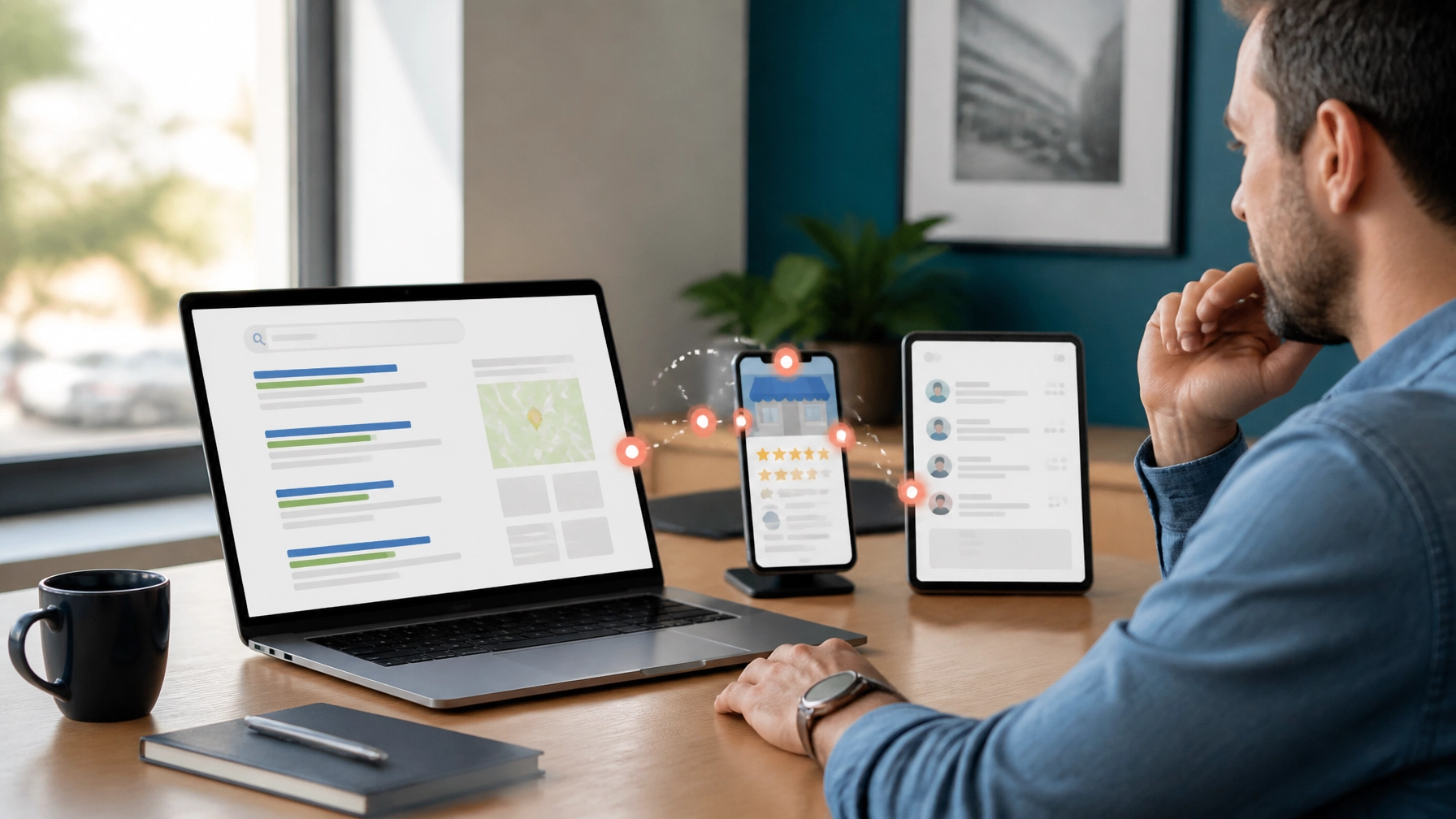
If you’ve ever searched for “emergency plumber” or “best sushi near me,” you’ve seen the “Local Pack.” It’s that coveted box at the top of Google’s search results that shows a map and three local business listings. For most local business owners, getting into that top three is the difference between a phone that rings off the hook and a website that’s a digital ghost town.
But how does Google actually decide who gets those spots? It’s not just random luck, and it’s certainly not just about who has the prettiest website. Google uses a specific set of rules to determine which businesses are the most “worthy” of a user’s attention.
In the world of Local SEO, everything boils down to three core pillars: Relevance, Proximity, and Prominence. If you understand these, you can stop guessing and start ranking. Let’s break down exactly how these work and what you can do to master them.
The Three Pillars of Local Ranking
Before we dive into the weeds, let’s look at the big picture. Google wants to provide the best possible answer to a user’s query. To do that, it weighs these three factors against every business in its database.
| Factor | What It Means | Key Ranking Signals |
|---|---|---|
| Relevance | How well your business matches the search intent. | GBP Categories, Keywords, Website Content. |
| Proximity | How close your business is to the person searching. | Business Address, Service Area, User Location. |
| Prominence | How “famous” or well-known your business is. | Reviews, Backlinks, Citations, Brand Mentions. |

A friendly cartoon robot wearing a detective hat, using a large magnifying glass to inspect a digital map with colorful pins.
Relevance: Do You Actually Do What They Need?
Relevance is the first gatekeeper. If someone searches for “dental implants” and your Google Business Profile (GBP) only says you’re a “General Dentist,” you might lose out to a competitor who explicitly lists “Dental Implants” as a primary category or service.
Google looks at your business name, your selected categories, and the content on your website to see if you’re a match. This is where most businesses leave money on the table. They set up their profile once and forget about it.
To win the relevance game, you need to be specific. That means ensuring your primary category is the most accurate reflection of your main revenue driver. If you’re a professional practice, your website content should mirror the services you offer on your profile. For instance, having dedicated service pages is much more effective than one long “Services” list. If you’re wondering how to structure this, our 10-point local SEO audit checklist can help you align your site with Google’s expectations.
In practice, relevance is about teaching Google exactly what you do so it can confidently recommend you.
Proximity: The Geography You Can’t Escape
Proximity is the most straightforward factor, but also the most frustrating. It’s simply how close you are to the user at the moment they search. If you are a plumber based in North Chicago, you are much more likely to show up for searches in North Chicago than in South Chicago.
Google tracks the user’s GPS location (on mobile) or their IP address (on desktop) to deliver results that are physically convenient. That said, there is a common debate for businesses that don’t have a traditional storefront: should you show your address or hide it?
Setting up your service area correctly is vital here. If you’re a contractor, you might not want people showing up at your home office, but you still need to prove to Google that you serve specific neighborhoods. This is a nuanced topic we’ve covered deeply in our guide on Service Area vs. Physical Address GBP setups.
While you can’t change your physical location, you can optimize for the “micro-neighborhoods” around you by creating local-specific content.

A cartoon robot holding a compass and a ruler, measuring the distance between a small shop icon and a person icon on a vibrant green landscape.
Prominence: The Popularity Contest
If Relevance and Proximity get you into the race, Prominence is what helps you win it. Prominence is Google’s way of asking, “Is this business actually good? Do people like them?”
Google determines prominence by looking at:
- Reviews: The quantity, quality (star rating), and frequency of your Google reviews.
- Backlinks: Links from other reputable websites to yours.
- Citations: Mentions of your Name, Address, and Phone number (NAP) across the web.
- Local Authority: How often your brand is mentioned in local news or community blogs.
“According to BrightLocal’s Local Consumer Review Survey, 98% of consumers at least ‘occasionally’ read online reviews when searching for local businesses, making review signals one of the most powerful prominence factors in the algorithm.”
Think of prominence as your digital reputation. If you have 200 five-star reviews and your competitor has 10, Google is going to view you as the “safer” recommendation. This is why managing your reputation isn’t just a PR move, it’s a direct ranking strategy.
How Behavioral Signals Tip the Scales
Beyond the three pillars, Google also watches how people interact with your listing. These are called behavioral signals. If Google shows your business in the Top 3 but nobody ever clicks on your phone number or asks for directions, Google might decide you aren’t the best fit after all.
High-intent actions, like clicking “Call” or “Get Directions,” send a strong signal to Google that your business is solving the user’s problem. By using data-driven heatmaps and lead intelligence, you can actually see where people are clicking and optimize your profile to encourage more of those high-value actions.

A group of cheerful cartoon robots standing around a giant gold trophy, with one robot holding a smartphone showing a 5-star rating.
Local SEO in the AI Era
We can’t talk about ranking in 2026 without mentioning AI. Google is increasingly using “AI Overviews” to answer local queries before a user even clicks a link. These AI summaries pull data from your GBP, your website, and even third-party review sites.
To survive this shift, your data needs to be structured and clear. Google’s AI needs to be able to “read” your business quickly. This means using proper schema markup on your site and ensuring your GBP is 100% complete. For a deeper look at this, check out our insights on surviving AI Overviews and Google Maps changes.
Getting Your Business Ready for the Top 3
Dominating local search isn’t about “gaming” the system; it’s about providing the most relevant, closest, and most reputable solution to a user’s problem.
Start by cleaning up your relevance, fix your categories and update your service list. Then, work on your prominence, get a system in place to ask every happy customer for a review. Finally, keep your data consistent across the web.
Here’s why this matters: Local SEO is a compounding asset. Once you secure a spot in the Top 3, you get more clicks, which leads to more reviews, which leads to even higher prominence. It’s a cycle that, once started, is very hard for your competitors to break.

A cartoon robot sitting at a high-tech desk with multiple holographic screens showing upward-trending growth charts and map locations.
Does the physical distance to a searcher always matter most?
While proximity is a major factor, a business with incredibly high prominence (lots of great reviews and authority) can often outrank a closer competitor who has a poorly optimized profile.
How long does it take to see results from Local SEO?
Generally, you can see changes in rankings within 30 to 90 days of consistent optimization. However, prominence factors like building a strong review profile can take longer to fully influence the “Top 3” placement.
Can I rank in multiple cities if I only have one office?
Yes, but it’s harder. You’ll need to focus heavily on “Relevance” and “Prominence” for those specific areas by creating localized content and potentially utilizing service-area settings in your Google Business Profile.
Do Google Ads help my organic Local SEO rankings?
Directly? No. Running ads won’t magically boost your organic ranking. However, ads can increase brand awareness (prominence), which might lead to more people searching for your business by name, which does help your organic signals.
What is the most important part of a Google Business Profile?
Your primary category is the single most important factor for relevance. After that, your business name and your average review rating carry the most weight.