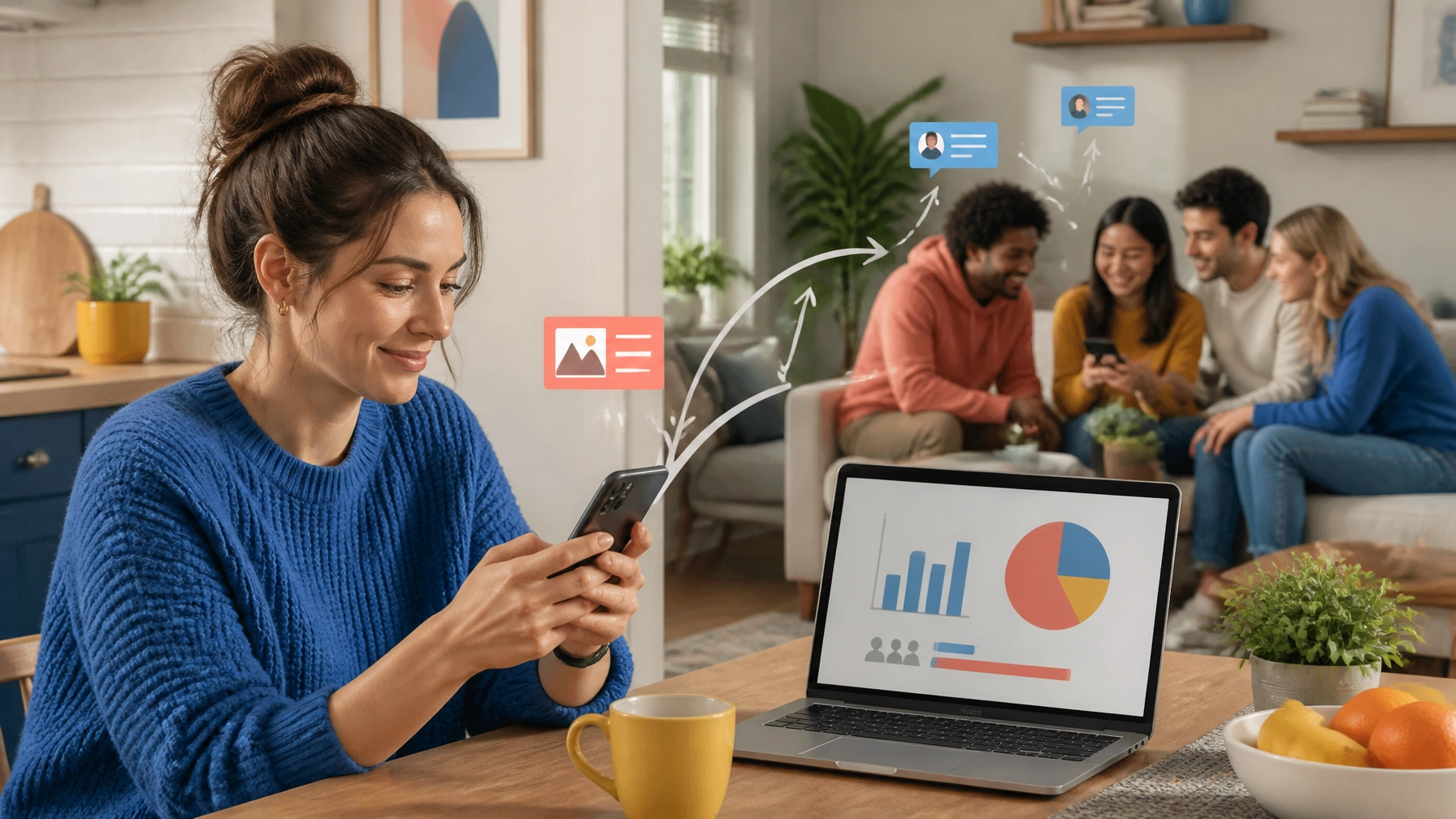
For over a decade, the “infinite scroll” was the engine of the digital economy. It was a dopamine loop designed to keep your thumb moving and your eyes glazed, feeding you a relentless stream of content that you didn’t ask for but couldn’t stop watching. But by 2026, the engine has stalled. The passive, zombie-like scrolling that once defined social media has been replaced by a more discerning, guarded, and purposeful behavior: the intentional feed.
You’ve likely felt this shift yourself. The exhaustion of being marketed to every three seconds has reached a breaking point. Users are no longer just “on social media”, they are carefully curating their digital environments to protect their mental space. This isn’t just a trend; it’s a fundamental rewiring of how digital attention is earned. Brands that continue to shout into the void of the algorithm are finding that their voices are being filtered out by a new generation of “intentional consumers.”
The Great Backlash Against “AI Slop”
The primary catalyst for this shift is the explosion of what culture has dubbed “AI slop.” As generative tools made it possible to produce infinite amounts of content with zero effort, the internet became flooded with low-quality, algorithm-baiting videos and articles. This “slop” is technically competent but emotionally vacant. It fills the feed without adding value, leading to a massive decline in trust.
In 2026, the uncanny valley has moved from robot faces to brand messaging. If a piece of content feels like it was generated by a prompt rather than a pulse, audiences immediately tune out. That said, the response isn’t to abandon AI altogether, but to use it as a scaffold for human creativity rather than a replacement for it.
“The paradox of 2026 is that the more abundant content becomes, the more valuable the human ‘signature’ becomes. Efficiency is no longer a competitive advantage; resonance is.” , Digital Culture Report, 2026
This environment has forced a return to the storytelling edge, where the goal is no longer to be “seen” by millions, but to be “felt” by a specific few.

Radical Subjectivity and the Rise of “Cringe Confidence”
As polished, AI-assisted perfection becomes the baseline, the new status symbol is “Radical Subjectivity.” This is the move away from the “curated aesthetic” toward something much more raw, messy, and undeniably human.
Enter “Cringe Confidence.” You see it in creators who film themselves in unglamorous settings, messy kitchens, noisy streets, or during moments of genuine frustration. This isn’t about being unprofessional; it’s about being un-faked. In a world of deepfakes and filtered reality, showing your “cringe”, your awkwardness, your mistakes, your unfiltered perspective, is the ultimate proof of life.
For brands, this is a difficult transition. It requires letting go of the “corporate mask” and allowing real people to lead the conversation. This shift is deeply connected to why 2026 is about community trust rather than massive follower counts. When you show up with cringe confidence, you aren’t trying to appeal to everyone. You are signaling to your “people” that you are one of them.
Comparing the Eras: Scrolling vs. Intentionality
To understand how to pivot your strategy, it helps to look at how the fundamental mechanics of engagement have changed over the last two years.
| Feature | 2024: The Passive Scroll | 2026: The Intentional Feed |
|---|---|---|
| Primary Metric | Reach & Impressions | Time Spent & Depth of Interaction |
| Content Goal | Stop the Scroll (Clickbait) | Start a Conversation (Relevance) |
| Aesthetic | Polished, High-Production, Filtered | Raw, Subjective, “Cringe Confident” |
| Discovery | Algorithm-Led Recommendation | Community-Led Curation |
| Brand Tone | Authoritative & Polished | Human, Opinionated, & Relatable |
| Frequency | High Volume (Daily/Hourly) | Lower Volume, Higher Intent |
The Architecture of “Small Social”
Because the main feeds are increasingly viewed as noisy and unreliable, we are seeing a mass migration to “Small Social.” These are the niche Discords, private Telegram channels, Substack communities, and “Close Friends” lists.
This isn’t just about privacy; it’s about control. Users are opting into environments where the signal-to-noise ratio is manageable. In these spaces, attention isn’t something that is “captured” by a flashy hook; it is “gifted” by a community that trusts the source. This is exactly why social search is the new SEO; people are looking for answers from people they know, not from a faceless search engine or a cluttered “For You” page.

How Modern Brands Earn Engagement
Earning attention in 2026 requires a radical departure from the “content factory” mindset. Here is how successful brands are navigating the transition:
- Prioritize “Point of View” Over “Keywords”: AI can write a 1,000-word article about HVAC maintenance, but it can’t tell a story about the time a technician saved a family’s Christmas by fixing a furnace in a blizzard. Your specific, subjective experience is your moat.
- Embrace the “Messy” Middle: Don’t wait for perfect lighting or a scripted teleprompter. Use your phone. Show the behind-the-scenes. Speak directly to the camera with “cringe confidence.” The friction is what makes it feel real.
- Build a “Value-First” Gated Community: Whether it’s a newsletter or a private group, give your most loyal followers a place to escape the main feed. This allows you to gather first-party data and build deeper relationships away from the algorithmic whims.
- Audit for “Slop”: Every piece of content you put out should pass the “Human Test.” If you remove your logo, would someone still know it’s you? If the answer is no, it might be slop.
As we’ve discussed in our guide on reclaiming humanity from the digital grind, the future of marketing isn’t about doing more, it’s about being more.

Conclusion: From Exposure to Intimacy
The era of digital marketing as a numbers game is ending. You can no longer buy your way into someone’s heart by simply appearing in their feed 50 times a day. In the world of the intentional feed, attention is a finite resource that users protect fiercely.
To win in 2026, you must stop trying to “hack” the algorithm and start trying to “honour” the audience. Move from exposure to intimacy. Move from shouting to listening. When you stop treating your audience like a metric and start treating them like a community, you don’t just get their attention, you get their trust.
What is the “intentional feed” exactly?
The intentional feed refers to a shift in user behavior where people actively curate what they see, moving away from passive scrolling and toward specific creators, niche communities, and value-driven content.
How do I know if my content is “AI slop”?
If your content is generic, lacks a unique point of view, or is produced primarily to satisfy search engines or algorithms without offering real human insight, it is likely being perceived as AI slop.
Why is “cringe confidence” important for brands?
Cringe confidence signals authenticity. In a world of hyper-polished and AI-generated visuals, showing real, unscripted, and sometimes “awkward” human moments builds a level of trust that polished corporate marketing cannot replicate.
Should I stop posting on big platforms like Instagram or TikTok?
No, but your strategy should change. Use these platforms as “discovery” points to lead people toward your own “Small Social” communities, like a newsletter, a private group, or your website.
How often should a brand post in 2026?
Frequency is less important than intentionality. It is better to post three high-value, deeply resonant pieces of content per week than to post low-quality “filler” content three times a day.