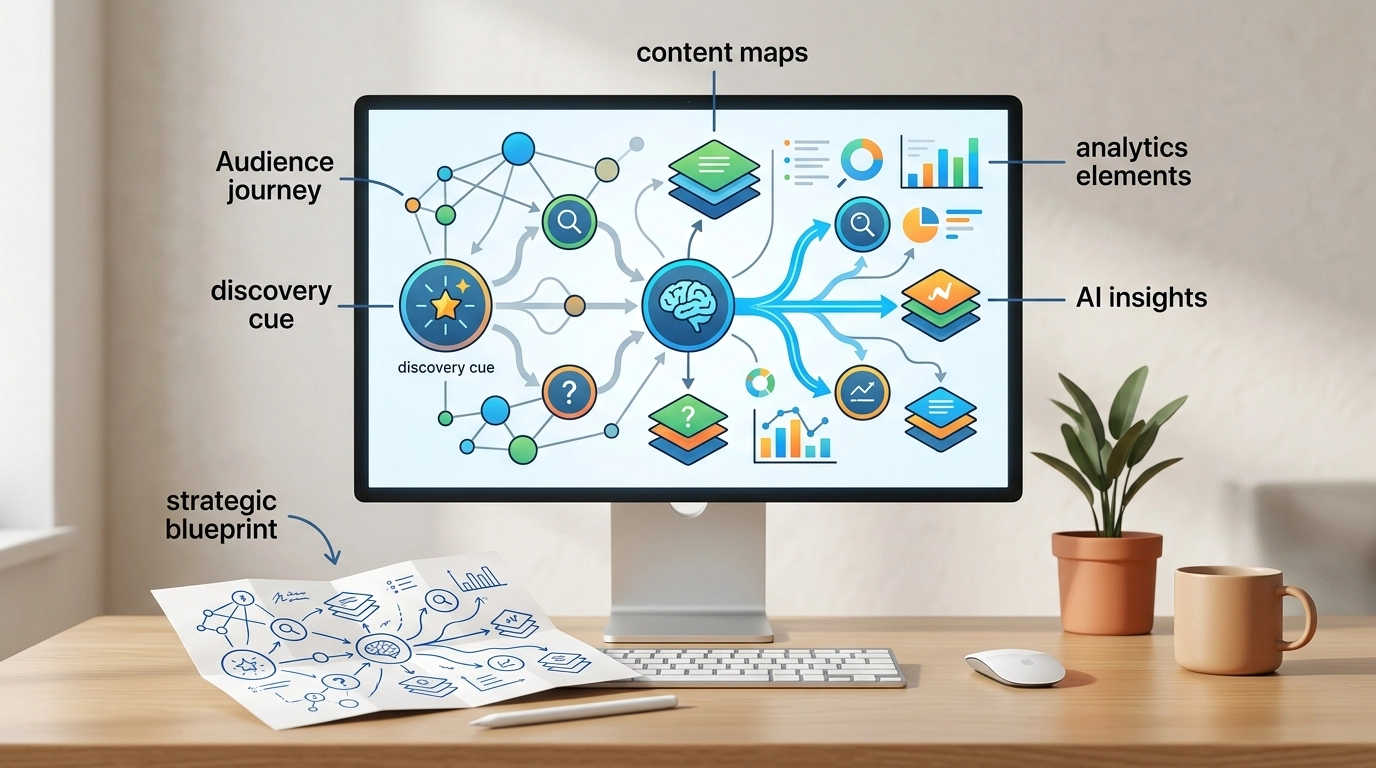
The traditional marketing funnel, once a predictable straight line, has effectively dissolved. In 2026, the consumer journey is no longer a descent from awareness to purchase; it is a multi-surface exploration across AI agents, social discovery engines, and traditional search platforms. For businesses navigating this landscape, the old playbook of “ranking for keywords” has been replaced by a more sophisticated necessity: intent mapping.
Modern discoverability is less about appearing in a list and more about being the synthesized answer to a complex problem. Whether you are a local service provider or a national brand, your content must now act as a reliable signal in a noisy, AI-filtered world. At Trust Media, we see this shift not as a hurdle, but as an opportunity to build deeper, more resilient authority.
The Death of the Keyword-First Era
For decades, digital strategy was built on volume. Marketers chased high-traffic keywords, often at the expense of actual utility. However, the rise of AI-driven search has fundamentally changed the value of a click. Today, roughly 60% of Google searches are “zero-click,” meaning the user finds their answer directly on the results page.
“Search intent beats keywords every time, especially in AI-powered environments where systems focus on user outcomes rather than exact-match phrases.” : Industry Insight, 2026.
This doesn’t mean SEO is dead; it means it has matured. Users are no longer just searching for “best HVAC repair”; they are asking their AI assistants to “find a highly-rated HVAC contractor who specializes in energy-efficient heat pumps and has availability this Tuesday.” To capture this intent, your content must provide the depth and structured data that these agents require to cite you as a solution.

The Three Surfaces of Discovery
To build an effective content marketing strategy in 2026, you must map your brand across three distinct “surfaces.” Each surface serves a different psychological need for the consumer.
1. The Exploratory Surface (AI & Chat)
Platforms like ChatGPT, Claude, and Perplexity are where consumers go for education and synthesis. They don’t want a list of links; they want a plan. Content optimized for this surface must be comprehensive, factual, and logically structured.
2. The Validation Surface (Social & UGC)
Once a consumer has a solution in mind, they move to TikTok, Reddit, or YouTube to see it in action. They are looking for “lived experience.” They want to know: Is this brand legit? Does this product actually work for people like me? This is where video-first content and authentic testimonials become the ultimate “Trust Filter.”
3. The Transactional Surface (Traditional Search & Local Packs)
When the user is ready to act: to book, buy, or visit: they return to traditional search. Here, speed, clarity, and proximity matter most. Your Google Business Profile and localized landing pages must be impeccably optimized to close the gap between intent and action.
Strategic Comparison: Keywords vs. Intent Clusters
| Traditional Keyword Strategy | Modern Intent Mapping |
|---|---|
| Focuses on “Head Terms” (e.g., “Chicago Lawyer”) | Focuses on “Tasks” (e.g., “How to file a small business claim in Illinois”) |
| Measures success by Rank Position | Measures success by “Answer Presence” and Influence |
| Prioritizes search volume | Prioritizes conversion relevance and depth |
| High-frequency, thin content | Lower-frequency, authoritative depth |
Mapping the “Trust Filter” Journey
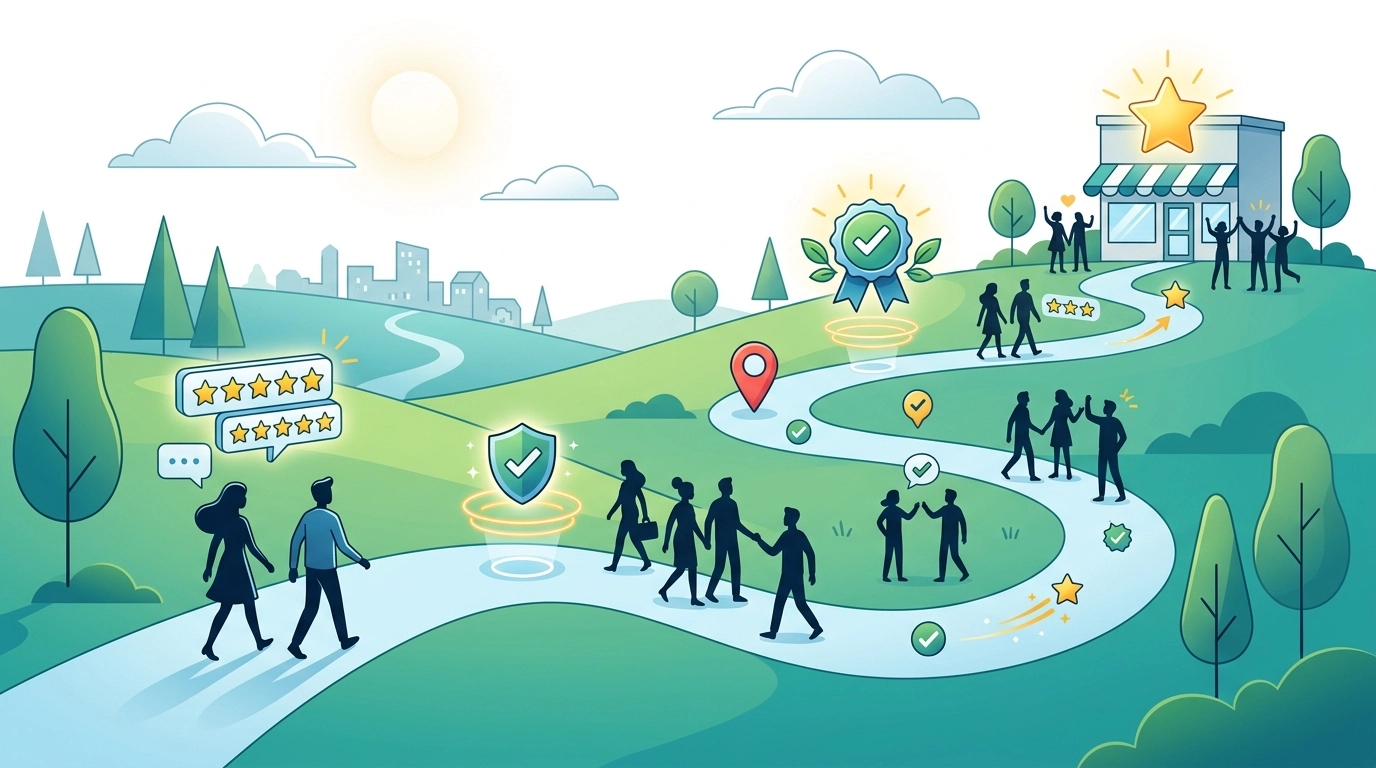
In 2026, the consumer has developed a highly sophisticated “BS detector.” With AI-generated content flooding the web, humans are over-indexing on signals of real expertise. This is what we call the Trust Filter.
To pass through this filter, your digital marketing agency for small business partner should help you focus on E-E-A-T (Experience, Expertise, Authoritativeness, and Trustworthiness) more than ever. This isn’t just about adding an author bio; it’s about citing original data, sharing behind-the-scenes processes, and demonstrating a track record of solving real problems.
Depth Over Breadth: The 2026 Ratio
A common mistake in modern content strategy is trying to be everywhere at once with surface-level content. Data from 2026 shows that depth is the primary driver of ROI. In fact, long-form articles (2,000+ words) receive 77% more backlinks than short posts.
The most effective strategy today is a “Hub and Spoke” model:
- The Hub: A massive, authoritative guide that solves a major problem.
- The Spokes: 10-15 smaller pieces (short-form videos, social posts, FAQs) that point back to the hub.
By focusing on one deep pillar, you provide enough “semantic weight” for AI tools to recognize you as an authority. You aren’t just writing for people; you are building a knowledge graph for the machines that serve them.
Practical Steps for Implementation
Transitioning to an intent-based blueprint doesn’t happen overnight. It requires a shift in how you measure and create content.
- Audit for Outcome, Not Ranking: Look at your top-performing pages. Are they actually helping a user complete a task, or are they just defining a term?
- Structured Data is Non-Negotiable: Ensure your site uses Schema markup for FAQs, Products, and Reviews. This makes your “ingredients” readable for AI search agents.
- Incorporate “Real Human” Proof: Embed user-generated content and video case studies directly into your long-form guides.
- Solve the “Next Question”: Don’t just answer the search query. Predict what the user will need to do next and provide the link or tool to do it.

The Future of Discoverability
As we look toward the remainder of 2026, the businesses that thrive will be those that stop fighting the algorithm and start embracing the user’s intent. Search has become a conversation. Content has become a utility. By mapping your strategy to the specific tasks your customers are trying to achieve, you position your brand as more than a vendor: you become an essential part of their digital ecosystem.
Building this authority takes precision and a commitment to quality over volume. It is about being the most useful answer, regardless of where the question is asked.
What is the difference between search intent and keywords?
Keywords are the specific words a user types into a search bar. Search intent is the reason they typed those words. In 2026, search engines and AI focus on the intent (e.g., “how do I fix this?”) rather than just the words used, meaning content must be more helpful and less repetitive.
How does AI search affect my website traffic?
AI search tools often provide “zero-click” answers, which can reduce top-of-funnel traffic. However, the traffic that does click through is usually much higher in intent and further along in the buying process, leading to better conversion rates.
Should I stop writing short blog posts?
Short posts still have a place for news or quick updates. However, for long-term SEO and authority, investing in deep, comprehensive “pillar” content is more effective for building backlinks and appearing in AI summaries.
Why is social search important for B2B businesses?
Even in B2B, buyers use platforms like LinkedIn, YouTube, and Reddit to validate a company’s claims. They look for peer reviews and real-world demonstrations to reduce the risk of a high-ticket purchase.
What is the “Hub and Spoke” content model?
It is a strategy where you create one central, in-depth “Hub” page on a broad topic and then link it to several “Spoke” pages that cover more specific, related sub-topics. This helps search engines understand your topical authority.