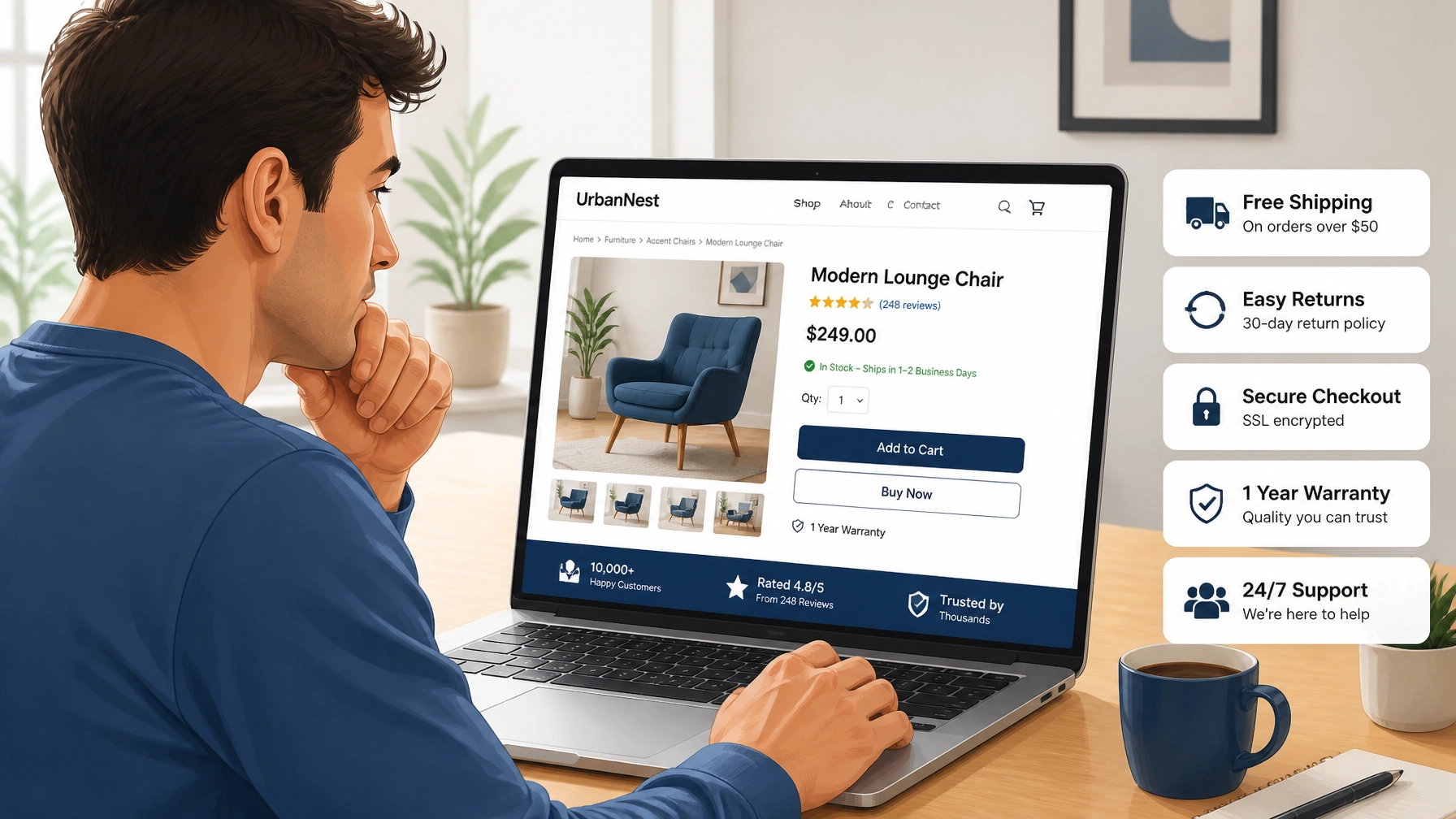
Think about the last time you hovered over a “Buy” button for a premium product, perhaps a $200 candle, a high-end espresso machine, or a subscription to a specialized masterclass. You likely had the budget, and you certainly had the interest. Yet, you hesitated.
In e-commerce, we often blame that hesitation on “friction.” We assume the shipping was too slow, the price was too high, or the checkout process had too many steps. But frequently, the real barrier is invisible. It’s not about the product’s utility; it’s about your own identity. You weren’t asking, “Does this candle smell good?” You were asking, “Am I the kind of person who spends $200 on a candle?”
This is the Identity Gap. It is the psychological distance between who a shopper is today and the version of themselves they want to become. If your marketing doesn’t bridge that gap, no amount of discounting will close the sale.
Understanding the Four Dimensions of Self-Congruity
To move a shopper from curiosity to conversion, you have to understand that every purchase is a vote for a specific identity. Social psychologists refer to this as “Self-Congruity Theory.” It suggests that consumers don’t just evaluate a product based on its features; they compare the brand’s “personality” to their own self-concept.
Modern e-commerce buying behavior typically falls into four categories of identity:
- Actual Self: “This product matches how I see myself right now.”
- Ideal Self: “This product matches who I want to be.”
- Social Self: “This product matches how others see me.”
- Ideal Social Self: “This product matches how I want others to see me.”
When a shopper abandons their cart, they are often experiencing “identity risk.” They fear that the purchase is a “mismatch”, that owning the product will feel like wearing a costume that doesn’t fit. As we discussed in The Performance Mirage, even the best-targeted ads will fail if they reach the right person but offer them the wrong identity.
“Self-congruity theory explains that consumers prefer brands whose symbolic image matches how they see themselves or want to be seen. When self-congruity is high, consumers show more favorable attitudes, emotional attachment, and long-term loyalty.” , Journal of Consumer Research Findings (2024)
Bridging the Gap with Social Proof and Community
If the Identity Gap is the problem, social proof is the bridge. But most brands use social proof incorrectly. They treat reviews as a way to prove the product works. While that’s important, the more powerful use of social proof is to prove the product belongs.

When a shopper sees user-generated content (UGC) from someone who looks, acts, and lives like them, the Identity Gap shrinks. They stop thinking, “I’m not the kind of person who buys this,” and start thinking, “People like me use this to become people like that.”
This is where The Clarity Advantage comes into play. Clarity isn’t just about big buttons; it’s about clear representation. If your imagery only shows one “type” of person, you are accidentally signaling to everyone else that your product isn’t for them.
Using Micro-Commitments to Ease the Identity Shift
Asking someone to buy a $1,000 skincare system is asking them to make a massive identity shift overnight. They have to go from “someone who ignores their skin” to “someone who follows a 10-step luxury regimen.” That is a lot of psychological weight.
Micro-commitments, like quizzes, style finders, or simple surveys, act as an “identity onboarding” process.
- The Quiz: “Find your professional aesthetic.”
- The Finder: “Which coffee roast matches your morning ritual?”
- The Survey: “What kind of explorer are you?”
By answering these questions, the shopper is actively defining their identity in relation to your brand. They aren’t just giving you data; they are convincing themselves that they belong in your world. By the time they reach the product page, the “identity risk” has already been neutralized.

Identity-Denying vs. Identity-Affirming Experiences
The difference between a store that struggles and one that dominates often comes down to how they handle these subtle psychological cues.
| Feature | Identity-Denying (High Friction) | Identity-Affirming (High Conversion) |
|---|---|---|
| Messaging | “Buy this product because it is 20% off.” | “Join the community of creators who use this.” |
| Imagery | Staged, generic stock photos. | Relatable, real-world usage from diverse peers. |
| Navigation | Product-focused (e.g., “Men’s Shoes”). | Persona-focused (e.g., “For the Urban Explorer”). |
| Social Proof | Five stars and “Works great!” | “I finally feel like the professional I wanted to be.” |
| Emails | Generic “We miss you” coupons. | Segmented content based on their stated goals. |
Post-Purchase: Validating the New Identity
The sale doesn’t end at the checkout. In fact, the most critical moment for trust-building happens immediately after the purchase. This is where buyers’ remorse sets in, another form of identity risk. The customer wonders, “Did I just make a mistake? Is this really me?”
Your post-purchase experience should be designed to validate their new identity. Your confirmation emails shouldn’t just say “Order #1234 is confirmed.” They should say, “Welcome to the club. You’re now part of a group that values [Identity Trait].”
This is why The Silent Signal of strategic email marketing is so effective. It’s not about pushing the next sale; it’s about reinforcing the current one. If you can make the customer feel like their purchase was a smart, identity-consistent move, they won’t just keep the product, they’ll become a loyal advocate.

The Strategic Shift
Modern e-commerce is no longer just a game of logistics and pricing. It is a game of psychology and belonging.
Stop asking how you can make your product cheaper. Start asking how you can make your product more “congruent” with the person your customer wants to be. When you bridge the Identity Gap, you aren’t just selling a product, you’re helping your customer become the best version of themselves. And that is a value proposition that no discount code can beat.
How does identity-based marketing differ from traditional demographic targeting?
Demographic targeting looks at external traits like age, location, and income. Identity-based marketing looks at internal self-concept, how a person perceives themselves and their aspirations. Two people with the same demographics might have completely different identities; one may see themselves as a “budget-conscious pragmatist” while the other is an “early-adopting trendsetter.” Your marketing must speak to the identity, not just the age bracket.
What is the best way to start using identity cues if I have a small brand?
Start with your imagery and your “About Us” page. Move away from generic product shots and show the product being used by the specific “persona” you want to attract. Use language that reflects the values of that persona. If you are selling to high-performers, use words like “efficiency,” “edge,” and “precision.” If you are selling to hobbyists, use words like “joy,” “discovery,” and “community.”
Can identity-based marketing backfire?
Yes, if it feels inauthentic. Customers have a high “BS detector” for brands that try to adopt an identity that doesn’t match their actual product quality or company values. This is why transparency and clarity are essential. You cannot simply “claim” an identity; you have to facilitate it through every touchpoint of the customer journey.
Why do micro-commitments work so well for expensive products?
Expensive products carry higher “identity risk.” By using a quiz or a consultation, you are lowering the barrier to entry. The customer isn’t committing to a $2,000 purchase yet; they are only committing to learning more about themselves. Each small “yes” during the quiz builds momentum and makes the final “yes” at checkout feel like a natural conclusion rather than a risky leap.