
If you spent your morning clearing out an inbox filled with “Checking in” notes and “Just following up” pings, you’re already behind. By 2026, the way we interact with email has fundamentally shifted. We no longer live in an era where users dutifully scroll through every subject line to find a nugget of value. Instead, we’ve entered the age of the zero-click inbox.
In this new landscape, your primary audience isn’t actually a human, it’s an AI agent. Whether it’s Google’s Gemini, Apple Intelligence, or specialized tools like Shortwave, an AI is now standing between your business and your customer’s eyeballs. This agent decides what is “urgent,” what is “noise,” and what gets summarized into a three-bullet-point notification on a smartwatch.
For local businesses like dental clinics or HVAC companies, this change is a double-edged sword. If you optimize for it, you’ll stay top-of-mind. If you ignore it, your carefully crafted newsletters will rot in a “Promotions” folder that no human will ever open again.
The Reality of the AI Filter
The numbers tell a sobering story. Research into digital communication trends in early 2026 indicates that nearly 76% of all incoming email is classified as “noise” by modern mail servers. Even more telling is that 40% of professional employees carry a permanent backlog of at least 50 unread emails, even with AI assistance.

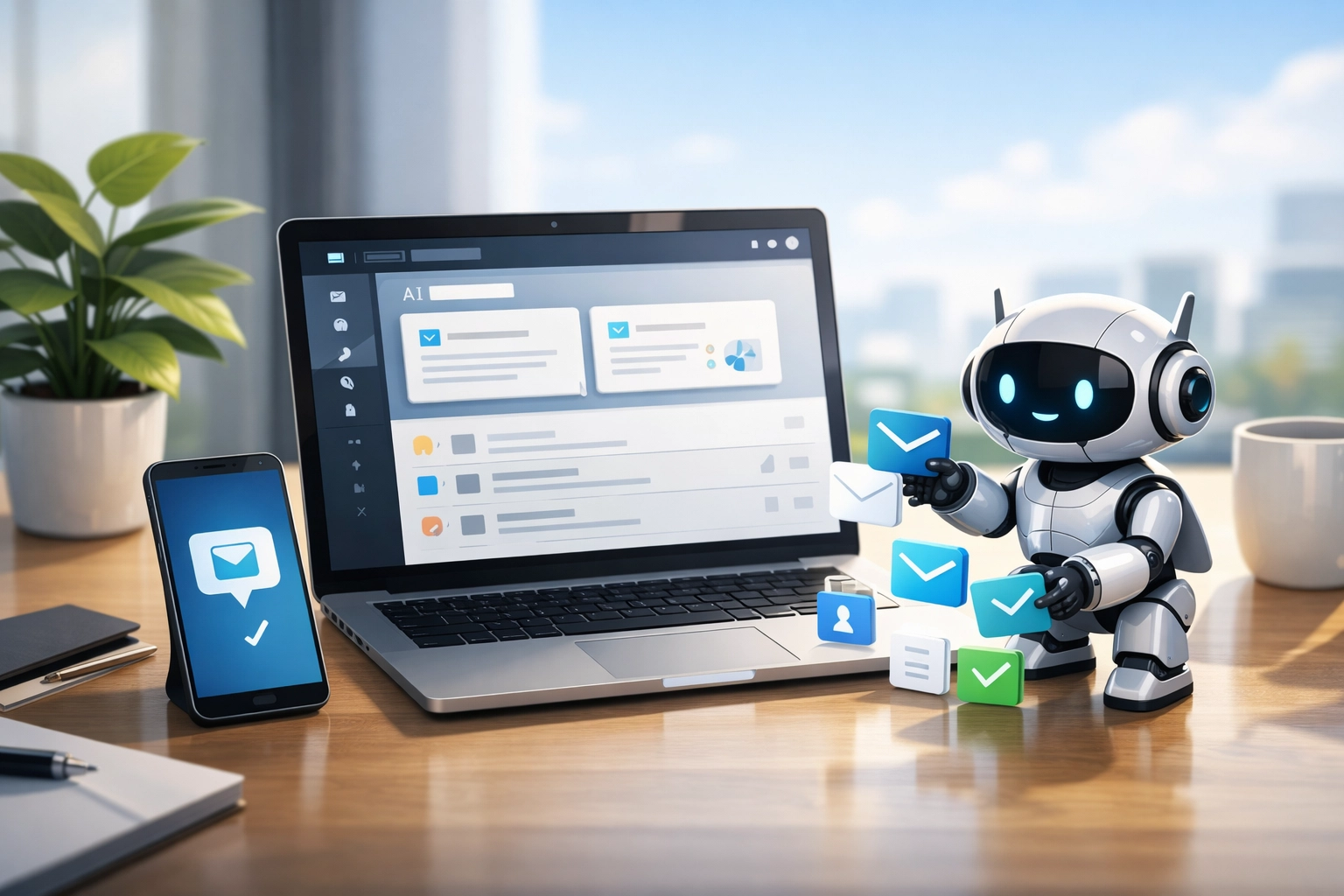
A landscape cartoon showing a friendly AI robot sorting floating email envelopes into two trays—urgent vs later—inside a bright home office.
The AI doesn’t just block spam; it prioritizes intent. If a customer has been searching for “emergency tooth extraction” and your clinic sends an appointment reminder, the AI flags that as high priority. If you’re just sending a generic monthly tip about flossing, it’s going to the summary pile.
“The 2026 email ecosystem prioritizes ‘Actionable Intelligence’ over ‘Information Volume.’ Systems like Gmail’s Gemini-powered triage now automatically draft replies and summarize threads before the user even opens the app, making machine-readability the new SEO for the inbox.” , Inspired by Litmus 2026 Email Engagement Reports.
Machine-Readability: The New Secret Weapon
To survive in a zero-click world, your emails must be “scannable” by machines. This means moving beyond pretty graphics and focusing on Schema Markup. Just as you use Local SEO strategies to help Google understand your physical location, you need to use email schema to help AI agents understand your message’s purpose.
When a contractor sends a quote via email, the AI should be able to extract the price, the service date, and the “Approve” button without the customer ever reading the body text. This is what we call machine-readability.
| Feature | Traditional Email (2022) | AI-Optimized Email (2026) |
|---|---|---|
| Primary Goal | High Open Rate | High Intent Extraction |
| Success Metric | Click-Through Rate (CTR) | Action Completion / Summary Placement |
| Content Focus | Catchy Subject Lines | Schema Markup & Contextual Data |
| Visuals | Image-Heavy Layouts | Clean, Text-First, Machine-Readable |
| User Action | Manual Reading & Clicking | AI-Drafted Approval / Calendar Sync |
Why Your Local Business Needs a “Zero-Click” Strategy
Think about a local dental practice. In the old days, you’d send an email saying, “It’s time for your cleaning!” and hope they’d click a link to your booking software. In 2026, that’s too much friction.
Today, your email needs to trigger the user’s AI assistant to say: “You have a dentist appointment suggestion for Tuesday at 2 PM. Should I add it to your calendar and reply ‘Yes’?”
The user clicks once on their watch, and the job is done. No website visit, no login, no manual typing. This level of frictionless interaction is what separates the thriving businesses from the ones wondering why their “marketing” isn’t working anymore. This is very similar to how AI-driven Google Ads now focus on predicting user behavior rather than just bidding on keywords.

A landscape cartoon of a busy homeowner approving a local service quote with a single tap on a smartwatch in a bright modern kitchen.
The Technical Implementation: Beyond the Subject Line
How do you actually build a “scannable” email? It starts with the “Headless Content” approach. Your emails should contain a hidden layer of JSON-LD data. This data tells the AI exactly what the email is about.
- Event Reservations: For dentists and service pros, use schema to define appointment times.
- Order Tracking: For e-commerce, ensure the AI can see the shipping status without clicking a tracking link.
- One-Tap Actions: Use “Action” schema to embed buttons like “Confirm,” “Review,” or “Pay Now” directly into the inbox preview.
In practice, this means your email shouldn’t just be a PDF invoice attached to a blank message. It should be a structured data packet that the AI can interpret as a “Payment Request.”
From Clicks to Conversations
We are seeing a shift where “Open Rates” are becoming a vanity metric. If an AI summarizes your email for a client, the email might never technically be “opened” in the traditional sense, but the message was successfully delivered.
That said, the content still matters. The AI is looking for relevance. If your content is consistently marked as “Not Useful” by the AI (because the human never interacts with the summaries), your sender reputation will tank.
For local contractors, this means your “Information” emails, like “How to prep your pipes for winter”, need to be high-value and sent at the exact moment the local weather forecast predicts a freeze. Context is the only way to bypass the “Noise” filter.

A landscape cartoon showing two clean server racks exchanging a structured data “schema” concept using simple geometric icons—bright, minimal, and uncluttered.
Strategic Takeaways for 2026
To stay ahead, local business owners should focus on these three pillars:
- Audit Your Automation: Are your emails sent from a generic “noreply” address with zero structure? If so, the AI will likely deprioritize them.
- Implement Schema: Work with your dev team or agency to ensure your booking and billing emails use JSON-LD.
- Focus on Intent: Stop sending “Monthly Newsletters” that nobody asked for. Shift to “Event-Triggered” emails that provide immediate value or solve a specific problem.
By mastering the zero-click inbox, you aren’t just sending mail; you’re integrating your business into your customer’s life through their most trusted digital advisor: their AI.
Q&A
Does a zero-click inbox mean people won’t visit my website anymore?
Not necessarily, but it means they will only visit your website when they need to perform a complex task. For simple things, like booking a cleaning or approving a quote, the transaction will happen inside the inbox or via an AI summary. Your website needs to become a high-conversion hub for those complex interactions, rather than a mandatory stop for every minor task.
Is schema markup hard to implement for a small business?
It can be technical, but most modern email marketing platforms and booking softwares (like those used by dentists and contractors) are starting to integrate these features natively. If you’re using a custom solution, you may need an expert to add the JSON-LD code to your templates.
Will my emails still look “pretty” to humans?
Yes. Schema markup is invisible to the human eye. Your email can still have your branding, colors, and photos. The machine-readable layer sits in the background, ensuring that even if the human doesn’t look at the “pretty” version, the AI still knows exactly what to do with the information.
How does this affect my spam rating?
Actually, it helps. AI filters are more likely to trust emails that are transparent about their purpose. By providing clear, structured data, you’re proving to the mail server that you aren’t trying to hide malicious links behind “clickbait” subject lines.
Is the “subject line” officially dead?
No, but its role has changed. It’s now a “label” for the AI as much as a “hook” for the human. It should be descriptive and data-rich (e.g., “Your HVAC Quote: $450 – Approval Needed” instead of “Big Savings Inside!”).


