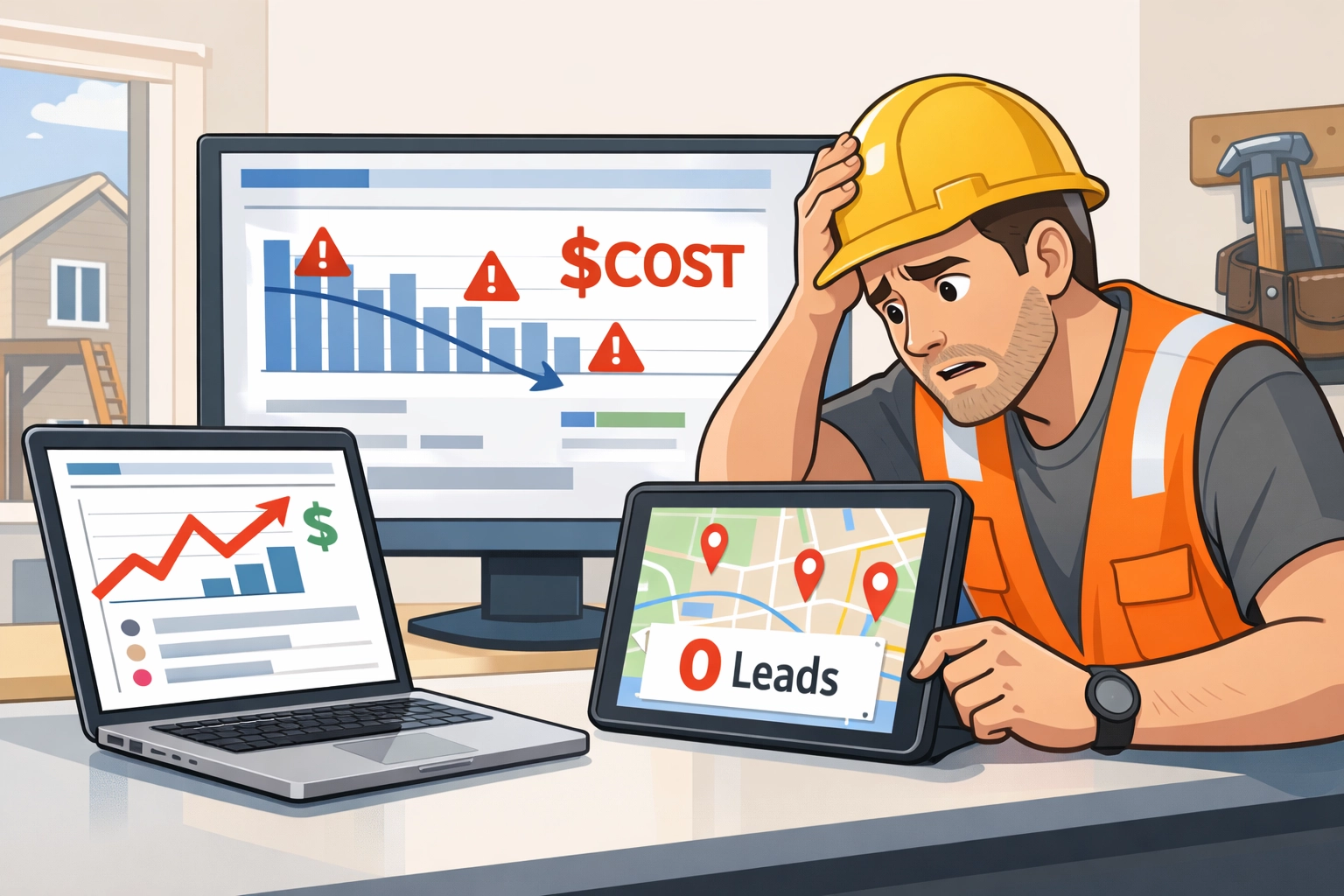
You’re getting clicks. The ad spend is climbing. But the phone isn’t ringing with qualified leads.
If you’re a local contractor running Google Ads in 2026, you’re competing in one of the most expensive digital advertising spaces. The average cost-per-click for home services keywords ranges from $15 to $50, and in competitive metros, it can climb even higher. When every click costs serious money, structural mistakes in your campaigns don’t just reduce performance: they drain your budget fast.
We’ll walk through the five most common Google Ads mistakes local contractors make, why they’re costing you qualified leads, and exactly how to fix them. These aren’t minor optimizations: they’re foundational issues that, when corrected, can cut your cost-per-lead in half while doubling the quality of inquiries coming through.

Why Are Your Google Ads Showing to People Who’ll Never Hire You?
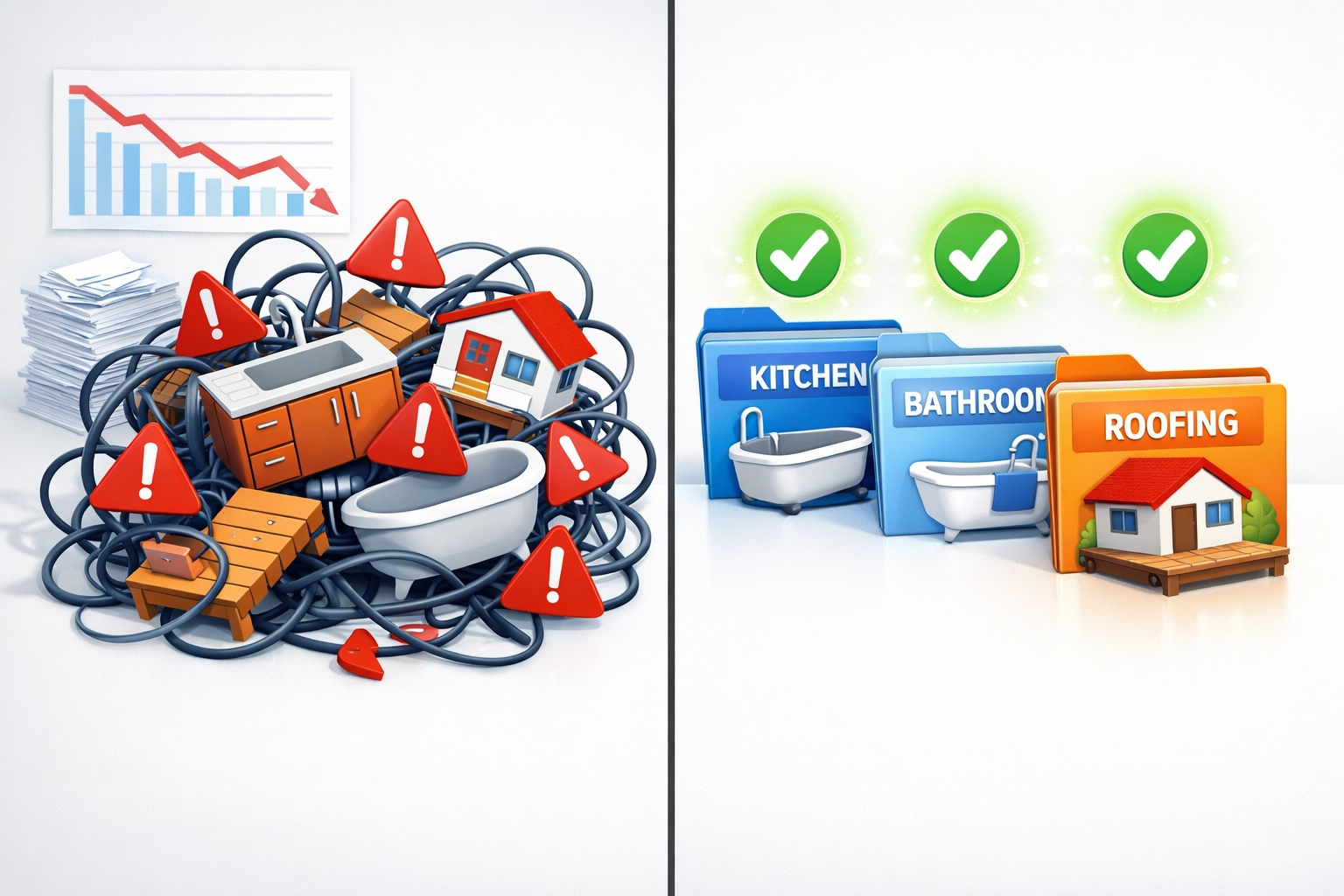
Poor campaign structure is the silent budget killer. Most contractors throw every service into one campaign or ad group: kitchen remodels, bathroom renovations, roofing repairs, deck builds, and flooring installs all lumped together. This confuses Google’s matching system and creates a fundamental targeting problem.
Here’s what happens: someone searches “emergency roof repair near me”: high intent, urgent need, ready to hire. Your ad appears, they click, and you pay $35. But your ad was written for general home remodeling services, and your landing page shows all your work, from custom kitchens to landscaping. The searcher bounces in eight seconds because you didn’t speak to their specific problem.
“Campaigns with tightly themed ad groups see up to 50% higher Quality Scores and significantly lower cost-per-click compared to loosely organized campaigns.” : Google Ads Best Practices Guide, 2025
The solution is service-specific campaign segmentation. Break your advertising into distinct campaigns for each major service line.
| Campaign | Example Keywords | Landing Page Focus |
|---|---|---|
| Kitchen Remodeling | kitchen remodel contractor, kitchen renovation near me | Kitchen-specific portfolio, before/after photos, kitchen testimonials |
| Bathroom Renovation | bathroom remodel, bathroom contractor near me | Bathroom projects, tile work, shower installations |
| Roofing Services | roof repair, roof replacement contractor | Roofing materials, warranty information, emergency service |
| Home Additions | room addition contractor, second story addition | Addition portfolio, permit expertise, structural work |
This structure improves keyword relevance, increases Quality Score, lowers your cost-per-click, and most importantly, delivers searchers to pages that directly answer their specific need. Your ad copy can speak directly to their problem, and your landing page can present exactly what they’re looking for.
Are Broad Match Keywords Draining Your Budget on Junk Traffic?
Broad match keywords without proper controls are the fastest way to burn through your daily budget before lunch. Contractors often bid on terms like “home remodeling” or “contractor services” thinking they’re casting a wide net for customers. Instead, they’re attracting tire kickers, DIYers, people looking for free advice, and searchers with zero intent to hire.
When you use broad match on “home remodeling,” Google shows your ads for:
- “DIY home remodeling ideas”
- “home remodeling cost calculator”
- “home remodeling TV shows”
- “free home remodeling estimates” (people shopping for free quotes with no intent to buy)
- “home remodeling financing options” (researchers not ready to commit)
Each click costs money. None of these searchers are ready to hire you.
The fix requires two actions: tighter keyword match types and a robust negative keyword list.
Negative keywords you should add immediately:
- DIY, do it yourself, how to, tutorial, ideas
- Free, cheap, budget, affordable, low cost
- Software, app, course, book, magazine
- Jobs, hiring, careers, employment
- Wholesale, supply, materials (unless you sell them)
- Permits, regulations, code (informational searches)
Start with phrase match and exact match keywords for high-intent terms. Save broad match for remarketing or when you have conversion data proving certain broad terms deliver qualified leads. In practice, most successful contractor campaigns use 70-80% phrase and exact match keywords.
| Match Type | Example | When to Use |
|---|---|---|
| Exact Match | [kitchen remodeling contractor] | High-intent commercial keywords |
| Phrase Match | “bathroom renovation near me” | Location-specific service searches |
| Broad Match Modified | Removed by Google in 2021 | No longer available |
| Broad Match | kitchen remodel | Only with extensive negative keyword lists and proven conversion data |
This shift eliminates wasted spend on informational searches and focuses your budget on people ready to request estimates.

How Can You Optimize What You’re Not Measuring?
Running Google Ads without conversion tracking is like driving blindfolded. You see clicks and spend, but you have no visibility into which keywords, ads, or campaigns actually generate leads, schedule consultations, or close jobs.
Most contractors track basic metrics: impressions, clicks, click-through rate: but stop there. The critical question isn’t “how many clicks did I get?” It’s “which clicks turned into paying customers?”
“Businesses that implement comprehensive conversion tracking see 30% better ROI from paid search campaigns compared to those tracking only clicks and impressions.” : WordStream Advertising Benchmarks Report, 2025
Set up conversion tracking for every meaningful action:
- Primary conversions: Contact form submissions, phone calls from ads, “request estimate” button clicks
- Secondary conversions: Email newsletter signups, project gallery views, financing page visits
- Revenue tracking: Actual job value when available (use CRM integration)
Google Ads allows phone call tracking through forwarding numbers that log when someone calls directly from your ad. This is critical for contractors where 60-70% of leads come through phone calls rather than forms.
Once tracking is active, you gain visibility into which services generate profitable leads. You might discover that “deck building” keywords cost $20 per click but convert at 8%, while “kitchen remodel” costs $45 per click but converts at 3%. Without this data, you’re guessing. With it, you know exactly where to invest.
For contractors serious about ROI, consider reading our detailed guide on tracking local phone leads and turning data into revenue.
Why Is Your Homepage Killing Your Conversion Rate?
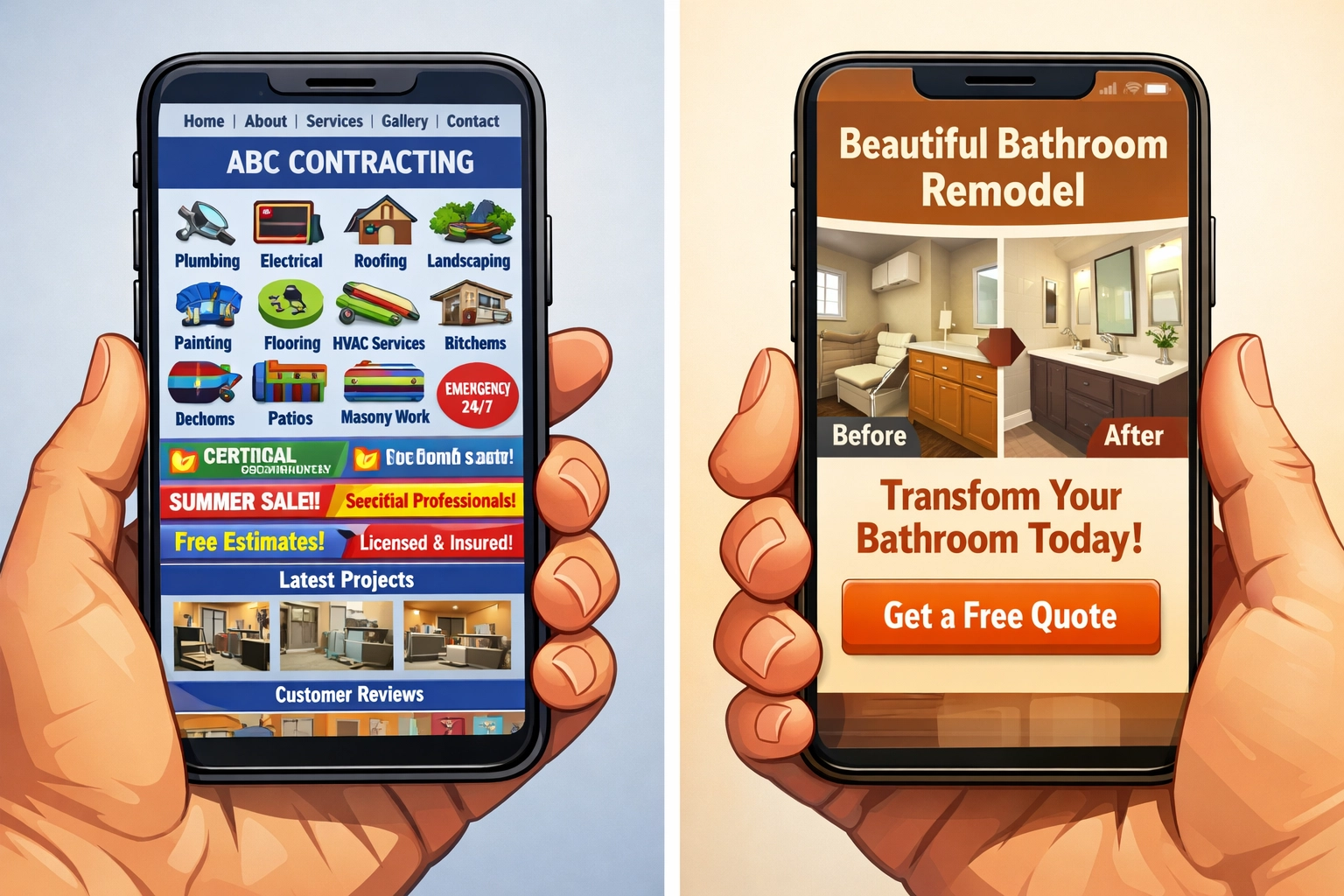
You’re paying $40 for a click from someone searching “bathroom remodeling contractor near me”: a searcher with clear intent, ready to evaluate options. They click your ad and land on your homepage, which displays your company logo, a generic tagline about “quality craftsmanship,” a slideshow of various projects, and links to 12 different services.
The searcher wanted bathroom information. You gave them everything except a clear path forward for bathroom projects. They leave within seconds to find a competitor who speaks directly to their need.
This is the landing page disconnect, and it destroys conversion rates. Your homepage serves as a general introduction to your business. That’s fine for organic traffic and brand searches, but paid search traffic: where you’re spending significant money per click: requires dedicated, service-specific landing pages.
What a high-converting contractor landing page includes:
- Service-specific headline matching the ad and search intent
- Immediate visual proof: 3-5 before/after project photos for that specific service
- Clear, singular call-to-action: “Schedule Your Free Kitchen Consultation”
- Service-specific testimonials and reviews
- Trust signals: licenses, insurance, years in business, guarantees
- Simple contact form (name, phone, project timeline)
- Expected investment range to pre-qualify leads
Here’s the performance difference:
| Landing Page Type | Avg. Conversion Rate | Cost per Lead |
|---|---|---|
| Homepage | 1-2% | $800-$2,000 |
| Service-Specific Page | 5-8% | $250-$600 |
| Optimized Service Page with Social Proof | 8-12% | $150-$400 |
The numbers speak clearly. A dedicated landing page for each major service can triple your conversion rate, which means the same budget generates three times more leads. That said, this doesn’t happen automatically: the page must be well-designed, mobile-optimized, and focused on one clear action.
Contractors looking to improve landing page performance should explore UX tweaks that turn websites into lead machines.
What Happens When You Launch Campaigns and Walk Away?
The “set it and forget it” approach kills Google Ads profitability faster than any other mistake. Contractors launch campaigns, see some initial leads, and assume the system will run itself. Meanwhile, competitors are actively optimizing, search behavior is evolving, and your campaigns are slowly becoming less effective.
Google Ads is an auction system. Your competitors adjust bids, refine targeting, test new ad copy, and improve landing pages. If you’re not actively managing your campaigns, you’re falling behind: and paying more for worse results.
Campaign optimization requires ongoing attention to:
- Search term reports: Review every 7-14 days to identify new negative keywords and high-performing search phrases
- Bid adjustments: Increase bids on converting keywords, decrease or pause underperformers
- Ad copy testing: Run A/B tests on headlines and descriptions to improve click-through rates
- Quality Score monitoring: Low Quality Scores increase your costs; address them immediately
- Device and location performance: Adjust bids based on conversion rates by device and geography
- Seasonal adjustments: Construction and remodeling demand fluctuates; your budget should too
For example, if you notice “emergency roof repair” searches spike during storm season, you should temporarily increase budget allocation to roofing campaigns during those periods. If mobile traffic converts 40% worse than desktop, you should bid 30-40% less on mobile clicks.
The difference between managed and unmanaged campaigns is substantial:
| Management Approach | Monthly Time Investment | Avg. Cost per Lead | Lead Quality |
|---|---|---|---|
| Set-and-forget | 0-1 hours | $900-$1,500 | Low to Medium |
| Basic monthly review | 2-4 hours | $600-$900 | Medium |
| Active weekly optimization | 4-8 hours | $300-$600 | Medium to High |
| Professional management | Outsourced | $250-$500 | High |
Active management doesn’t mean obsessing over campaigns daily. It means scheduled weekly reviews, systematic testing, and data-driven adjustments. If you lack the time or expertise, professional management often pays for itself through improved performance.
For a deeper dive into what matters when evaluating Google Ads performance, check out our analysis on what ROI-focused businesses need to know about wasted ad spend.

The Real Cost of These Mistakes
These five mistakes compound over time. Poor campaign structure leads to irrelevant clicks. Broad keywords without controls multiply that waste. No conversion tracking means you can’t identify the problems. Generic landing pages fail to convert the few qualified clicks you do get. And without ongoing optimization, performance slowly degrades.
A contractor spending $3,000 monthly on Google Ads with these issues might generate 75 clicks at $40 each, convert 2 of those into leads, and close 1 job. That’s a $3,000 cost-per-customer before accounting for job value.
The same $3,000 budget with proper structure, controlled keywords, conversion tracking, dedicated landing pages, and active management might generate 120 clicks at $25 each, convert 10 into leads, and close 4 jobs. That’s $750 cost-per-customer: a 4x improvement.
The framework isn’t complicated. It requires systematic implementation:
- Restructure campaigns by service line
- Implement phrase and exact match keywords with comprehensive negative keyword lists
- Install conversion tracking for forms, calls, and revenue
- Build service-specific landing pages optimized for single clear actions
- Schedule weekly reviews and monthly strategic adjustments
These changes transform Google Ads from a frustrating expense into a predictable lead generation channel that scales with your business.
What’s the biggest mistake contractors make with Google Ads?
The biggest mistake is treating Google Ads as a passive lead source. Contractors launch campaigns, see some initial activity, and assume the platform will automatically deliver leads. In reality, Google Ads requires active management, continuous testing, and systematic optimization to remain profitable: especially in competitive home services markets where cost-per-click can exceed $40.
How much should a contractor spend on Google Ads monthly?
Budget depends on market competitiveness, service area size, and business capacity. Most local contractors see meaningful results starting at $2,000-$3,000 monthly, which typically generates 50-100 clicks in moderately competitive markets. The key isn’t total spend: it’s ensuring every dollar is allocated to high-intent keywords with proper tracking and optimized landing pages.
Should contractors use broad match keywords in 2026?
Broad match can work when paired with extensive negative keyword lists, conversion tracking, and proven historical performance data. However, most contractors see better results starting with phrase match and exact match keywords for high-intent commercial searches. Broad match tends to generate too much irrelevant traffic without careful management.
How long does it take to see results from Google Ads?
Initial data appears within days, but meaningful optimization requires 30-60 days to accumulate enough conversion data for strategic decisions. Campaigns typically hit optimal performance after 90 days of active management, testing, and refinement. Contractors should plan for a 3-month ramp period before judging campaign profitability.
What conversion rate should contractors expect from Google Ads traffic?
Conversion rates vary significantly by service, market, and landing page quality. A well-optimized service-specific landing page should convert 5-10% of paid search traffic into leads (form submissions or phone calls). Homepage traffic typically converts at 1-3%. If your conversion rate is below 3%, investigate landing page experience and keyword relevance before increasing budget.
Do contractors need separate landing pages for every service?
For major service lines: kitchen remodeling, bathroom renovation, roofing, additions: dedicated landing pages significantly improve conversion rates. Minor services can often share landing pages if they’re closely related. The principle is matching searcher intent: if someone searches for a specific service, they should land on a page focused exclusively on that service with relevant examples, testimonials, and calls-to-action.