For decades, the path to local discovery was linear: a customer felt a need, opened a browser, and typed a query into a search bar. Today, that journey has fractured. As we move through 2026, the primary search engine for the next generation of spenders isn’t a white page with blue links; it’s a vertical video feed.
If you are running a local business, you’ve likely noticed that traditional SEO tactics, while still vital, are no longer the only way customers find you. Social search is the fundamental shift where platforms like TikTok and Instagram act as the new Yellow Pages. Consumers aren’t just looking for entertainment; they are looking for “best patio dining near me” or “emergency plumber in Austin.”
This evolution requires a change in your digital strategy. You are no longer just optimizing for Google’s crawlers; you are optimizing for AI-driven algorithms that prioritize visual proof and human engagement.
Understanding the Social Search Shift
The reason social search has exploded in 2026 is simple: trust. A static website can claim a business is the “best,” but a 15-second TikTok video showing a crowded restaurant or a contractor’s finished kitchen provides immediate, visual evidence.
In practice, this means your “searchable” surface area has expanded. Your Instagram captions, the words you speak in your Reels, and the text overlays on your TikToks are all being indexed by both the social platforms and Google itself.
| Feature | Traditional Search (Google) | Social Search (TikTok/Instagram) |
|---|---|---|
| Primary Format | Text and Website Links | Short-form Video and Images |
| Trust Factor | Domain Authority & Backlinks | Visual Proof & User Engagement |
| Discovery Method | Intent-based (Active Query) | Interest-based (Algorithm Feed + Search) |
| Local Signal | Google Business Profile | Geo-tags and Neighborhood Keywords |
| Ranking Speed | Slow (Weeks to Months) | Fast (Hours to Days) |

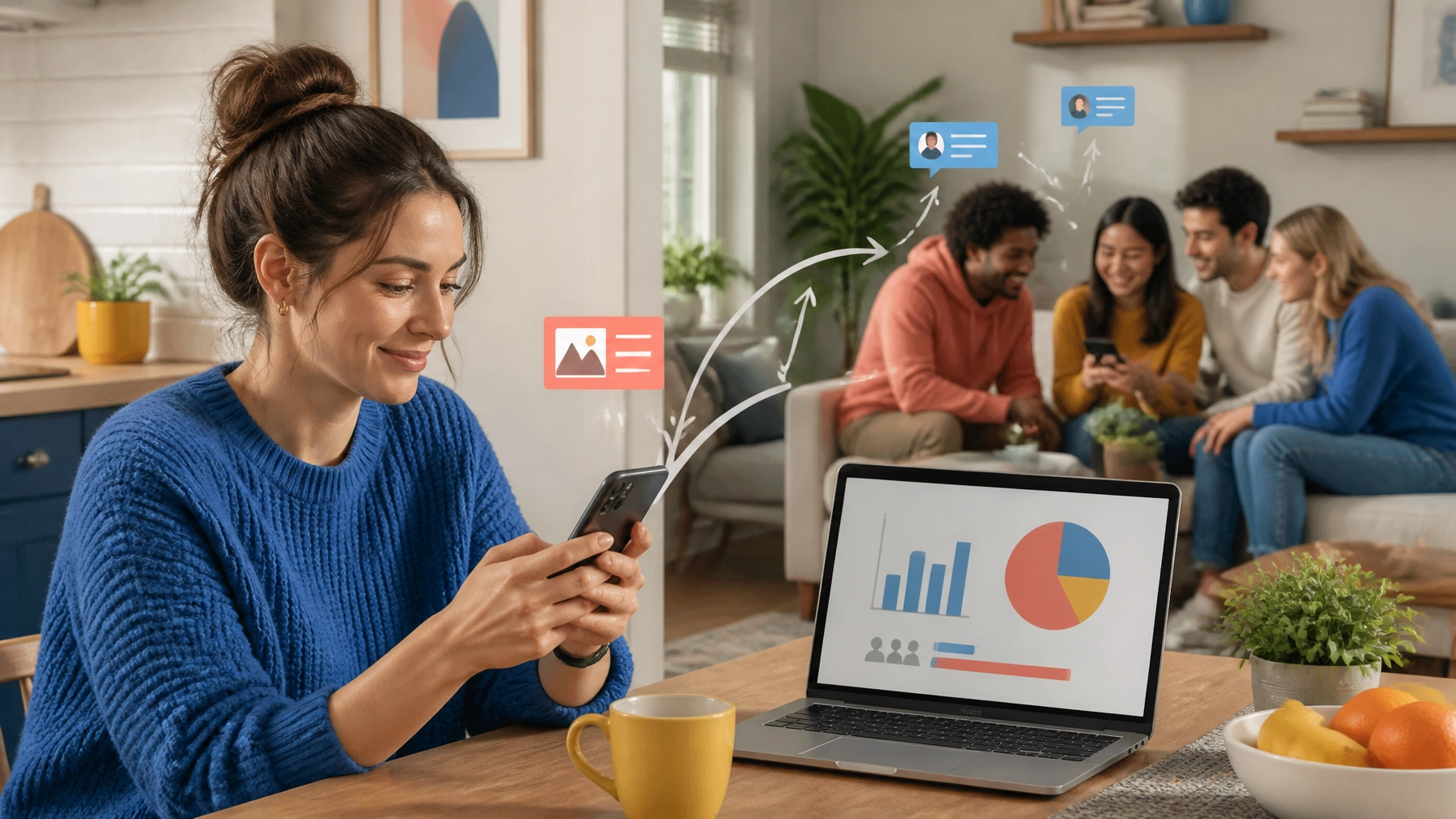
A landscape cartoon-style illustration showing a diverse group of young professionals using their smartphones to find local businesses on a stylized TikTok and Instagram interface.
Dominating TikTok for Local Visibility
TikTok has officially transitioned from a dance app to a powerful local discovery tool. By 2026, nearly 50% of American consumers use TikTok as a search engine. For a local business, the goal isn’t to go “viral” globally; it’s to rank for the right keywords in your specific city.
TikTok’s algorithm prioritizes engagement over follower count. This is great news for you. You don’t need 100,000 followers to rank at the top of a search for “local seo services” or “best hair salon.” You need high-retention content that answers a specific search intent.
To rank on TikTok, you must treat your video descriptions like meta tags. Use full sentences and incorporate your primary keywords naturally. More importantly, TikTok’s AI now “listens” to your audio and “reads” your on-screen text. If you are a contractor, saying “We’re doing a kitchen remodel in downtown Chicago” out loud in the video significantly increases your chances of appearing when someone searches for that exact phrase.
“As of early 2026, search-integrated discovery on social platforms accounts for 54% of local service leads, surpassing traditional organic web search for the first time in the small business sector.” , Global Digital Commerce Report 2026.
Instagram SEO: More Than Just Hashtags
Instagram has followed suit, transforming its search interface to mimic a more traditional search engine. In 2026, the platform relies heavily on keywords in your bio, your captions, and even the “alt text” on your images.
For local businesses, the most important lever is the Instagram Map. When you tag your location, you aren’t just letting people know where you are; you are placing yourself in a geographic index that functions similarly to your google business profile optimization.
When users search for a category like “coffee shop” in the Instagram search bar, the results are populated based on:
- Your username and profile handle.
- Keywords in your bio.
- Location tags on your most recent Reels and posts.
- The relevance of your captions to the search query.
This is where working with a digital marketing agency for small business becomes an advantage. They can help you align your social keywords with the same data-driven insights used in your local seo services to ensure a unified brand voice across the web.

A landscape cartoon-style image of a local storefront with a giant “Search” magnifying glass over it, showing social media icons popping out like localized map pins.
Integrating Social Search with Your Core SEO
Social SEO doesn’t exist in a vacuum. In 2026, the lines between social media and traditional websites are blurred. Google now frequently indexes TikTok videos and Instagram Reels directly in its search results. This means your social content can help you “leapfrog” competitors who only focus on their websites.
As you navigate The Entity Era, you’ll realize that search engines are looking for “entities”, verified businesses with a consistent presence across multiple platforms. If your business is mentioned and tagged frequently on Instagram, and those tags match the address on your website, your “entity” becomes stronger and more trustworthy in the eyes of AI.
This mirrors the shifts we’ve seen with The Rise of Agentic AI, where AI agents are sent out to find the most relevant, highly-rated service provider for a user. These agents don’t just look at your site; they look at your social proof and recent activity.
Practical Steps for Local Ranking in 2026
To stay ahead, you need to treat every post as a searchable asset. Here is how you can start optimizing for social search today:
- Optimize Your Bio: Use your primary service and location in your display name. Instead of “John’s Plumbing,” use “John’s Plumbing | 24/7 Emergency Plumber Austin.”
- Speak Your Keywords: In every video, verbally mention your location and what you are doing. TikTok and Instagram’s auto-captioning technology will index these words.
- Use On-Screen Text: The first three seconds of your video should have text that mirrors a search query, such as “How to fix a leaky faucet in 5 minutes.”
- Geo-Tag Everything: Never post without a specific location tag. If you are a service-area business, tag the specific neighborhood where the job is taking place.
- Focus on Reviews: Engagement on social media, comments, shares, and saves, acts as a modern “backlink.” Encourage your customers to tag you in their stories, as this builds local authority.

A landscape cartoon-style illustration showing a “Search Engine Results Page” where video thumbnails from social media are ranked alongside traditional website listings, with “AI Overviews” highlighting a local business.
The landscape of search is changing, but the goal remains the same: being where your customers are. By mastering social search, you ensure that your business stays visible, whether someone is searching via a voice assistant, an AI agent, or a TikTok feed. If you’re feeling overwhelmed by these shifts, remember that search in the age of AI is about authenticity and consistency.
Stay active, stay local, and keep your content searchable.
Do I really need to be on TikTok if my customers are older?
By 2026, the demographic gap on TikTok has closed significantly. While Gen Z leads the search trend, Millennial and Gen X users increasingly use the platform for practical “how-to” advice and local service recommendations. If you provide a visual or service-based solution, your audience is likely searching there.
How many hashtags should I use for SEO?
In 2026, the “less is more” rule applies. Both Instagram and TikTok suggest using 3-5 highly relevant hashtags rather than a “cloud” of 30. Focus on one for your niche (e.g., #PlumbingTips), one for your location (#AustinSmallBusiness), and one for the specific content of the video.
Does social search replace my Google Business Profile?
No. Think of social search as a “top-of-funnel” discovery tool. Many users will find you on TikTok, but they will still head to your Google Business Profile to check your official hours or call you. It is essential to maintain your google business profile optimization alongside your social efforts.
Can a small business realistically rank against big brands?
Absolutely. In fact, local businesses often have an advantage in social search because the algorithm favors geographic relevance and authentic, “unpolished” content over high-production corporate ads. Local influencers and neighborhood tags give you a “home-field advantage” that national brands can’t easily replicate. For more on this, check out our guide on why local influencer marketing works.