The search landscape has shifted beneath our feet. If you’ve looked for a local service lately: whether it’s a plumber in Chicago or a dental clinic in Austin: you’ve likely noticed that the traditional list of blue links is disappearing. In its place, Google now presents a comprehensive, AI-generated summary that answers your question before you even click a website.
By 2026, AI Overviews (formerly known as SGE) have become the primary way users interact with Google. For local business owners, this change can feel like a threat to your traffic. However, this isn’t the end of local SEO; it’s a total evolution. To stay visible, you must transition from “keyword matching” to “entity authority.”
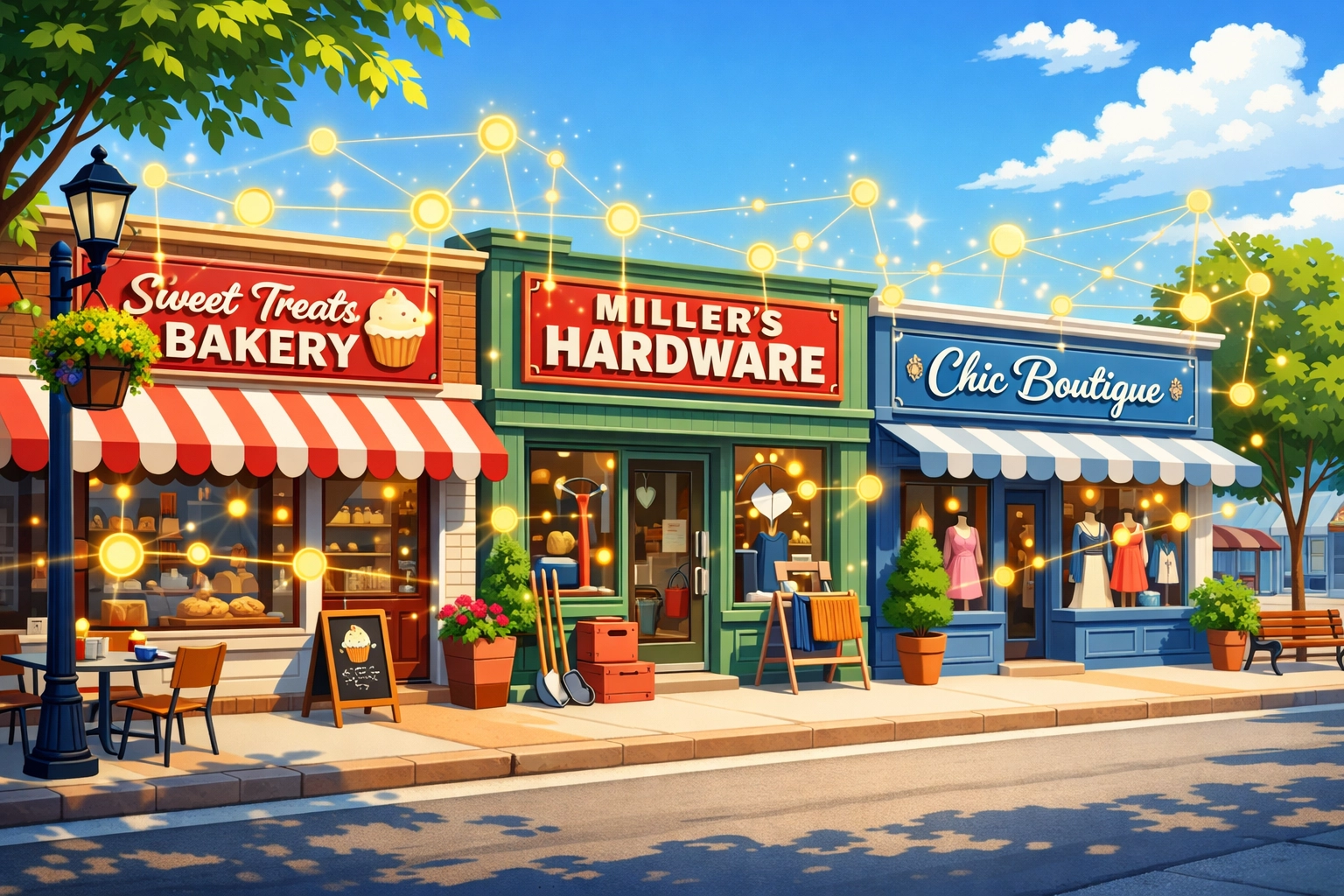
A colorful cartoon-style landscape showing a local street where digital AI sparkles hover over shop signs, highlighting how information is scanned in real-time.
The Death of the “10 Blue Links” and the Rise of AI Overviews
For two decades, the goal of SEO was simple: get to the top of page one. Today, being #1 in organic search doesn’t mean what it used to. AI Overviews now occupy the “zero position,” pulling data from various sources to provide a direct answer. If Google’s AI can explain your services, pricing, and availability without the user visiting your site, your click-through rate might drop: unless you are the source the AI is citing.
AI Overviews prioritize information density. They look for businesses that provide clear, structured, and authoritative data. This is why your digital footprint needs to be more than just a homepage. It needs to be a knowledge base.
“By 2026, autonomous AI agents will handle routine operations like inventory management, customer service, and sales qualification, potentially automating up to 70% of everyday work tasks.” : Emerging Tech Trends Report 2026
This automation extends to how customers find you. If an AI agent is booking a lawn care appointment for a homeowner, that agent isn’t scrolling through Google; it’s querying a database of trusted local entities.
How Google Maps Has Transformed into a Discovery Engine
Google Maps is no longer just a tool for directions. It has morphed into a visual, AI-driven discovery engine. With features like Immersive View and AI-curated review summaries, the “3-Pack” is more competitive than ever. Google now uses computer vision to “see” inside your business through the photos you upload and uses Natural Language Processing (NLP) to understand the sentiment in your reviews.
If a customer searches for “cozy coffee shop with fast Wi-Fi,” Google doesn’t just look for those keywords in your description. It analyzes your reviews, your menu, and even the photos of people working on laptops in your shop to confirm the “vibe.”
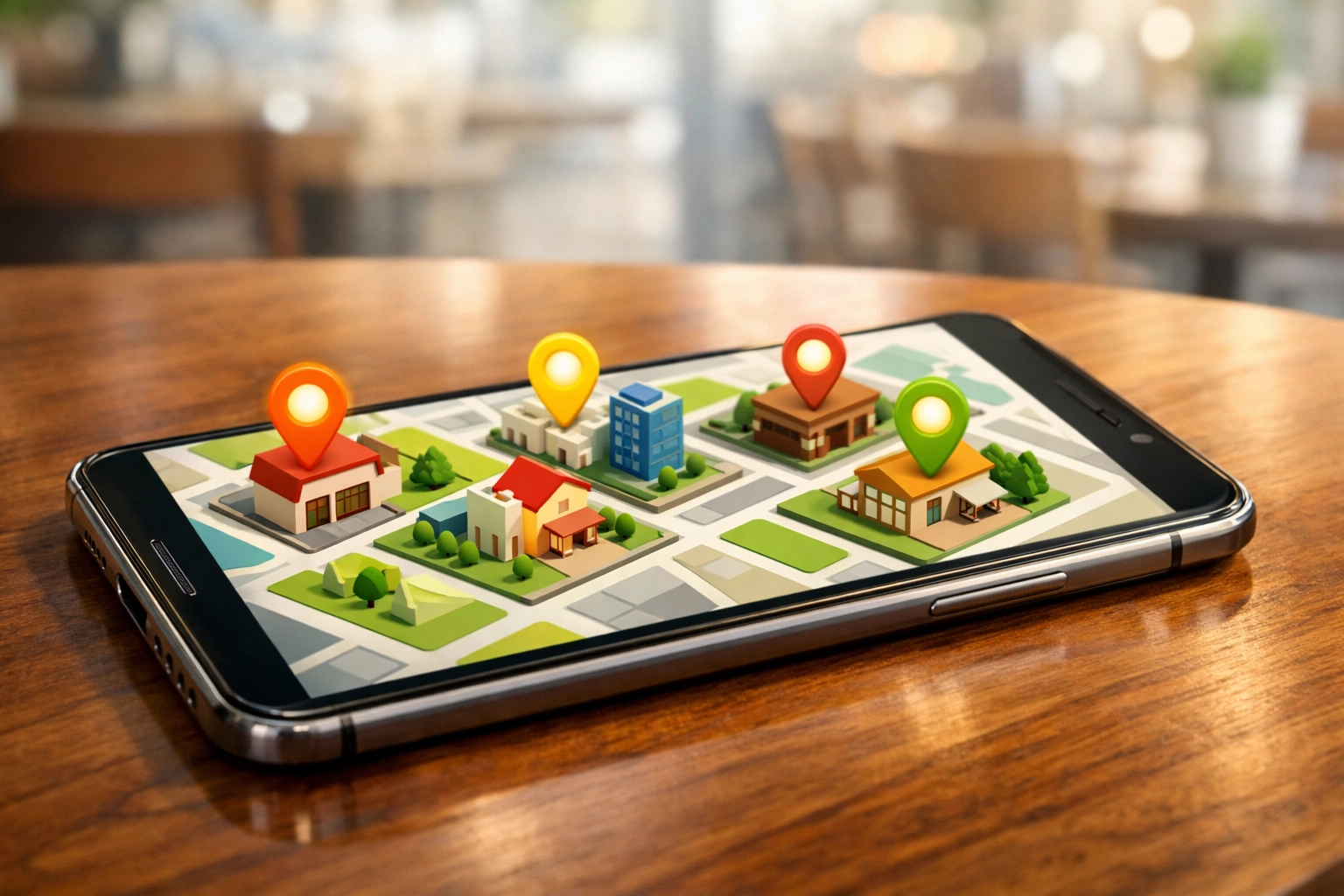
A cartoon-style landscape depicting a smartphone displaying a 3D immersive map of a neighborhood with glowing “pins” for top-rated local businesses.
To win in this environment, you need to ensure your Google Business Profile is a reflection of your physical reality. This is where Beyond the Blog: How Local Content Drives Google Maps Success becomes vital. Your content shouldn’t just exist on your site; it should feed the Google ecosystem with localized data points that AI can easily digest.
The Shift from Keywords to Entities
In the old days, you might repeat the phrase “emergency plumber” five times on a page and call it a day. In 2026, Google understands the entity of a plumber. It knows a plumber should have a license, specific tools, a service area, and related services like pipe bursting or water heater repair.
To survive AI Overviews, your website needs to be structured in a way that proves you are a legitimate, authoritative entity. This involves using advanced Schema Markup: a backend code that tells AI exactly what your data means.
| Strategy Component | Traditional SEO (Pre-2024) | AI-First SEO (2026) |
|---|---|---|
| Content Focus | Keyword density and backlinks | Information density and entity authority |
| Google Maps | Basic NAP (Name, Address, Phone) | Immersive content, AI review sentiment |
| User Intent | Finding a website | Getting a direct answer or booking |
| Search Method | Typing short phrases | Voice, conversational AI, and visual search |
Voice Search and the “Conversational” Local Lead
Voice search is no longer something people only use while driving. With the rise of advanced AI assistants, people are having full conversations with their devices. Instead of searching “dentist near me,” they say, “Find me a pediatric dentist nearby that takes my insurance and has an opening this Wednesday.”
If your website doesn’t have the structured data or the conversational content to answer those specific long-tail queries, you won’t even be considered. This makes a Local SEO Audit more important than ever. You need to identify where your data is thin and where you’re failing to provide the “conversational” answers that AI assistants crave.
A cartoon landscape of a person at home speaking to a friendly-looking floating AI robot assistant while a local delivery van pulls up in the background.
Practical Steps to Protect Your Local Visibility
You don’t need to be a tech genius to stay relevant, but you do need to be proactive. Here is a checklist of how local businesses can adapt to the AI-driven search era:
- Optimize for Zero-Click Searches: Ensure your Google Business Profile is 100% complete. Include your price list, service areas, and high-quality landscape photos.
- Double Down on Real Reviews: AI summaries now highlight common themes in reviews. Encourage customers to be specific (e.g., “The HVAC technician, Mike, fixed my furnace in under an hour and was very professional”).
- Implement Local Schema: Use “LocalBusiness” and “Service” schema to define your business for AI crawlers.
- Create “Human-First” Content: While AI generates summaries, humans still want to read authentic stories. Use local case studies and community involvement to build trust that AI can’t fake.
- Monitor Your “Brand Mentions”: AI models learn from the whole web. If local news sites, blogs, or directories mention your business, it builds your authority as an entity.

A cartoon-style landscape of a business owner looking at a dashboard of glowing data icons, representing the different signals that feed into AI search.
Why Information Density is Your Secret Weapon
In 2026, the biggest risk to a local business is “digital invisibility.” If you only have a one-page website with a phone number, an AI agent has nothing to work with. It will pass you over for a competitor who has detailed service pages, a gallery of recent work, and a FAQ section that addresses specific customer pain points.
The goal isn’t just to “rank” anymore; it’s to be the most “useful” result. When you provide deep, localized information, you aren’t just helping Google; you’re helping your future customers make a decision without even leaving the search page. This is the new reality of digital marketing: being everywhere your customer is, with the exact answer they need.
Q&A
How do I know if my business is showing up in AI Overviews?
The best way is to perform conversational searches related to your business on a mobile device or via Google’s main search bar. Look for the shaded box at the top of the results. If your business is cited in the “Sources” section, you are successfully appearing in AI Overviews.
Will AI Overviews kill my website traffic?
They might decrease “top-of-funnel” traffic (people just looking for general information). However, the traffic that does click through to your site will be much higher intent, as they have already seen your basic info in the AI summary and want to engage further.
Do I still need to worry about keywords?
Keywords still matter, but they are now part of a broader “topic.” Instead of focusing on a single keyword, focus on covering a topic exhaustively. If you are a roofer, don’t just write about “roofing.” Write about hail damage, insurance claims, shingle types, and local building codes.
What is the most important part of my Google Business Profile in 2026?
Activity and accuracy. Regularly posting updates, responding to every review (even the bad ones), and uploading fresh, high-quality photos tells Google’s AI that your business is active and reliable.
How can a small business compete with big national brands in AI search?
Local businesses have a “proximity and specificity” advantage. A national brand cannot speak to the specific needs of a neighborhood or a local climate as well as you can. Use localized content: mentioning local landmarks, weather patterns, and community events( to signal your local relevance to AI engines.)