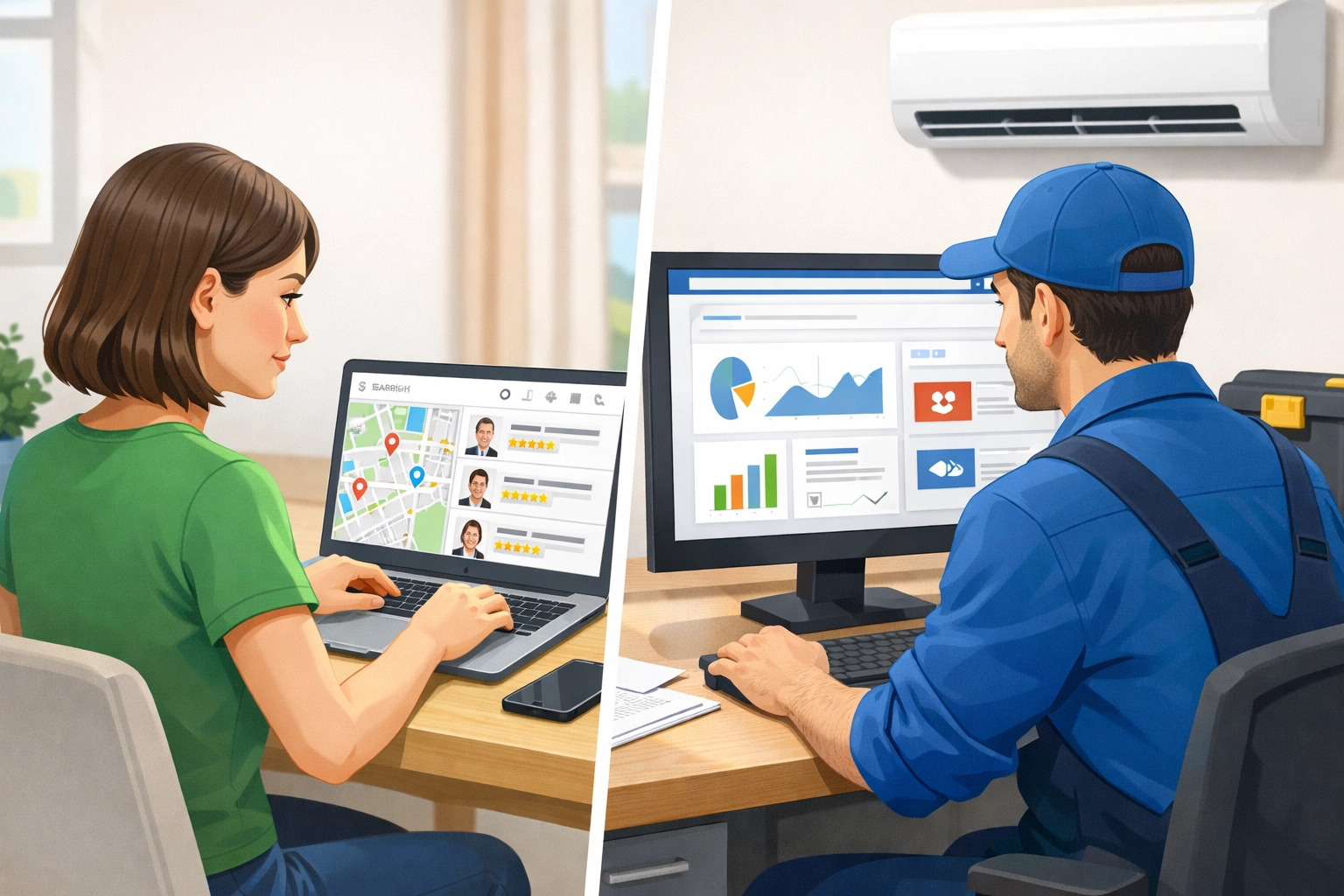
You’ve got a decision to make. Your HVAC company needs more leads, and you’re staring at two options: Google Local Services Ads or traditional Google Search Ads. Both promise to put your business in front of homeowners searching for heating and cooling help. But which one actually delivers?
Here’s the truth, Local Services Ads and Google Search Ads aren’t really competitors. They’re both part of Google’s advertising ecosystem, but they work completely differently. One charges you per lead. The other charges you per click. One shows up at the very top of search results with a green checkmark. The other shows up below it with a small “Ad” label.
For HVAC companies, this choice isn’t just about preference. It’s about where you spend your budget and which format converts browsers into paying customers. Let’s break down exactly how each one works and which one wins for your business.
What Are Google Local Services Ads?
Local Services Ads (LSAs) are Google’s pay-per-lead advertising format designed specifically for local service businesses. They appear at the absolute top of search results, above everything else, including traditional Google Ads.
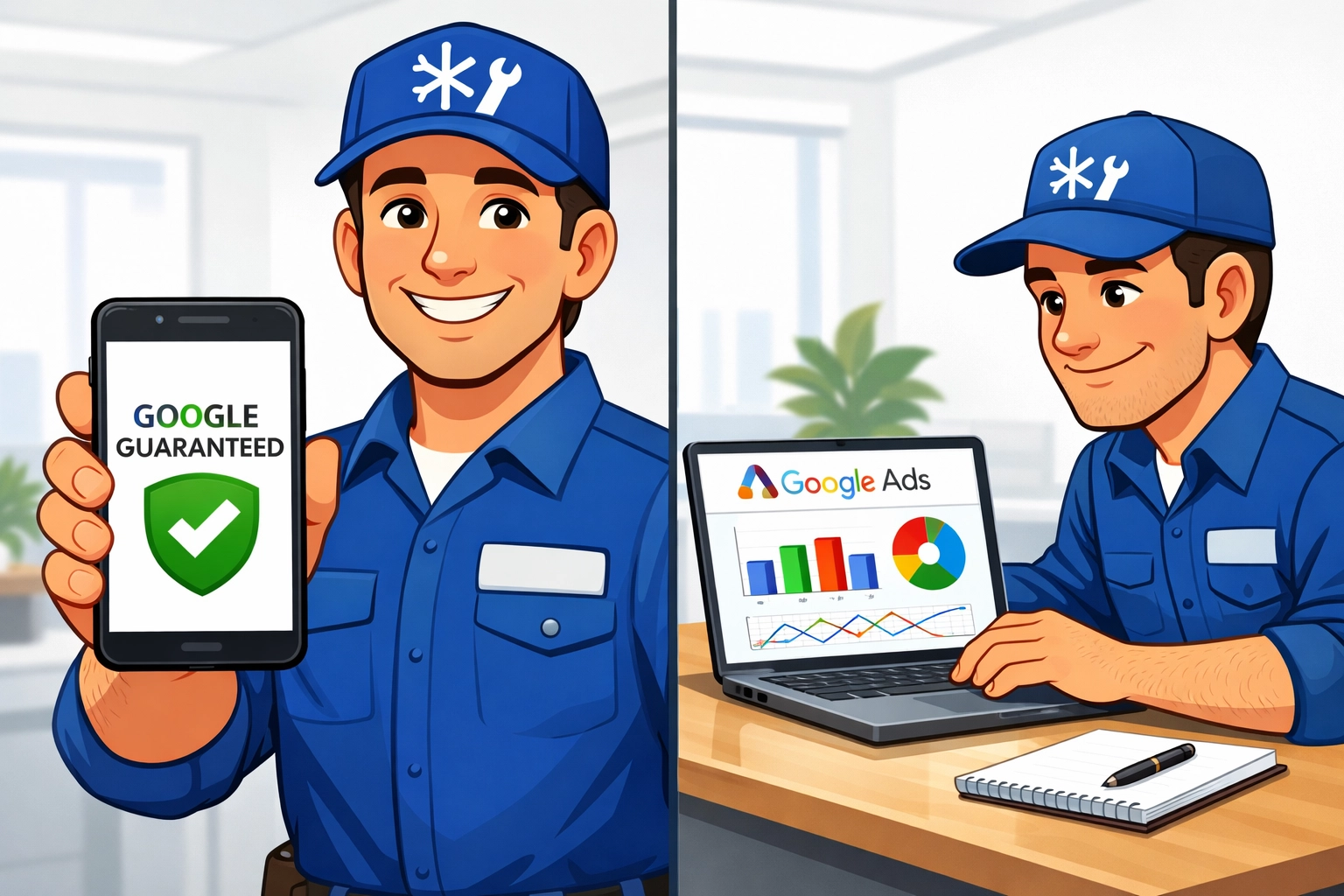
When someone searches “HVAC repair near me” or “air conditioning installation,” your LSA listing shows your business name, star rating, service area, hours, and the Google Guarantee badge. That badge matters. It tells potential customers that Google has verified your business license, insurance, and background checks.
Here’s where LSAs get interesting: customers don’t click through to your website. They call you directly from the ad. No landing page. No form fills. Just a phone call from someone who needs your service right now.
You only pay when someone contacts you through the ad, either by phone call, message, or booking request. That’s it. No payment for impressions. No payment for clicks that go nowhere.
What Are Google Search and Display Ads?
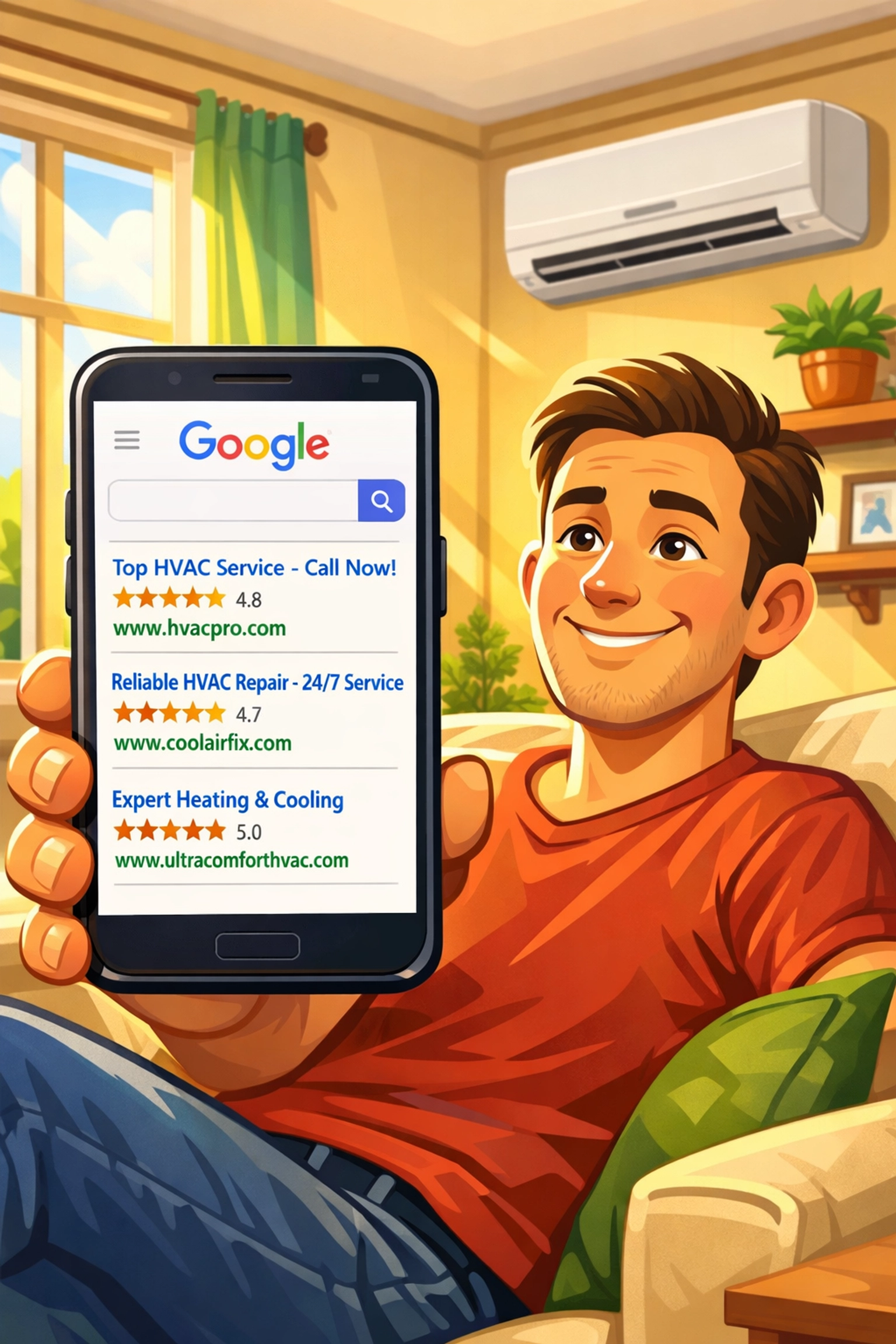
Traditional Google Ads (Search and Display) operate on a pay-per-click model. You bid on keywords like “emergency HVAC repair” or “furnace installation.” When someone searches those terms, your ad appears in the search results, usually below Local Services Ads but above organic listings.
Click costs vary wildly depending on competition and location, but HVAC keywords typically run between $15 and $100+ per click in competitive markets. Every click charges your account, whether that person converts into a customer or bounces after two seconds.
Search Ads direct traffic to a landing page where you control the message, offer, and conversion path. You can showcase promotions, testimonials, service details, and capture email addresses. Display Ads work similarly but appear on websites across Google’s network instead of in search results.
According to WordStream, Google Ads deliver an average return of $2 for every $1 spent across industries, representing a 200% ROI baseline.
The key difference? You’re paying for clicks, not leads. That means your conversion rate on the landing page determines whether those clicks turn into revenue or just drain your budget.
Key Differences Between LSAs and Google Ads
Let’s get specific about how these two formats compare side by side:
| Feature | Local Services Ads | Google Search Ads |
|---|---|---|
| Pricing Model | Pay-per-lead | Pay-per-click |
| Ad Position | Top of search results | Below LSAs, above organic |
| Verification | Google Guarantee badge | No verification badge |
| Landing Page | Direct phone call | Custom landing page |
| Targeting | Service area, job type | Keywords, location, demographics |
| Budget Control | Weekly budget cap | Daily budget cap |
| Lead Quality | High intent (ready to call) | Varies (depends on landing page) |
The format you choose changes everything about how you acquire customers. LSAs simplify the path from search to phone call. Google Ads give you more control over messaging and conversion optimization.
Performance Comparison for HVAC Companies
So which one actually works better for HVAC businesses? The research points to Local Services Ads as the winner for most companies, especially if you’re just getting started with paid advertising.
LSAs convert at higher rates because they eliminate friction. Someone searching for emergency AC repair doesn’t want to browse your website. They want to talk to someone who can fix their problem today. LSAs make that happen instantly.
Google Search Ads can deliver strong results, but only if your landing page converts. If your page loads slowly, lacks social proof, or buries your phone number, you’re paying for clicks that never turn into calls. One HVAC company reduced wasted ad spend by $1,200 per month simply by improving targeting and eliminating keywords that attracted tire-kickers instead of buyers.
That said, Search Ads scale better once you’ve nailed your conversion funnel. You can drive higher volume with Search Ads because you’re not limited by the number of Local Services Ads impressions in your market.
Cost Analysis: Which Format Saves You Money?
Let’s talk real numbers. Local Services Ads charge per lead, with costs typically ranging from $25 to $100+ depending on your market and service type. Emergency calls usually cost more than routine maintenance leads.
Google Search Ads charge per click. If your average click costs $50 and your landing page converts at 10%, you’re paying $500 per lead. That’s significantly more expensive than LSAs in most scenarios.
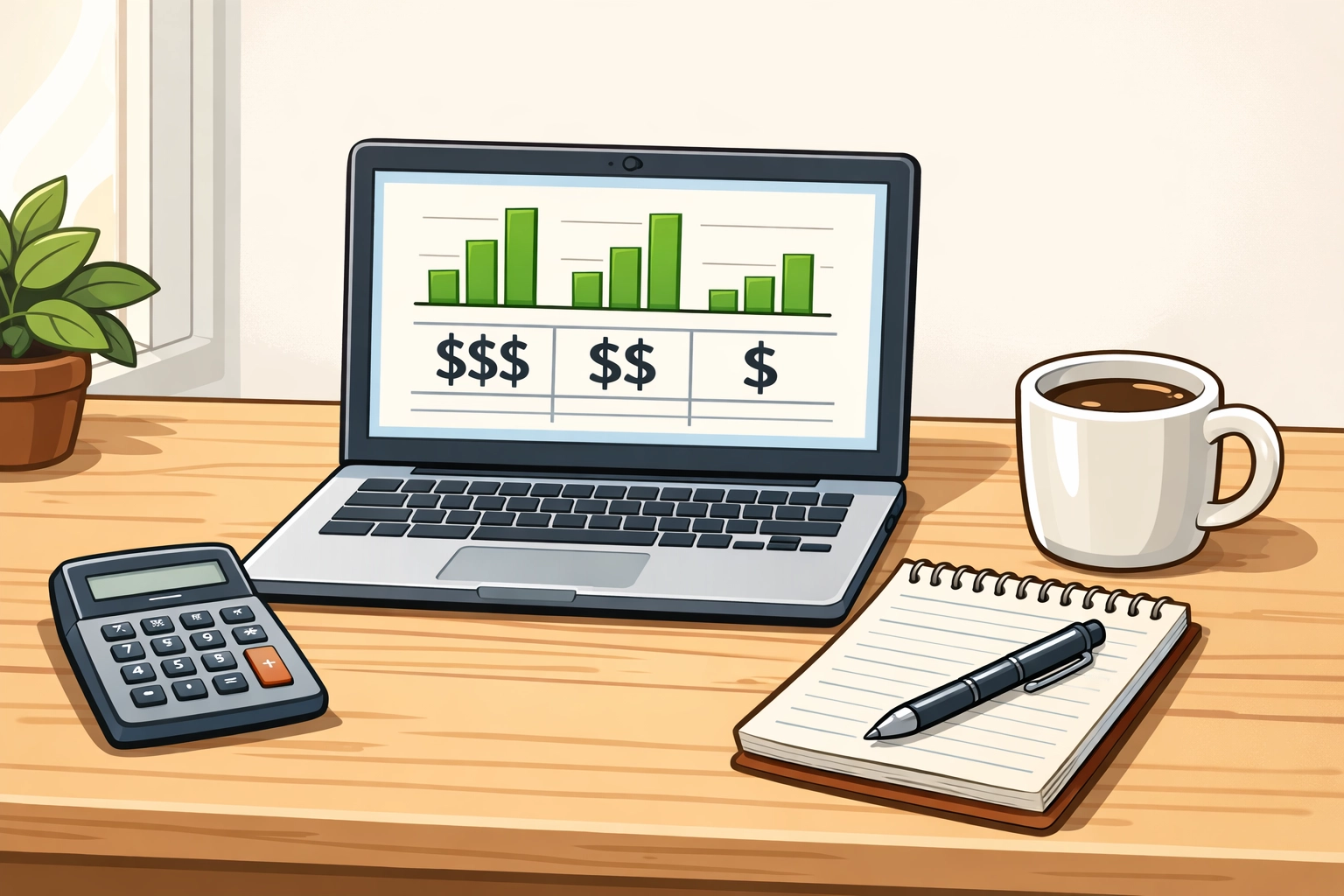
Here’s where the math gets interesting: if you improve your landing page conversion rate to 20%, your cost per lead drops to $250. That’s closer to LSA pricing, and you gain the ability to scale volume beyond what LSAs can deliver.
The bottom line? LSAs deliver cheaper leads out of the gate. Search Ads become cost-competitive only after you’ve optimized your landing page experience.
Which Format Should You Start With?
Start with Local Services Ads. Period.
LSAs require less setup, less optimization, and less risk. You don’t need to build landing pages, write ad copy variations, or split-test headlines. You just need a verified Google business profile and a phone line to answer calls.
That Google Guarantee badge also builds instant trust with homeowners who’ve never heard of your company. When your competitor’s ad sits right below yours without that green checkmark, guess who gets the call?
Once you’ve maxed out your LSA volume and you’re consistently booking jobs from those leads, then test Google Search Ads. Use the customer insights from your LSA calls to inform your Search Ads strategy, which keywords drive the highest-value customers, what objections you need to address on your landing page, what promotions convert best.
The Winning Strategy: Use Both Together
Here’s the truth most HVAC companies miss, you don’t have to choose just one format. The best strategy combines Local Services Ads and Google Search Ads to dominate search results.
Think about it from a homeowner’s perspective. They search “furnace repair near me” and see your business twice on the same page, once at the top with a Google Guarantee badge, and again below with a compelling offer. That double exposure builds credibility and captures customers at different stages of their decision process.
Some searchers call immediately from the LSA. Others want to see your website first, check your reviews, and compare pricing before they commit. Search Ads capture that second group.
This layered approach also protects your market share. If a competitor runs Search Ads but you only run LSAs, they’re capturing everyone who scrolls past your listing. If you run both, you own more real estate on the search results page than any single competitor can.
For maximum impact, pair your paid ads strategy with strong organic SEO fundamentals. Check out our guide on Google Maps SEO tactics to strengthen your local search presence beyond paid advertising.
Measurement and Optimization
You can’t improve what you don’t measure. Both advertising formats require different tracking approaches.
For Local Services Ads, track these metrics:
- Cost per lead
- Lead-to-booking conversion rate
- Average job value from LSA customers
- Response time to inbound calls
For Google Search Ads, monitor:
- Click-through rate (CTR)
- Cost per click (CPC)
- Landing page conversion rate
- Cost per acquisition (CPA)
Most HVAC companies discover that LSA leads convert at 30-40% while Search Ads leads convert at 10-20%, but Search Ads volume can be 3-5x higher once you scale budgets.
The key is testing, tracking, and adjusting based on actual customer acquisition costs versus lifetime customer value. If your average HVAC customer is worth $2,000 and your LSA cost per lead is $75, you’re winning even with a 20% conversion rate.
Q: Can I run Local Services Ads and Google Search Ads at the same time?
Yes, and you should. They complement each other by capturing customers at different decision stages. LSAs grab high-intent callers while Search Ads capture researchers who want to browse before committing.
Q: How much should I budget for Local Services Ads as an HVAC company?
Start with $1,000-$2,000 per month to test lead quality and conversion rates. Scale up once you’ve confirmed that LSA leads turn into profitable customers. Most successful HVAC companies spend $3,000-$10,000 monthly on LSAs once they’ve proven ROI.
Q: Do I need a website to run Local Services Ads?
No, but having one helps. LSAs direct customers to call you, not visit a website. However, many customers will search for your business online after seeing your ad, so a professional website builds credibility even if it’s not part of the direct conversion path.
Q: What’s the Google Guarantee and why does it matter?
The Google Guarantee is a verification badge showing Google has screened your business license, insurance, and background checks. It includes up to $2,000 in reimbursement protection for customers if they’re unhappy with your work. This badge significantly increases trust and click-through rates compared to unverified competitors.
Q: How long does it take to see results from each format?
Local Services Ads can generate leads within 24-48 hours of activation. Google Search Ads require 2-4 weeks of testing and optimization to dial in keywords, ad copy, and landing pages. Budget at least 90 days to properly evaluate which format delivers better ROI for your specific market.