You’ve likely felt the sting of a digital advertising budget that seems to vanish into thin air. You set up your search ads, target the right keywords, and wait for the phone to ring, only to realize you’re paying $50 per click while your competitor in the “Local Pack” is getting the lion’s share of the calls for free.
The reality of digital marketing in 2026 is that local intent has moved past simple search queries. When someone searches for “emergency plumber near me” or “dentist in Chicago,” they aren’t looking for a whitepaper or a long-form sales page. They are looking for a map, a star rating, and a “Call” button. This is why Google Business Profile (GBP) optimization isn’t just a “nice-to-have” SEO task; it is the most potent weapon in your digital advertising arsenal.
By aligning your paid efforts with a dominant organic local presence, you create a “surround sound” effect that makes your business the only logical choice. Let’s dive into how you can stop overpaying for leads and start winning the local map game.
The Local Search Landscape: Why Maps Matter More Than Ever
In the past, you could get away with a mediocre website if your ad spend was high enough. Today, Google’s algorithm prioritizes proximity and relevance above almost everything else for local queries. Most users never even make it past the first three results they see on the map, the coveted “3-Pack.”
If you aren’t appearing in that 3-Pack, you’re essentially invisible to the 46% of all Google searches that have local intent. Even if you are running paid search ads, a weak Google Business Profile can kill your conversion rate. A potential lead might click your ad, see your brand name, and then immediately search for your business on Google Maps to check your reviews. If they find a profile with no photos, an incorrect phone number, or 3-star ratings, they’ll bounce faster than you can say “wasted ad spend.”
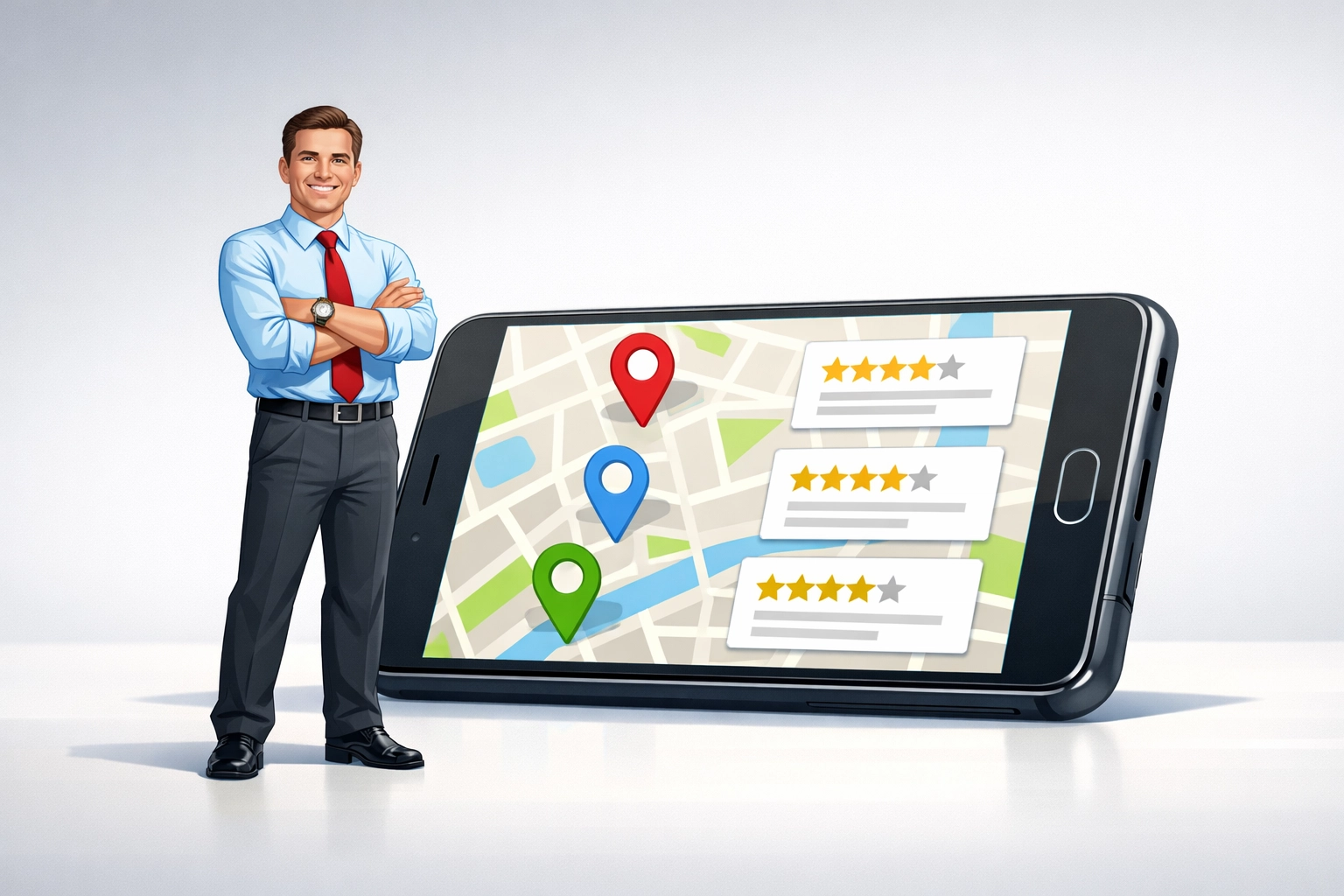
A cartoon-style landscape illustration showing a local business owner standing triumphantly on top of a giant smartphone displaying a Google Maps 3-pack listing with five stars.
Comparing Paid Search vs. Optimized Local Listings
To understand the value of GBP optimization, we have to look at the numbers. While paid ads offer immediate visibility, an optimized local profile offers higher trust and long-term ROI.
| Feature | Standard Google Search Ads | Optimized Google Business Profile |
|---|---|---|
| Initial Cost | High (Cost-Per-Click) | Free (Organic) |
| Trust Signal | “Sponsored” tag (Lower trust) | Reviews and Photos (High trust) |
| User Intent | High | Extremely High (Ready to visit/call) |
| Placement | Top of Search | Google Maps & Local 3-Pack |
| Long-term ROI | Stops when budget ends | Compounds over time |
The Synergy of Google Maps SEO and Digital Advertising
You shouldn’t view Google Maps SEO and digital advertising as two separate silos. In fact, they work best when they feed into each other. For example, if you are a dental practice looking to grow your patient list, google maps mastery allows you to dominate the area while your ads capture specific high-value treatments like “Invisalign” or “Dental Implants.”
When your profile is fully optimized, your Local Services Ads (LSAs) often perform better because Google recognizes your business as a verified, high-quality entity. This “halo effect” reduces your cost per acquisition and increases the quality of the leads coming through your phone lines.
“Businesses that respond to at least 25% of their online reviews earn up to 35% more revenue on average than those that don’t.” , Womply Research Study on Local Business Revenue
This statistic highlights a crucial point: optimization isn’t just about keywords; it’s about engagement. If you are ignoring your reviews, you are literally leaving money on the table.
Actionable Steps for GBP Optimization in 2026
Optimization is a marathon, not a sprint. However, there are a few “low-hanging fruit” items that can yield immediate results for your local visibility. Whether you’re a local contractor or a professional service provider, these steps are non-negotiable.
1. Master Your NAP Consistency
NAP stands for Name, Address, and Phone Number. It sounds simple, but you’d be surprised how many businesses have conflicting information across the web. Google rewards consistency. If your profile says “Street” but your website says “St.”, it creates a tiny bit of friction in the algorithm’s trust. You can maximize local SEO with online directory listings to ensure your data is synchronized across the entire ecosystem.
2. Choose the Right Categories (and Sub-categories)
Your primary category is the single most important ranking factor for Google Maps SEO. If you are a dentist, don’t just pick “Dentist.” Use sub-categories like “Cosmetic Dentist,” “Pediatric Dentist,” or “Dental Hygienist” to capture a wider range of search queries.
3. High-Resolution Visuals
In 2026, customers buy with their eyes. You need professional, high-resolution photos of your office, your team, and your work. For contractors, “Before and After” photos are gold. For professional services, a clean, welcoming office photo builds immediate rapport before the first phone call.

A cartoon-style landscape drawing of a professional office interior being photographed by a friendly robot, with bright colors and a welcoming atmosphere.
4. Strategic Backlinking
Local SEO isn’t just about what’s on your profile; it’s about what the rest of the web says about you. Acquiring links from local news sites, chambers of commerce, and local blogs tells Google you are a pillar of the community. Learn more about how local backlinking boosts your online presence to give your GBP that extra ranking “oomph.”
The Impact of AI on Local Search
As we move deeper into the era of agentic AI, the way people find local businesses is shifting. Generative search experiences now summarize business profiles to answer user questions directly. Instead of just showing a list, Google might say, “Dr. Smith’s office is highly rated for pediatric care and has a playroom for kids.”
This means your “Attributes” and “Q&A” sections on your GBP are more important than ever. If you haven’t filled out whether you have “Wheelchair accessible seating” or “Free Wi-Fi,” you might be filtered out of an AI-generated recommendation. Preparing for the AI search evolution is no longer optional, it’s a survival requirement.
Converting Map Traffic into Leads
Getting the “click” on Google Maps is only half the battle. Once they see your profile, you need to drive them toward an action. This is where your website’s UX comes into play. If a user clicks from your GBP to your site, that experience needs to be seamless. We often see businesses spend thousands on ads but send traffic to a site that doesn’t work on mobile.
| Conversion Factor | Why it Matters | Optimization Tip |
|---|---|---|
| Mobile Speed | Most local searches happen on the go. | Use compressed images and clean code. |
| Click-to-Call | Frictionless contact. | Ensure the phone number is prominent. |
| Local Proof | Validates the user’s choice. | Embed your Google reviews on the landing page. |
| Clear CTA | Tells the user what to do next. | Use “Book Now” or “Get a Free Quote.” |
For those in the service industry, a UX framework that turns traffic into calls is the final piece of the ROI puzzle. Without it, you’re just paying for “digital window shoppers.”
“76% of people who conduct a local search on their smartphone visit a physical place within 24 hours.” , Google Consumer Insights
This high conversion intent is why an optimized profile is a “secret weapon.” It captures the user at the peak of their interest.
Leveraging Local Signals for Long-Term Dominance
Finally, don’t forget the power of social signals. While not a direct ranking factor in the same way as reviews, activity on platforms like Instagram and TikTok can drive branded searches. When people search for your business by name specifically, it sends a massive “relevance” signal to Google.
If you are a contractor, showing off your latest project on social media can trigger these searches. We’ve seen local heroes use this neighborhood strategy to dominate their service area without spending a fortune on traditional commercials.
A cartoon landscape of a suburban neighborhood with various houses featuring small “Trust” icons over them, symbolizing local brand dominance and community trust.
By treating your Google Business Profile as the landing page of your digital advertising, you ensure that every dollar you spend, whether on SEO or paid ads, is working twice as hard. Stop looking at your GBP as a static directory listing and start treating it like the high-conversion sales tool it actually is.
Does optimizing my Google Business Profile really help if I’m already running Google Ads?
Absolutely. An optimized GBP improves your “Trust Score” in the eyes of both Google and the consumer. Often, users will see your ad and then search for your business on Maps to verify your reviews. If your profile is weak, you’ll lose the lead you just paid for.
How often should I post updates to my Google Business Profile?
We recommend at least once a week. Frequent updates through “Google Posts” signal to the algorithm that your business is active and providing current information to users.
Can I manage multiple locations from one Google Business account?
Yes, Google provides a robust dashboard for multi-location management. However, each location needs its own unique optimization strategy (local photos, local reviews, and location-specific descriptions) to rank effectively in its specific 3-Pack.
What is the most important factor for ranking on Google Maps?
While there are many factors, proximity to the searcher, the primary category of your business, and the quantity/quality of your reviews are generally considered the “Big Three” of local SEO ranking.
Do I need a physical office to have a Google Business Profile?
Not necessarily. If you are a service-area business (like a plumber or electrician), you can set up a “Service Area” profile which hides your home address but still allows you to appear in searches within the areas you serve.