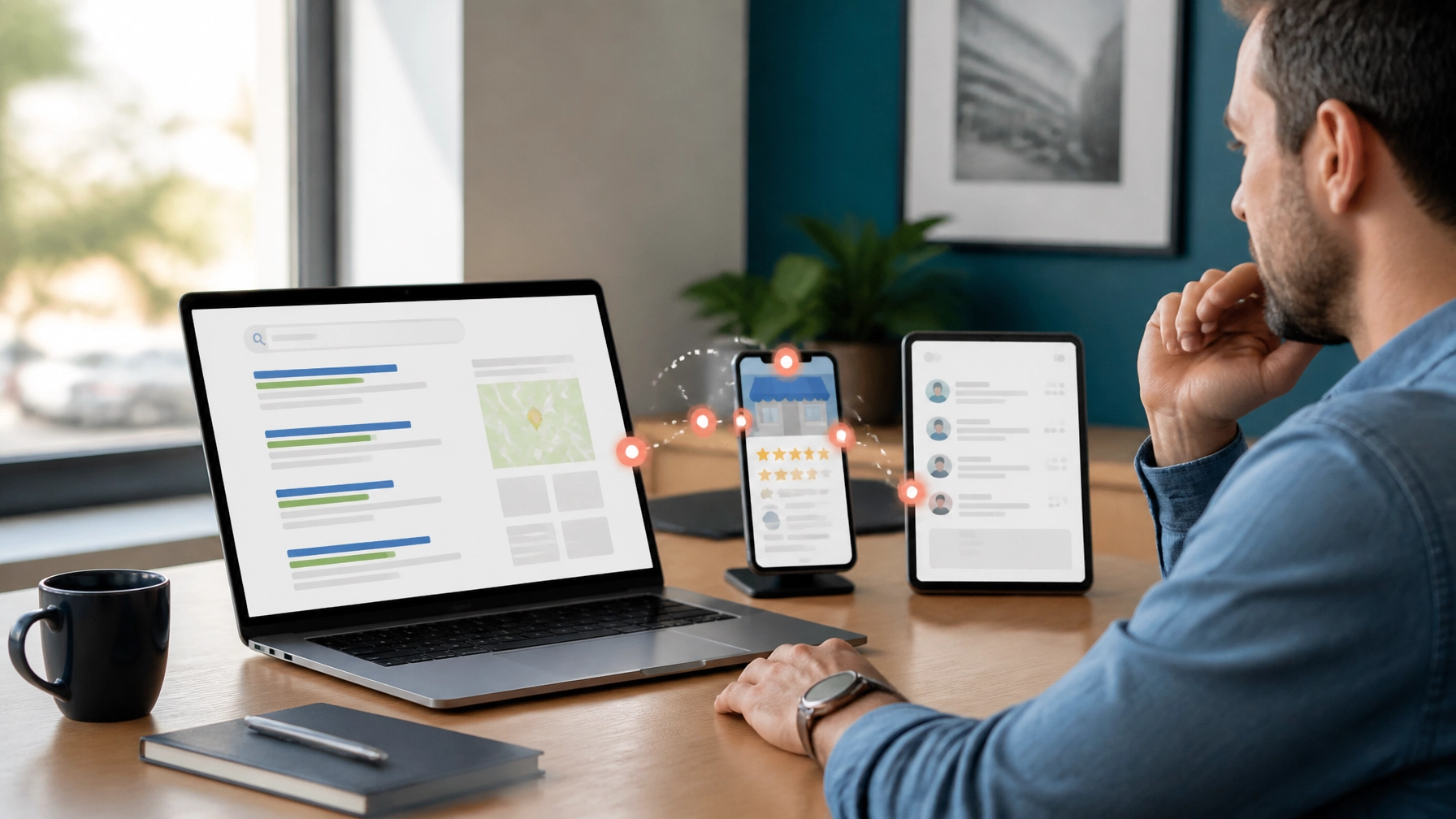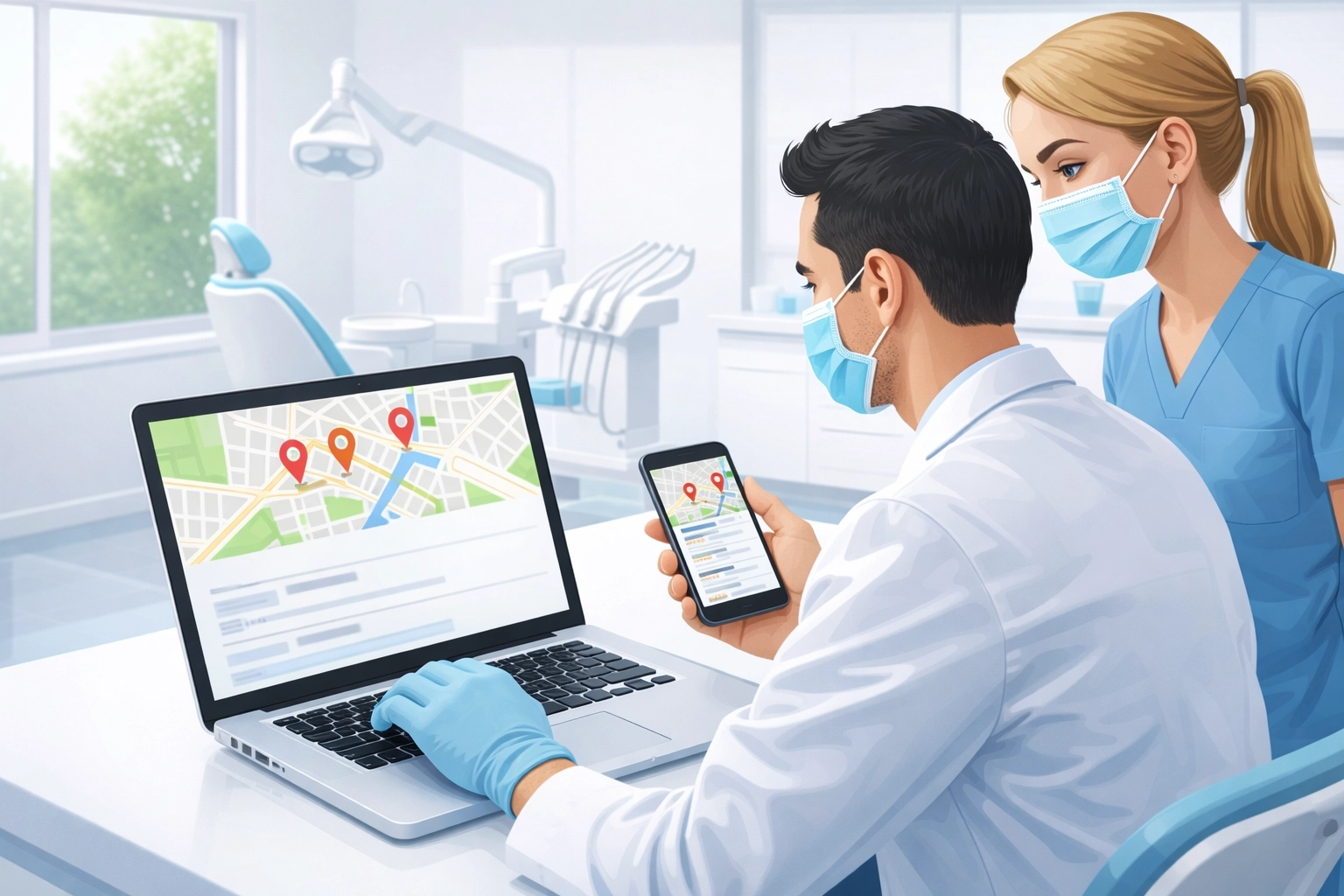
If you’re running a dental practice, the “3-Pack” isn’t just a nice feature on a search results page: it’s one of the highest-intent ways patients find and choose a provider. In 2026, the landscape of local search has shifted. We are no longer just fighting against other businesses; we are navigating an environment where AI-driven generative overviews and hyper-local signals dictate who gets the call and who gets scrolled past.
Winning in the Google Maps 3-Pack requires more than just “setting and forgetting” your profile. It’s about creating a ecosystem of trust, relevance, and technical precision. If you’ve noticed your rankings slipping, you might be falling victim to some common reasons your general contractor business isn’t showing up on Google Maps, but today we’re looking at the roadmap for total dominance.
The 2026 Core Ranking Factors
The algorithm still relies on the classic trio of relevance, distance, and prominence. However, the weight of these factors has evolved. Google now prioritizes behavioral signals: real human interactions: over simple keyword density.
| Factor | Description | 2026 Impact Weight |
|---|---|---|
| Relevance | How well your profile matches the user’s specific intent. | High |
| Prominence | Your brand’s “fame” online (reviews, backlinks, citations). | Very High |
| Distance | Physical proximity of your business (or service area) to the user. | Medium |
| Engagement | Clicks for directions, calls, and “Search-to-Contact” speed. | Critical |
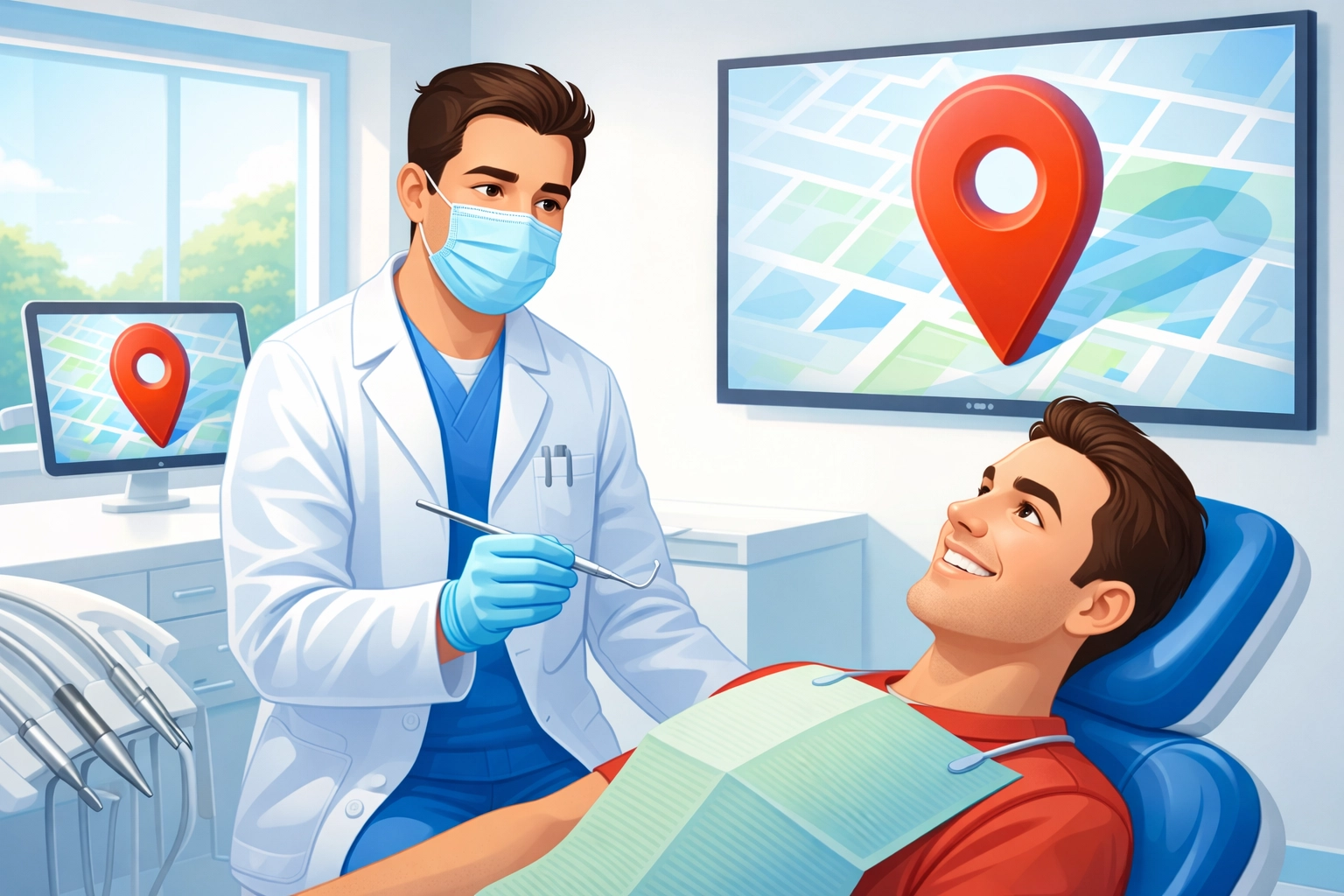
Description: A colorful cartoon of a dentist and patient in a clean, welcoming dental clinic, with a tablet showing a generic map pin concept (no readable text).
Relevance: Moving Beyond General Categories
In 2026, being a generic “Dentist” is often too broad to consistently win your best cases. To dominate, you must choose a precise primary category that matches your highest-value, most requested service line. For example, a practice focused on implants should align the primary category accordingly (where eligible), while using additional categories for related services like cosmetic dentistry, emergency dental care, or pediatric dentistry. Your primary label tells Google exactly which “bucket” you belong in.
This specificity helps you capture long-tail searches. Instead of only showing up for “dentist near me,” you’ll start appearing for searches like “emergency dentist open now,” “teeth whitening near me,” or “dental implants consultation.” This is where why Google My Business is essential for local visibility becomes clear: it acts as your digital storefront that speaks directly to Google’s AI.
“Consumers used Google to evaluate local businesses 2.7 billion times in 2024.” : BrightLocal — Local Consumer Review Survey (2025, reporting 2024 data)
The Power of Behavioral Signals and Prominence
Prominence isn’t just about how many reviews you have; it’s about the velocity and sentiment of those reviews. If you haven’t received a review in three months, Google perceives your business as less “active” than a competitor who gets three a week.
Systematically gathering reviews from every satisfied customer is no longer optional. But don’t just stop at the star rating. Encourage clients to mention specific services and use photos. A review that says “Best HVAC repair in Austin” with a photo of a new furnace carries significantly more weight than a generic “Great job.”

Description: A cartoon illustration of a patient leaving a 5-star review on their phone at a dental reception desk while a dental assistant in scrubs smiles in the background.
Furthermore, behavioral signals like “Clicks for Directions” and “Phone Calls” from your profile tell Google that people trust you. If users find your profile but don’t interact, your prominence score will eventually drop. This is why having a clear call-to-action is vital. Make sure your phone number is correct, appointment links work, and your website link leads to a high-converting page (think: insurance accepted, services, and “Request an Appointment” front and center). If your site isn’t converting those clicks, you might need to look at the UX framework that turns local website traffic into phone calls.
Integrating Your Website with Google Maps
Your website and your Google Business Profile (GBP) should function as one cohesive unit. Google scans your website to verify the information on your map listing. If your Name, Address, and Phone Number (NAP) are inconsistent across the web, your rankings will suffer.
To strengthen this connection, you should:
- Embed a Google Map on your contact page to anchor your location.
- Implement Local Business Schema, which is a piece of code that tells Google exactly where you are and what you do.
- Create Location Pages if you serve multiple cities. Each page should have unique content specific to that area.
By doing this, you are providing the “proof” Google needs to verify your distance and relevance signals. This is part of the broader AI search evolution where businesses must provide structured, clear data to stay visible.
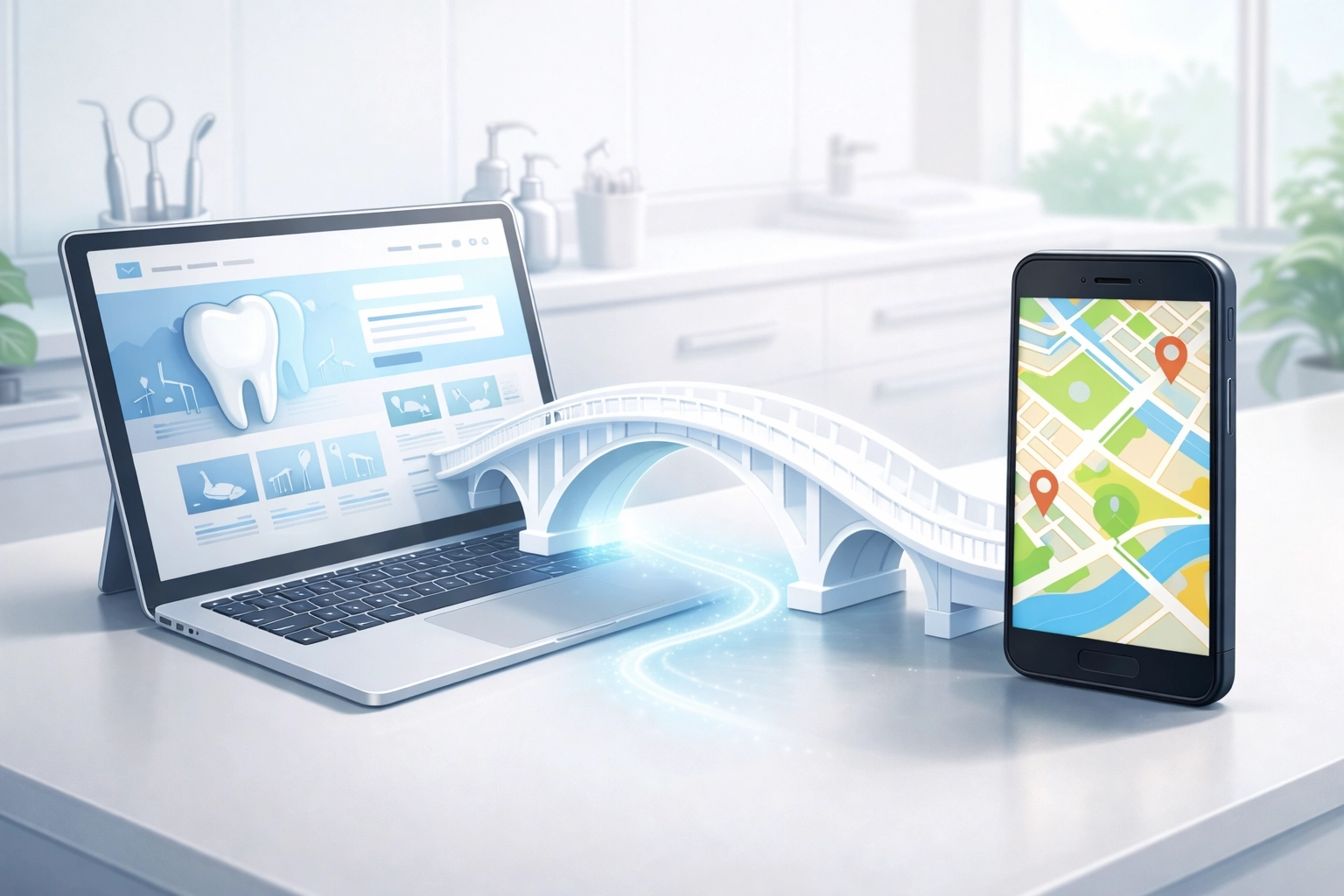
Description: A cartoon showing a digital bridge connecting a dental practice website on a laptop to a glowing generic 3-Pack map result on a smartphone, symbolizing clean data flow.
Avoid the “Spam” Trap
In 2026, Google is more aggressive than ever about suspending profiles that use “spammy” tactics. This includes keyword-stuffing your business name (e.g., “Austin’s Best Fast Emergency Plumbing Contractor & Drain Cleaning”). While it might provide a temporary boost, it often leads to a hard suspension that can take months to resolve.
Instead, focus on real-world engagement. Post regular updates to your profile. These “Google Posts” act like a social media feed for your business. Share photos of current projects, seasonal tips, or special offers. These updates keep your profile fresh and signal to Google that your business is thriving.
If you are currently running ads to supplement your organic reach, make sure you aren’t making the common 5 Google Ads mistakes costing local contractors leads, as Map Ads (Local Services Ads) are becoming increasingly integrated into the 3-Pack experience.
How long does it take to see results in the 3-Pack?
If you already have an established Google Business Profile, you can often see movement within 30 to 60 days of consistent optimization (categories, services, reviews, photos, and GBP updates). For brand new dental practices, it may take 3 to 6 months to build enough prominence to crack the top three.
Do I need a physical office to rank on Google Maps?
For dental services, yes. Dental practices are typically location-based and patient visits happen at a verified clinic address, so you should use a physical address and complete verification. In practice, a properly verified location tends to outperform profiles trying to rank without a real storefront presence.
How often should I upload photos?
Aim for at least 2–3 new photos per week. Mix in real images of your team (with consent), operatories, the waiting area, and before/after-style context where appropriate and compliant. This shows Google—and potential patients—that you’re active and trustworthy.
What is the most important ranking factor in 2026?
It’s still a mix, but for dental practices, “Review Velocity” (steady, recent reviews) and “Engagement Signals” (calls, direction requests, appointment clicks) have become the heaviest weights in the algorithm this year.
The UX Blueprint for High-Converting Service Pages in 2026

Getting people to your website is only half the battle. If you’re a local service provider, your website isn’t an art gallery: it’s a conversion machine. In 2026, User Experience (UX) has become the primary differentiator between a contractor who stays busy and one who struggles to fill the calendar.
The way people interact with local business websites has changed. They are less patient, more skeptical, and heavily reliant on mobile devices. If your service pages feel like a wall of text from 2015, you are losing money. To fix this, you need to apply the UX framework that turns local website traffic into phone calls.
The Psychology of the “Zero-Moment”
When a homeowner’s water heater bursts at 2:00 AM, they aren’t looking for your origin story. They are looking for three things:
- Do you do this specific work?
- Can I trust you?
- How do I get you here?
A high-converting service page answers these questions in the first three seconds. This is where “above the fold” design becomes critical. Your headline should be benefit-driven, and your call-to-action (CTA) should be impossible to miss.
| UX Element | Purpose | Impact on Conversion |
|---|---|---|
| Sticky Header | Keeps contact info visible while scrolling. | High |
| Proof Points | Reviews and badges near the CTA. | Very High |
| White Space | Reduces cognitive load and improves focus. | Medium |
| Fast Load Speed | Prevents bounce before the page even loads. | Critical |

Description: A bright cartoon of a patient holding a phone that shows a simple, clear dental website layout with a prominent appointment action (no readable text).
Design for Trust, Not Just Aesthetics
In an era of AI-generated content and stock photo overload, authenticity is the new premium. Using generic photos of “happy models” actually hurts your credibility. People want to see your trucks, your team, and your actual work in their actual neighborhood.
“90% of customers read at least two reviews before choosing a business, and 75% of users judge a company’s credibility based on its website design.” : Digital Trust & UX Benchmark Report 2026
This “trust deficit” is real. If your site looks unprofessional, users assume your work will be unprofessional too. This is why we argue that credibility is the only ROI metric that matters. Your UX should lead with trust signals: licenses, certifications, and real customer testimonials placed strategically near the decision-making points.
The “Mobile-First” Reality for Contractors
Over 80% of local service searches happen on mobile devices. If your website is just a shrunk-down version of your desktop site, you’re failing your users.
Mobile UX requires:
- Thumb-friendly buttons: Your CTA buttons need to be large enough to tap easily.
- Click-to-Call functionality: Don’t make people copy and paste your phone number.
- Short forms: If you use a contact form, keep it to 3-4 fields max.
We’ve seen businesses see a massive jump in results simply by applying ecommerce-style tweaks that turn browsers into sales, even for service-based businesses. The principle is the same: remove friction.
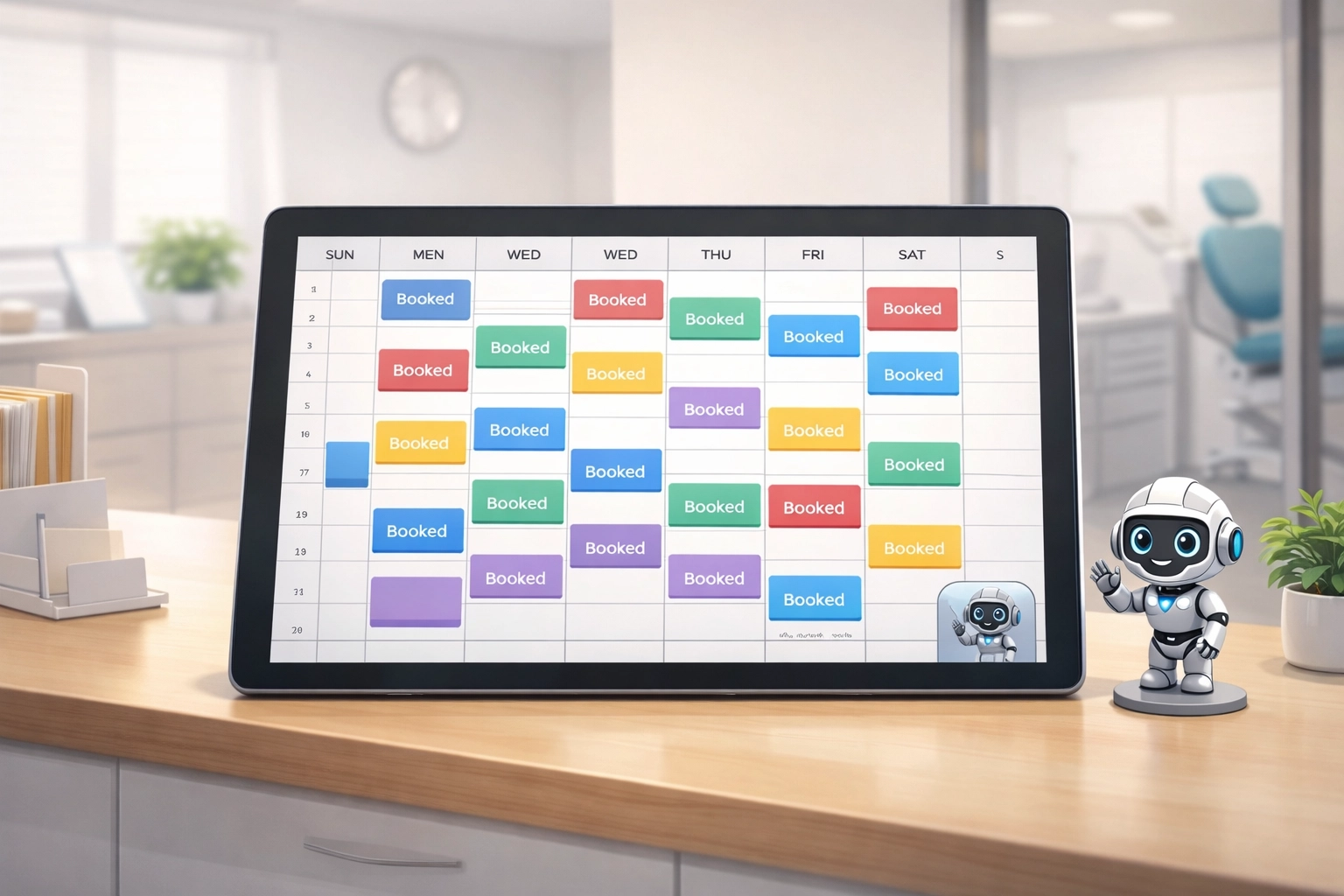
Description: A cartoon illustration of a tablet at a dental front desk showing a clean, generic calendar with booked slots (no readable text), suggesting automated scheduling.
Emerging Tech: AI Chat and Instant Scheduling
As we move through 2026, users expect instant gratification. Waiting 24 hours for a callback is no longer acceptable. Integrating agentic AI or automated scheduling tools directly into your service pages can drastically increase conversion.
When a lead lands on your page, an AI assistant can qualify them, provide a rough estimate, and book them into your calendar without you lifting a finger. This is the power of agentic AI in manual ad and lead management. It meets the customer exactly when their intent is highest.
Description: A friendly-looking cartoon robot in a hardhat holding a clipboard, standing next to a laptop that shows a calendar with several “Booked” slots.
Navigation and Information Architecture
Don’t make people hunt for information. Your services should be clearly categorized in your navigation menu. If you offer plumbing, HVAC, and electrical, each should have its own dedicated page. This isn’t just better for the user; it’s better for SEO.
Each page should follow a logical flow:
- Problem Recognition: Acknowledge the pain point (e.g., “Leaky roof?”).
- The Solution: Explain exactly how you fix it.
- The Proof: Show a local case study or review.
- The Action: Tell them exactly what to do next.
By following this blueprint, you stop burning your marketing budget on traffic that doesn’t convert. Whether you are driving traffic through organic search or Google Ads for contractors, your website’s UX is the “closer” that makes the sale.
What is the “3-second rule” in web design?
It refers to the fact that you have roughly three seconds to grab a user’s attention and communicate what you do before they consider clicking the back button.
Should I include prices on my service pages?
In 2026, transparency is highly valued. While you might not give an exact quote, providing “starting at” prices or “average cost” ranges helps qualify leads and builds immediate trust.
What is a “Heatmap” and why do I need one?
A heatmap is a UX tool that shows you where users are clicking and how far they are scrolling on your page. It’s essential for identifying “dead zones” where users are getting stuck or confused.
How often should I update my website’s design?
While a full overhaul isn’t needed every year, you should perform UX “tune-ups” every 6 months to ensure your site remains compatible with new browser updates and changing user behaviors.