If you have ever opened the Google Ads dashboard and felt like you were looking at the cockpit of a Boeing 747, you are not alone. For most local business owners, whether you are running a dental clinic, a law firm, or a roofing company, the sheer number of buttons, toggles, and “expert” settings is enough to make anyone close the tab and stick to word-of-mouth.
But the digital landscape has shifted. Relying solely on referrals is a slow game, and traditional search ads often require a degree in data science just to break even. This is where Performance Max (PMax) enters the chat.
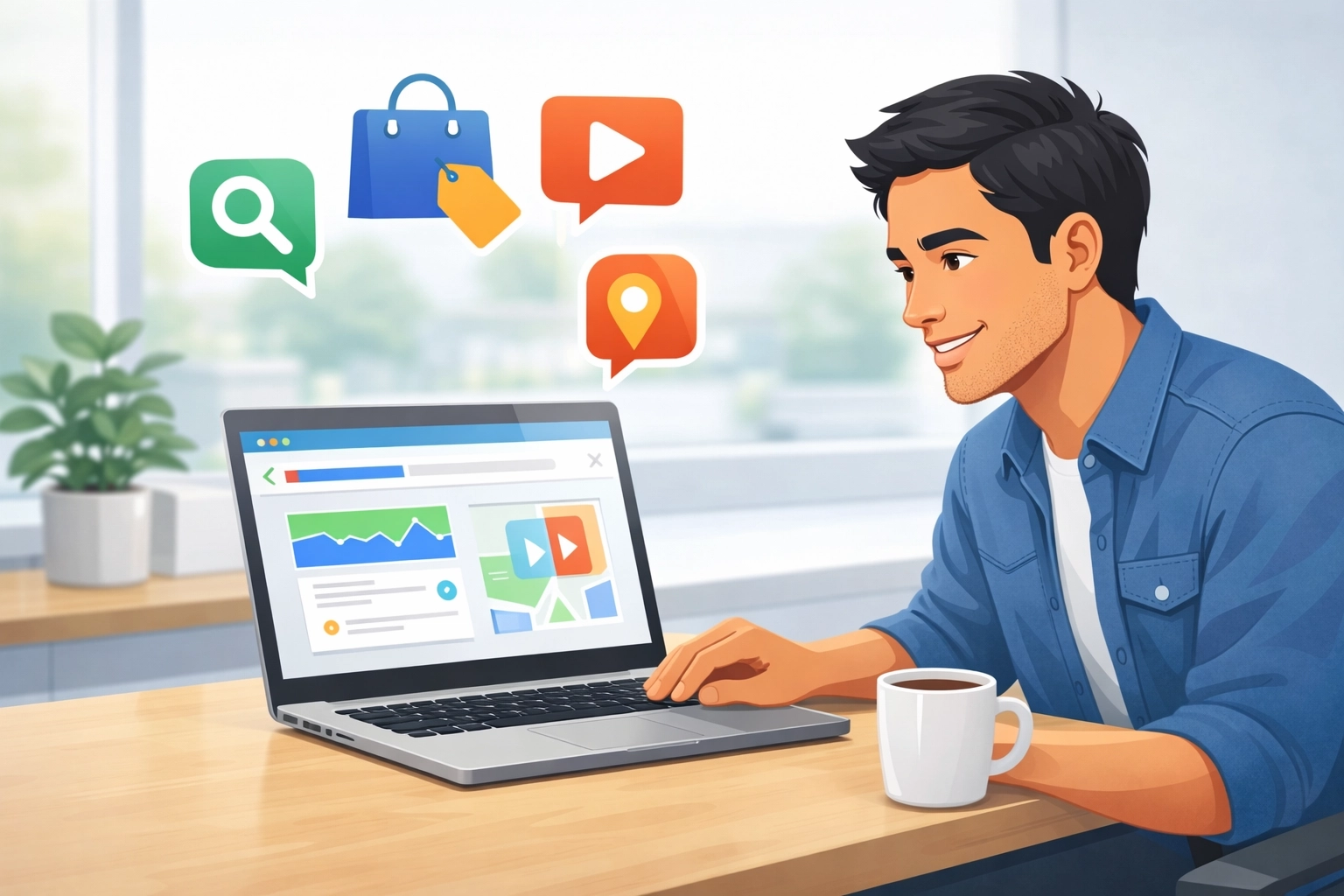
Think of Performance Max as the “Easy Button” for Google Ads. It is a goal-based campaign type that allows you to access all of Google’s advertising inventory from a single place. Instead of building five different campaigns for Search, YouTube, and Maps, you build one. It is the ultimate shortcut for beginners who want professional results without spending forty hours a week managing bids.
What Exactly is Performance Max?
In the old days of digital marketing, if you wanted to show up on Google, you had to build separate campaigns for every “channel.” You’d have a Search campaign for people typing in keywords, a Display campaign for banner ads on websites, and perhaps a YouTube campaign for video viewers.
Performance Max changes that by using artificial intelligence to handle the heavy lifting. You provide the “ingredients”, your budget, your goals, and some creative assets, and Google’s AI acts like a master chef, mixing them together to serve the right ad to the right person at the exactly right time.

A friendly robot chef in a bright, cartoon kitchen carefully mixing generic, unbranded channel icons into a glowing bowl to represent AI-driven lead generation.
This “all-in-one” approach is specifically designed to find customers wherever they are. For a local service business, this might mean a potential client sees your ad on YouTube while watching a DIY video, then sees a reminder on Google Maps while driving nearby, and finally clicks your ad when they perform a direct search. Performance Max connects those dots automatically.
Why Beginners Should Start Here
The biggest hurdle for beginners isn’t usually the budget; it’s the complexity. Traditional Google Ads require you to master keyword matching types, negative keyword lists, and manual bidding strategies. If you get one of those wrong, you can burn through your monthly budget in 48 hours with nothing to show for it.
Performance Max is a shortcut because it removes the guesswork. Here’s why it works so well for those just starting out:
- Simplified Setup: You don’t need to hunt for thousands of keywords. You tell Google your website URL and your business category, and its AI learns who your audience is.
- Automated Bidding: PMax uses “Smart Bidding.” It looks at millions of signals in real-time to decide exactly how much to pay for a click to ensure you actually get a conversion, not just a visitor.
- Cross-Channel Reach: Your ads automatically appear on Search, Maps, YouTube, Gmail, and the Display Network. You get the reach of a massive agency with the effort of a solo entrepreneur.
To see how this stacks up against what you might be used to, let’s look at the core differences:
| Feature | Standard Search Ads | Performance Max |
|---|---|---|
| Primary Driver | Keywords selected by you | Goals and Creative Assets |
| Where Ads Show | Google Search & Search Partners | Search, Maps, YouTube, Gmail, Display |
| Management | High (Manual bid/keyword tweaks) | Low (AI-driven optimization) |
| Setup Time | Several hours to days | Less than an hour |
| Learning Curve | Steep | Beginner-friendly |
The Power of the “Asset Group”
In a traditional campaign, you write a text ad. In Performance Max, you create an “Asset Group.” This is where you give the AI your building blocks:
- Headlines: Short, punchy hooks about your service.
- Descriptions: More detail about why you’re the best choice.
- Images: High-quality photos of your work or your team.
- Videos: Short clips of your services in action.
Once you upload these, Google’s machine learning starts testing combinations. It might find that for people on mobile, a specific image and a short headline work best. For someone on a desktop, it might show a longer description. This constant A/B testing happens in the background while you focus on running your business.
If you’re worried about how these ads look in the context of your overall strategy, it’s worth checking out how web design that works acts as the landing pad for these AI-driven leads. Even the best ad shortcut can’t fix a confusing website.
Why AI is Your New Best Friend
Some business owners are hesitant to let “the machine” take control. It’s a valid concern, you want to know where your money is going. However, the data shows that AI-driven campaigns are becoming significantly more efficient than manual ones because they can process more information than any human ever could.
“Advertisers who use Performance Max campaigns see an average increase of 18% total incremental conversions at a similar cost per action.” , Google Ads Internal Data, 2023.
This efficiency is why we often recommend it as a zero-waste lead generation strategy. Instead of bidding on broad keywords that might not result in a phone call, PMax looks for “intent.” It knows if a user is just browsing or if they are ready to book an appointment right now.

A colorful, landscape cartoon showing a local business owner using a tablet while friendly helper robots point out nearby customers on a large, unbranded neighborhood map with generic location pins.
Setting Up Your First Campaign (The Right Way)
While PMax is a shortcut, it isn’t “set it and forget it.” You still need to provide high-quality inputs. Garbage in, garbage out.
First, ensure your conversion tracking is rock solid. If Google doesn’t know when a lead calls you or fills out a form, the AI can’t optimize. Using lead intelligence and call tracking is essential here to close the data loop.
Second, give it time. Performance Max has a “learning period” that usually lasts 1-2 weeks. During this time, the AI is testing different audiences and placements. It’s tempting to toggle things off if you don’t see a lead in the first 48 hours, but patience is the secret sauce.
Lastly, pay attention to your “Audience Signals.” You can tell Google, “Hey, look for people who look like my current customers.” This gives the AI a head start so it doesn’t have to start from zero. This is particularly useful for niche markets, like agentic technology for clinics, where the target audience is very specific.
Survival in the Age of AI
The reality is that Google is moving toward a future where AI overviews and automated maps changes are the norm. By adopting Performance Max now, you are essentially training your business’s digital presence to thrive in this new environment.
You aren’t just buying ads; you are feeding data into a system that gets smarter every day. As the system learns which customers are the most profitable for you, your ROI naturally trends upward. For a beginner, there is no faster way to compete with established players who have much larger marketing teams.
Does Performance Max work for very small budgets?
Yes, but you need to be realistic. If your budget is too low (e.g., $5 a day), the AI won’t have enough data to learn. We generally recommend starting with at least $30-$50 a day to see meaningful results within the first month.
Do I need to make my own videos for PMax?
If you don’t provide a video, Google will automatically create one using your images and text. Usually, these are “okay,” but they aren’t great. We highly recommend recording a simple 15-30 second video on your phone to give the AI better material to work with.
Can I choose which websites my ads appear on?
Not directly. Performance Max prioritizes performance over specific placement. However, you can use “Brand Exclusions” and account-level content filters to make sure your ads don’t show up on low-quality or irrelevant sites.
Will PMax replace my local SEO?
Not at all. Think of PMax as the accelerator and SEO as the engine. While PMax gets you leads today, optimizing your Google Business Profile is what builds long-term authority in your neighborhood. They work best when paired together.
How long should I wait before changing my campaign?
Wait at least 14 days. Every time you make a major change to your budget or assets, the AI goes back into a mini-learning phase. Frequent “tinkering” is the number one reason beginners fail with PMax.