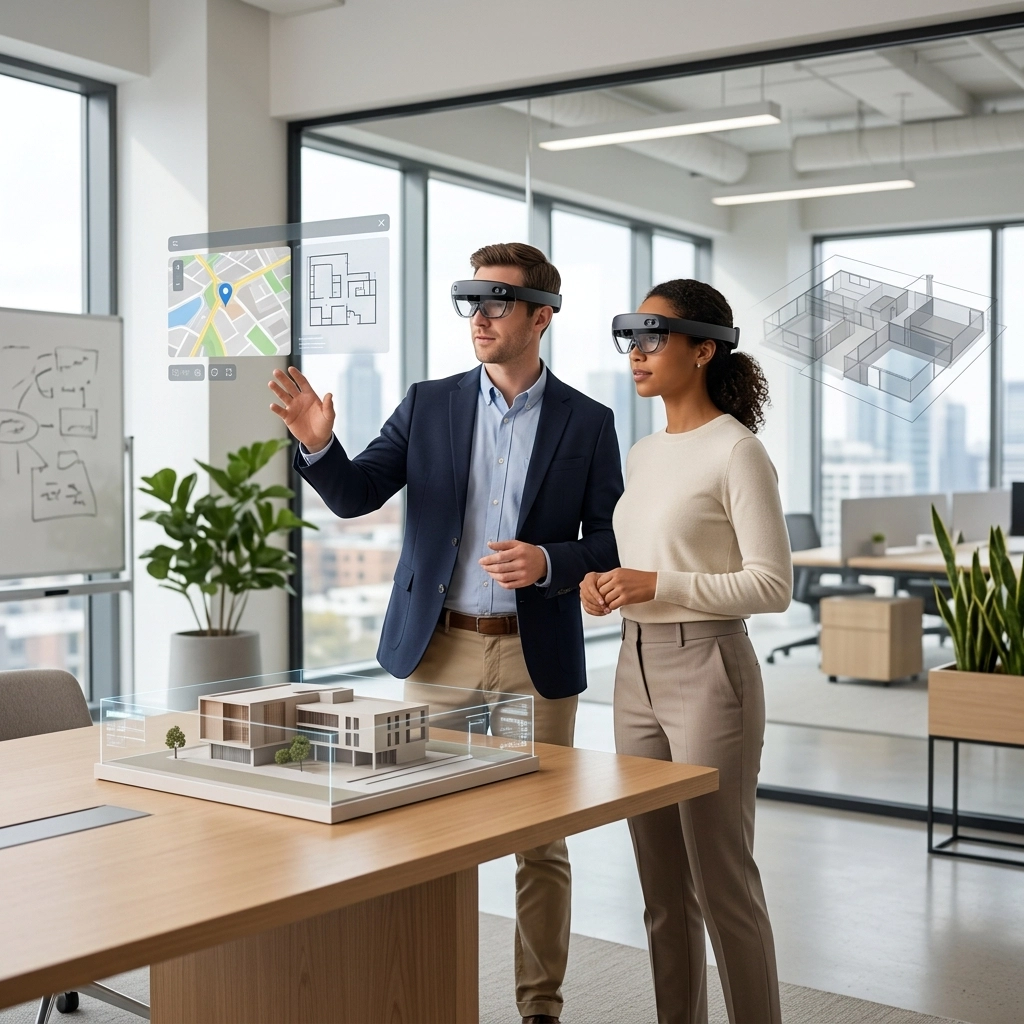
Remember when “visiting a site” meant actually putting on shoes and sitting in traffic? In 2026, that’s starting to feel a bit retro. We’ve officially moved past the era of staring at flat, 2D blueprints or scrolling through static photo galleries. Spatial computing has kicked the door down, and it’s changing how your customers find, interact with, and hire your business before they ever step foot on your property.
If you’re running a local business, whether you’re a high-end contractor, a dental surgeon, or a boutique owner, your digital presence is no longer just a “page.” It’s a place. Between Gemini-powered Google Maps and the rise of affordable AR glasses, the “site visit” has been reimagined as an immersive, data-rich experience.
The Death of the 2D “Gallery”
For years, local SEO for contractors meant uploading a few high-res JPEGs of a finished kitchen and hoping for the best. That won’t cut it anymore. Today, customers expect to walk through that kitchen using their mobile devices or smart glasses. This is made possible by a technology called Gaussian Splatting, which sounds like something out of a sci-fi novel but is actually the backbone of modern reality capture.
In practice, this means instead of a “gallery” page, you have a digital twin. A potential client can “stand” in a room you renovated, look up at the crown molding, and see the texture of the stone countertops in photorealistic 3D.
“Gaussian Splatting enables companies to capture these spaces with exceptional detail and view them in real-time on standard hardware, embodying a ‘capture once, use everywhere’ approach.” , Industry Research on Spatial Computing Transitions (2025).
This tech closes the gap between data and physical reality. When a customer can “test drive” your work from their couch, the level of trust skyrockets. That’s the core of web design in 2026, it’s not about how the site looks; it’s about how the space feels.
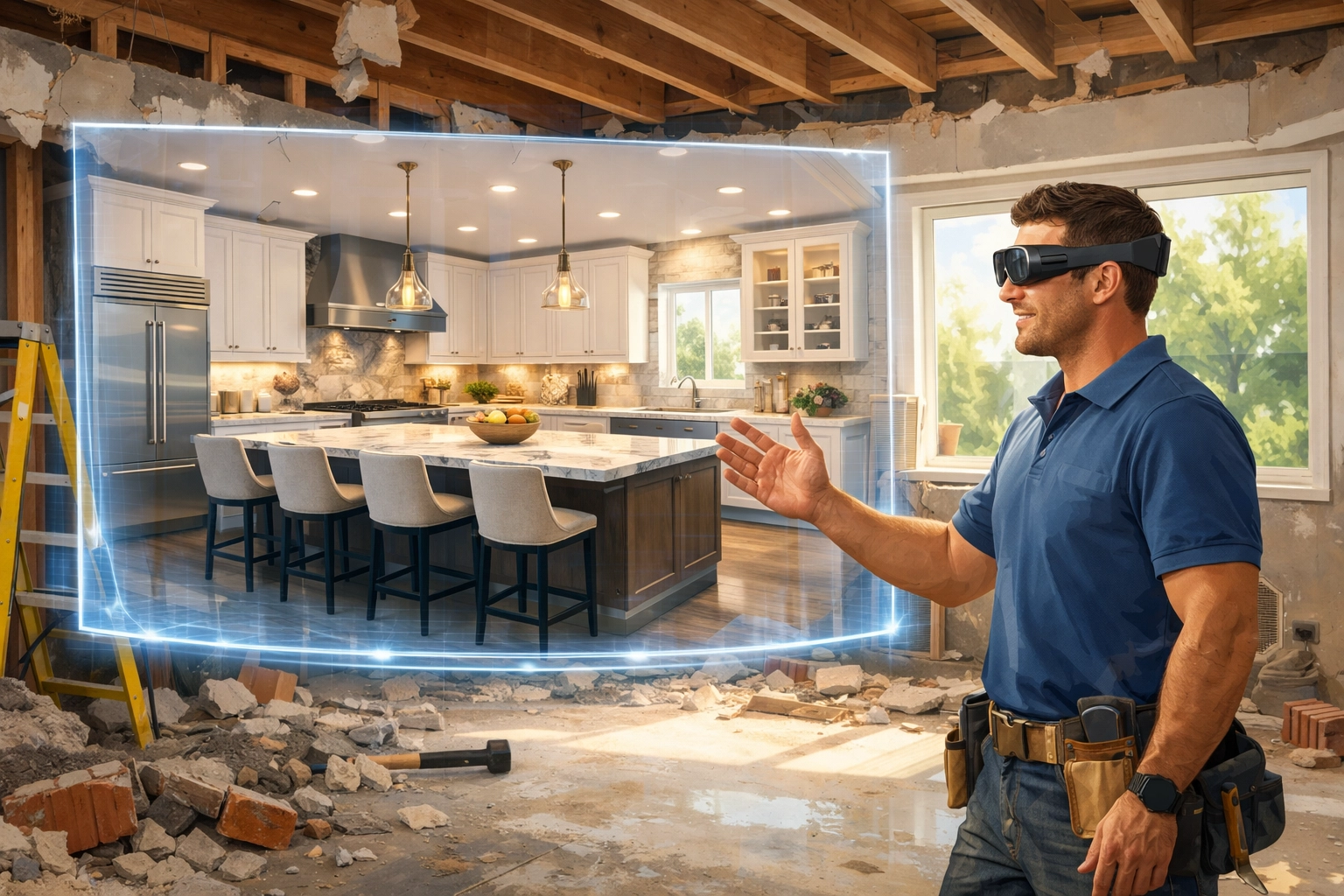
A landscape cartoon-style illustration of a contractor showing a 3D digital twin of a house to a client through AR glasses.
Voice-First Local Search: Asking, Not Typing
In 2026, we don’t type “best contractor near me” into a search bar. We talk to our environments. Voice-first local search has evolved from “Hey Siri, find coffee” to complex, intent-driven queries handled by Gemini in Google Maps.
A typical search now sounds like: “Hey Gemini, show me a local contractor who specializes in sustainable decks, has a 4.8-star rating, and can show me a 3D walkthrough of a project they finished last month.”
If your Google Business Profile optimization hasn’t accounted for these complex, conversational queries, you’re invisible. Google isn’t just looking for keywords; it’s looking for entities. It wants to know if your business “entity” matches the specific, multi-layered needs of the user.
2024 vs. 2026: The Local Search Evolution
| Feature | 2024 Standards | 2026 Reality |
|---|---|---|
| Search Input | Keywords & Short Phrases | Natural Language & Spatial Intent |
| Visuals | Static Photos & 360 Panoramas | Photorealistic Gaussian Splats |
| UX Focus | Click-Through Rate (CTR) | Immersive Interaction Time |
| SEO Anchor | Proximity & NAP (Name, Address, Phone) | Agentic Protocols & Machine-Readable Data |
| The “Visit” | Physical or Website Scroll | AR Overlay & Virtual Walkthrough |
Agentic Protocols: Making Your Data Machine-Readable
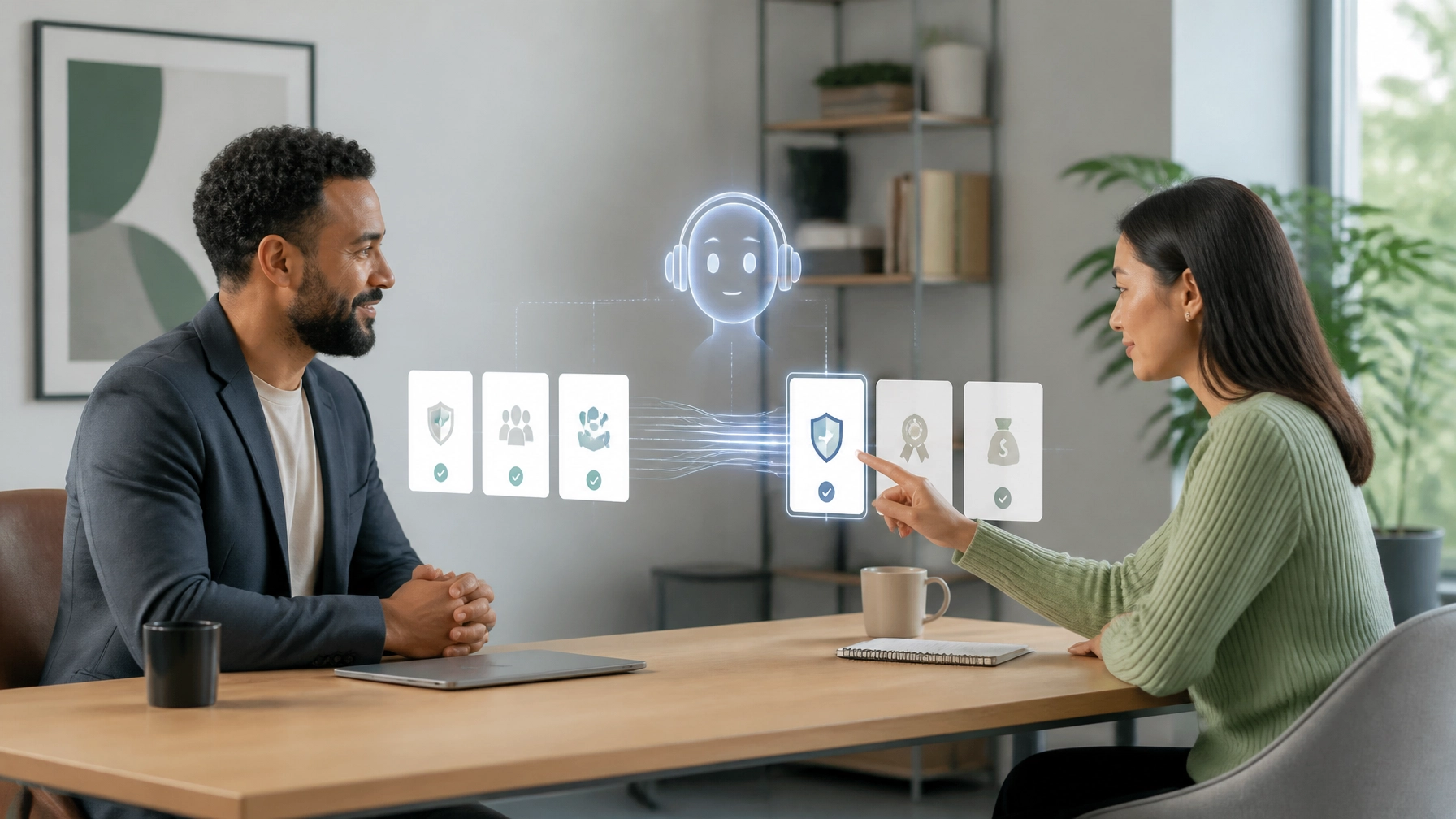
Here’s where it gets a little nerdy but incredibly important. In 2026, your website isn’t just for humans. It’s for agents, AI agents that are scouring the web to find the best solutions for their users. If you want to dominate Google Maps SEO, your data needs to be structured via “Agentic Protocols.”
These protocols allow AI models to “read” your business’s real-time availability, your spatial assets, and even your specific service nuances without a human having to interpret them. Think of it as SEO on steroids. When an AI agent recommends your business, it’s because your backend data was so clear that the agent felt “confident” in the recommendation.
This is especially critical for Google Business Profile optimization. You aren’t just filling out a bio; you’re feeding a neural network. If your spatial data (like your AR showroom) is properly tagged, Google Maps will prioritize you in the “immersive view” that users now prefer.
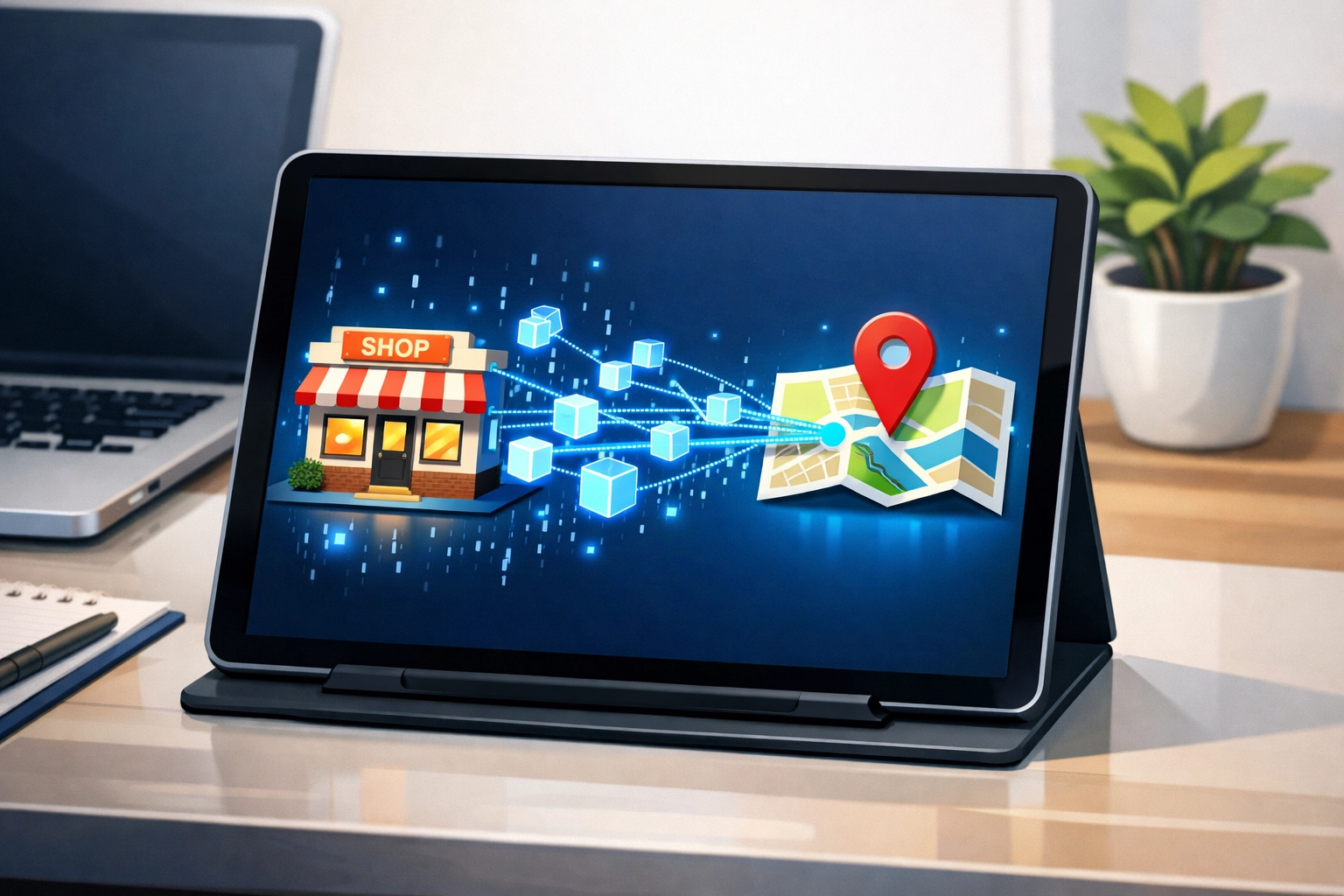
A landscape cartoon-style illustration showing an AI robot agent organizing digital “building blocks” of a business’s data to present to a human user.
Why This Matters for Local Contractors and Professional Services
You might be thinking, “Nahim, I just want to fix roofs or clean teeth. Do I really need spatial computing?”
The answer is a resounding yes, and here’s why: Efficiency.
In the old days, a contractor had to drive to a site to give an estimate. Today, using reality capture, a client can send you a spatial scan of their damaged roof or unfinished basement. You can “walk” the site virtually, take precise measurements from the digital twin, and provide an accurate quote without ever leaving your office.
This isn’t just a gimmick; it’s a massive reduction in overhead.
- Remote Inspections: Use Gaussian splats to inspect progress without travel.
- Immersive Training: Train new staff in a digital twin of your facility.
- Enhanced Trust: Show, don’t tell. Let the client see the 3D reality of your work.
“Architecture, engineering, construction, manufacturing, and energy sectors can create accurate replicas of physical assets to simulate conditions and test solutions without requiring constant on-site presence.” , Enterprise Spatial Tech Report (2026).
How to Optimize for the “Spatial Visit”
To stay ahead, you need to stop thinking about your website as a digital brochure. Here’s your 2026 checklist for staying relevant in a spatial world:
- Digitize Your Portfolio: Move beyond photos. Use reality capture tools to create 3D assets of your best work.
- Schema is King: Use advanced schema markup to ensure AI agents can interpret your spatial data and services.
- Voice-Optimization: Audit your content. Does it answer the “how,” “where,” and “why” of a spoken conversation?
- Google Maps Immersive View: Ensure your GBP has high-quality, up-to-date visual data that Google can use to generate its 3D “immersive” previews.
The businesses that embrace these “Emerging Technologies” are the ones that will win the trust of a generation that expects the digital world to be as rich and interactive as the physical one.
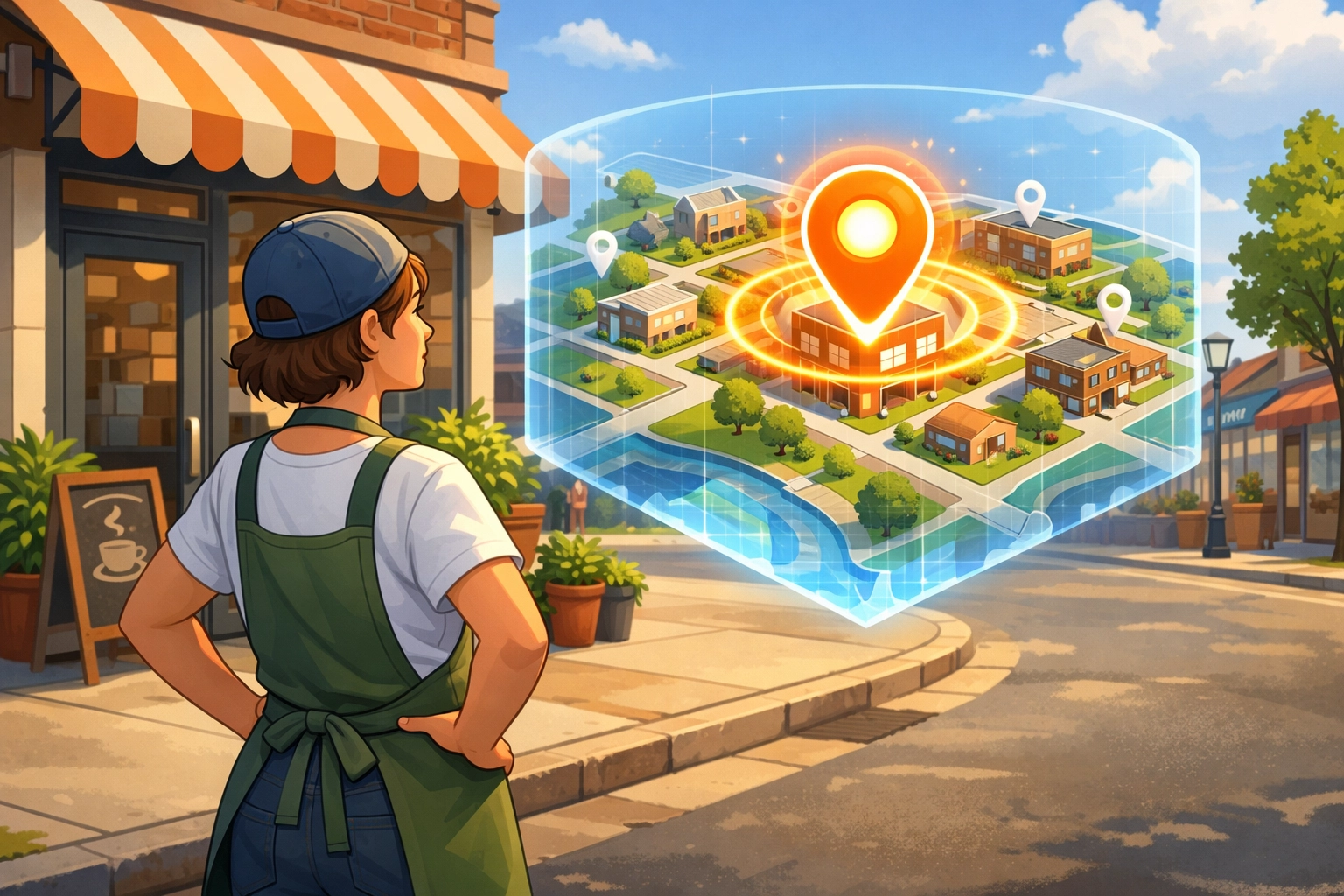
A landscape cartoon-style illustration of a local business owner looking at a holographic map of their city, seeing their business glowing as the top recommendation.
Is spatial computing only for big companies?
Not at all. In 2026, the tools to create 3D “splats” and AR walkthroughs are available on standard smartphones. Small local businesses can, and should, use them to compete with larger franchises by offering a more personalized, immersive experience.
Does this replace traditional Google Maps SEO?
It doesn’t replace it; it evolves it. You still need the basics, reviews, consistent NAP, and local citations, but those are now the “entry fee.” The spatial and agentic data are what move you from the top 10 to the top 1.
How does “Voice-First” change my content strategy?
You need to write the way people talk. Instead of “Affordable Dental Implants Chicago,” your content should address questions like “What does the recovery for a dental implant feel like?” AI agents look for context and authority, not just keyword density.
What is an Agentic Protocol?
It’s a standardized way of formatting your business data so AI “agents” can perform actions for users, like booking an appointment or comparing quotes, without the user ever visiting your actual website. It makes your business “machine-readable.”
Is my website still important in 2026?
Yes, but its role has shifted. It serves as the “Source of Truth” for AI agents and the “Immersion Hub” for users who want a deep dive into your spatial assets. It’s the engine room of your digital identity.
Ready to turn your local presence into a 3D powerhouse? At Trust Media, we specialize in bridging the gap between today’s SEO and tomorrow’s spatial reality. Let’s get your business on the (digital) map.