If you’re still running your Google Ads campaigns like it’s 2022, I have some tough news: your “proven” sales funnel is probably leaking cash. For years, we were taught that the customer journey was a neat, linear line. Someone sees an ad, clicks a landing page, reads a blog post, joins an email list, and eventually, hopefully, buys something.
In 2026, that linear path has officially collapsed. AI doesn’t wait for your five-step email sequence to kick in. Modern advertising is now intent-aware, and it happens in real-time. We’re moving away from static funnels and toward autonomous ecosystems where Google’s AI handles the “how” while you focus on the “what.”
The Collapse of the Awareness-to-Purchase Timeline
The biggest shift we’ve seen recently is the disappearance of the “consideration phase” as a separate entity. Thanks to AI-driven search and conversational interfaces, the gap between “I need this” and “I bought this” has shrunk to almost zero.
When a user interacts with an AI search overview, they aren’t just looking for information; they are looking for a solution. Google’s AI now interprets that intent and can surface your ad directly inside a shopping conversation or a map result at the exact micro-moment a decision is being made. If you are stuck trying to force users through a slow, manual funnel, you’re losing them to the competitor who is using autonomous bidding to show up exactly when the intent peaks.
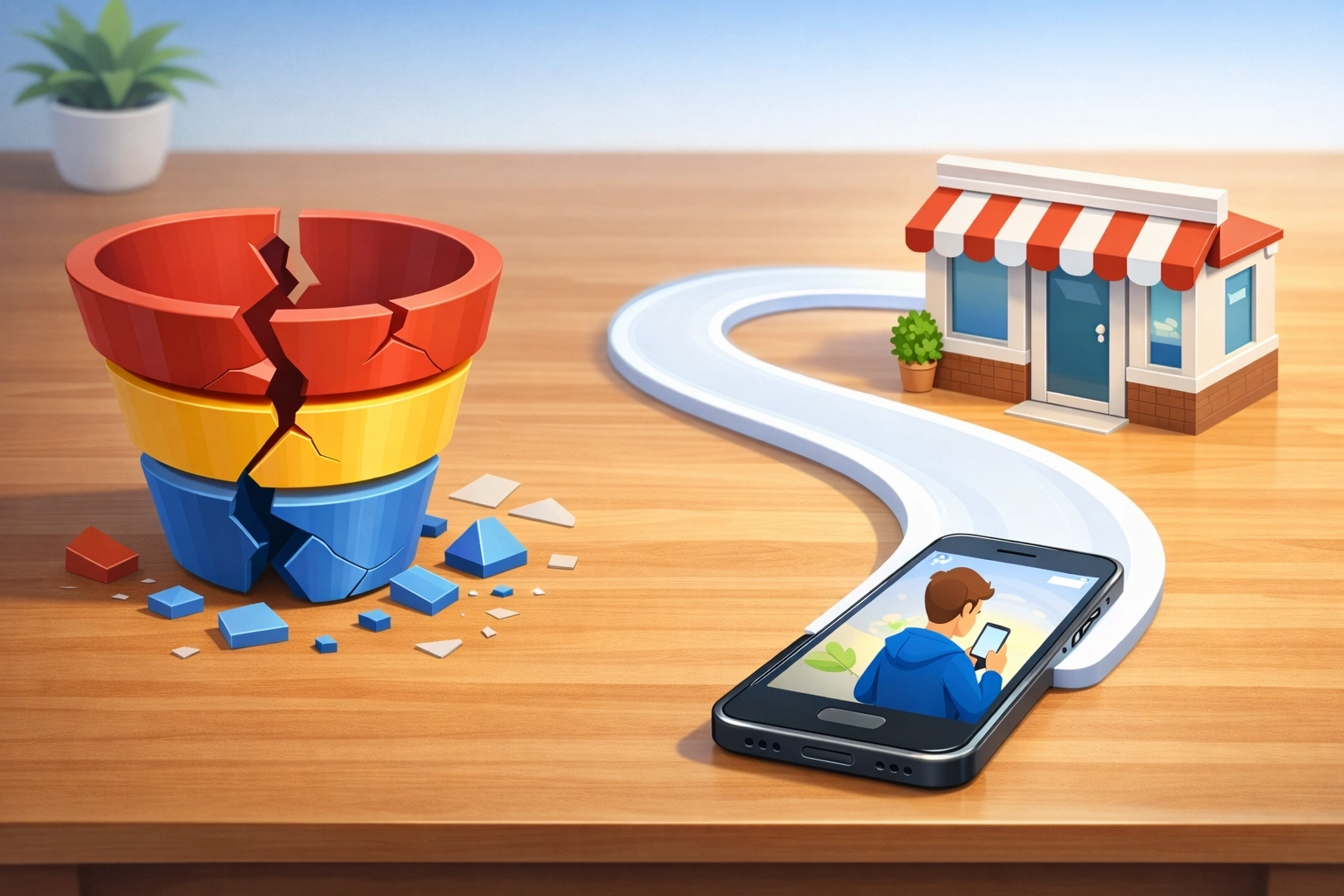
A cartoon-style landscape illustration showing a traditional wooden funnel breaking apart while a sleek AI robot instantly connects a customer to a product through a digital portal.
Performance Max: The All-in-One Engine
If you’ve spent any time in the Google Ads dashboard lately, you’ve seen Performance Max (P-Max). While some old-school purists still resist it, P-Max is the backbone of advertising in 2026. It eliminates the need for separate Search, Display, and YouTube campaigns. Instead, it uses a single campaign to span all of Google’s inventory.
The AI decides where your ad goes based on predicted performance rather than which “bucket” you put it in. This is why Google Ads for Beginners looks so different today than it did three years ago. You no longer bid on keywords alone; you bid on outcomes.
“According to research by Google, advertisers using Performance Max achieve on average over 18% more conversions at a similar cost per action, driven by AI’s ability to find customers across all of Google’s channels in real-time.” , Google Ads Benchmarks, 2025.
Static vs. Adaptive: The New Reality
To understand why your old strategy might be failing, look at how the mechanics have changed. We used to build funnels based on assumptions. We assumed that if someone searched for “plumber,” they were in the “awareness” stage. Today, the AI knows if that person is just browsing or if their basement is currently flooding based on their previous 10 minutes of digital behavior.
| Feature | Static Funnel (The Old Way) | AI-Adaptive Funnel (2026) |
|---|---|---|
| Targeting | Manual Keywords & Interests | Real-time Behavioral Signals |
| Customer Journey | Linear (Step 1 -> Step 2 -> Step 3) | Fluid, Intent-Aware, and Instant |
| Creative | Static A/B testing (Manual) | AI-Assembled & Personalized Assets |
| Bidding | Manual CPC or basic CPA caps | Autonomous Value-Based Bidding |
| Platform | Siloed (Search only or Display only) | Omnichannel (Search, YT, Maps, Gmail) |
Why “Signals” Beat “Keywords” Every Time
In the past, the keyword was king. If you wanted to reach a homeowner, you bid on “kitchen remodeling.” But in 2026, keywords are just one of many signals. Google’s AI now looks at:
- First-party data: Who are your actual customers?
- Contextual data: What is the user doing right now?
- Predictive behavior: What are they likely to do next?
This is where many businesses get stuck. They try to withhold data from the AI out of fear or privacy concerns, but the AI needs “fuel” to work. To get the best results, you need a healthy stream of data. Most experts now recommend a minimum of 30 to 50 conversions per month for the AI to truly “learn” your audience. Without that data, the AI is just guessing. If you’re struggling to track those conversions properly, you might need to look into lead intelligence and call tracking to close the loop.
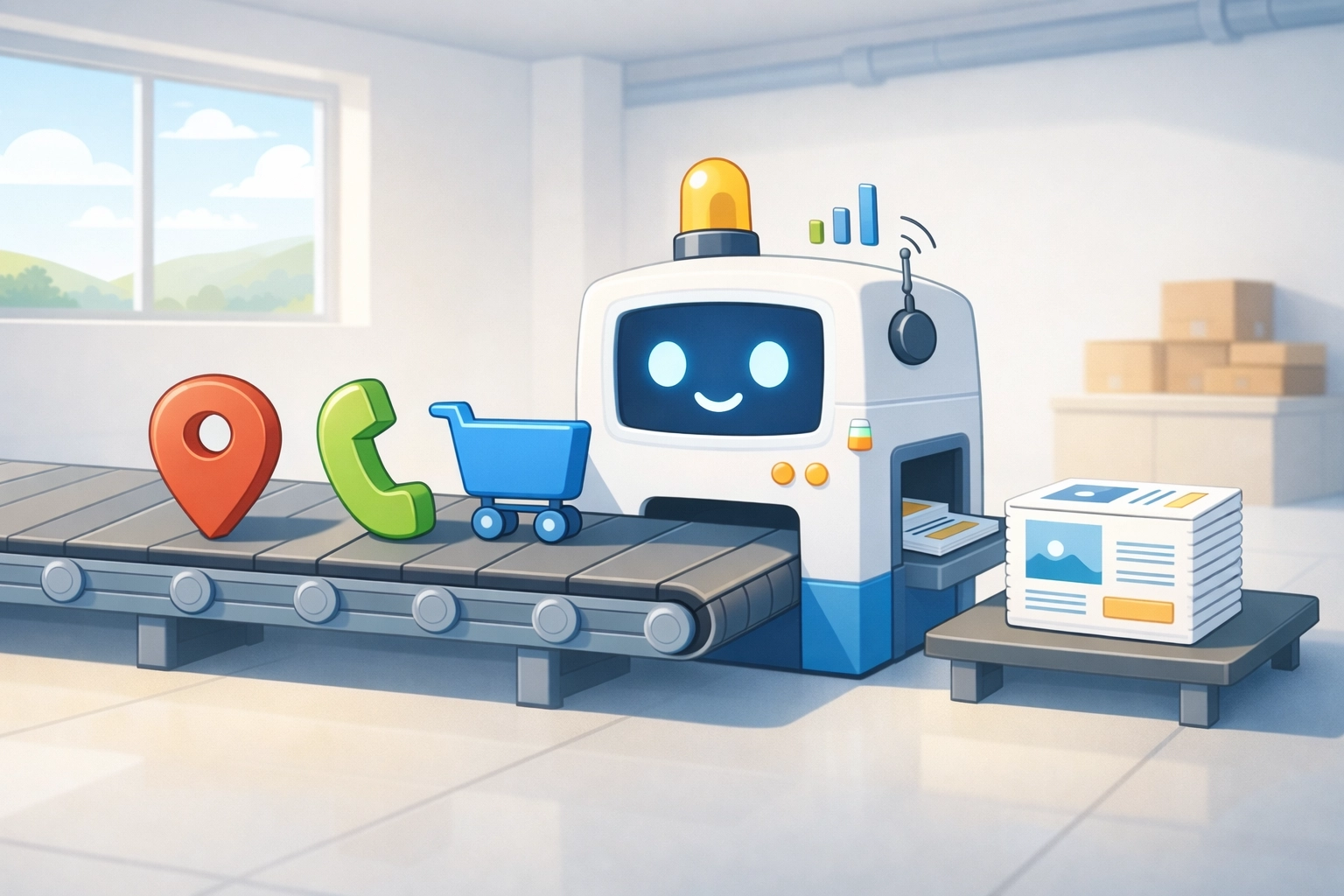
A cartoon landscape of a data factory where various “signals” like a person’s location, a phone icon, and a shopping cart are being fed into a glowing AI furnace that produces perfect ad matches.
How This Changes Strategy for Contractors and Pros
For service-based businesses, this shift is a lifesaver, if you adapt. Instead of managing 50 different ad groups for every city you serve, you can provide the AI with high-quality images, videos, and headlines, and let the system find the leads.
For example, a contractor doesn’t need to manually guess which YouTube video a homeowner is watching before they decide to renovate. The AI sees the pattern: the user searched for “home equity loans,” watched three “DIY kitchen” videos, and is now browsing “granite countertops.” The AI places your ad right there. This is a zero-waste lead generation strategy because you aren’t paying for clicks from people who are just “looking”, you’re paying for the ones the AI knows are ready to hire.
The Rise of Agentic Technology
We are also entering the era of “Agentic Discovery.” This sounds fancy, but it just means that AI assistants (like Gemini or specialized medical/legal AI agents) are often the ones “viewing” your ads first. They filter through the options and present the best one to the user.
This is especially critical for clinics and professional practices. If your data isn’t clean and your ads aren’t optimized for these assistants, you won’t even make the shortlist. You can read more about how agentic technology is redefining local discovery to see how this specifically impacts service providers.
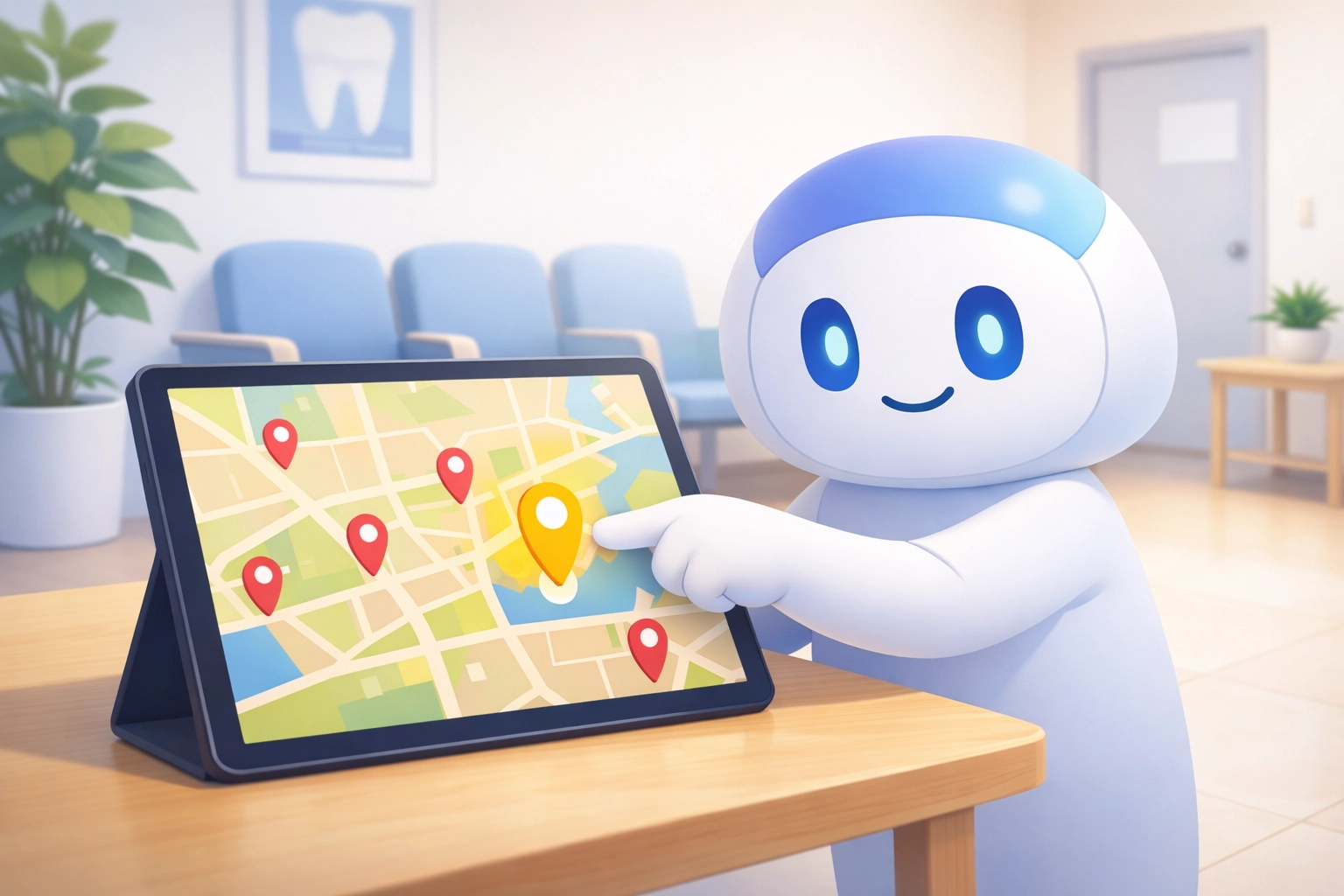
A cartoon-style landscape showing a friendly AI assistant holding a magnifying glass, looking at a list of local businesses and highlighting the one with the best “data signals.”
What You Should Do Right Now
If you want to survive the death of the static funnel, stop trying to control every click. Instead, focus on these three things:
- Feed the Machine: Upload your customer lists (securely) to Google. The more the AI knows about who already buys from you, the faster it can find people just like them.
- Focus on Creative Assets: Since the AI handles the bidding and placement, your job is to give it the best “ingredients.” This means high-quality, landscape-oriented photos, short videos, and punchy headlines.
- Optimize for Conversions, Not Clicks: A click is a vanity metric. If the AI drives 1,000 clicks but zero calls, it thinks it’s doing a great job. You must set up conversion tracking so the AI knows which clicks actually turned into revenue.
The transition from manual to autonomous might feel like losing control, but in practice, it’s about gaining scale. You can’t out-calculate a machine that processes millions of signals per second. You can, however, out-strategize your competition by giving that machine better data and better creative.
Are keywords completely useless now?
Not at all. Keywords still provide a foundational signal of intent. However, they are no longer the only factor. Think of keywords as the starting point, while AI signals are the GPS that actually gets you to the destination.
Is Performance Max too expensive for small businesses?
It can be if you don’t have conversion tracking set up. Without a clear “goal,” P-Max will spend your budget searching for anyone who might click. If you define your goals clearly (like a form submission or a phone call), it is often more efficient than manual campaigns.
How many images do I really need for an AI-driven campaign?
The more, the better. Google recommends at least 20 images (including logos) and up to 5 videos. The AI will mix and match these to see which combination works best for different users.
Do I still need a landing page if the AI does everything?
Yes. In fact, your landing page is more important than ever. The AI will scan your page to understand what you offer. If your page is slow or confusing, your “Ad Strength” score will drop, and your costs will go up. Make sure you have a high-conversion hub ready for the traffic.
Can I still exclude certain locations or times of day?
Yes, you can still set boundaries. While the AI is “autonomous,” you are still the pilot. You set the budget, the service area, and the target return on ad spend (ROAS). The AI just handles the heavy lifting of finding the specific people within those boundaries.